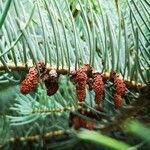
Abies concolor
Colorado White-Fir · Colorado fir · White fir · Silver fir · Low's fir
Description
Source: leafsnapAbies concolor, commonly known as the white fir, is a large evergreen tree native to the western United States. It can reach heights of up to 130 feet and features a conical shape with dense foliage. The tree's needles are bluish-green and can grow up to 2 inches long. Its cones are notably large, reaching up to 8 inches in length, and have a distinctive appearance with bracts protruding from between each scale. White fir is often used as an ornamental tree in landscaping due to its attractive appearance and ability to tolerate various soil types. Additionally, its wood is commercially valuable and used for lumber, pulpwood, and Christmas trees. Beyond its aesthetic and commercial uses, Abies concolor offers significant ecological benefits. It provides habitat for wildlife, including birds and small mammals, and helps prevent soil erosion by stabilizing slopes with its extensive root system. Overall, Abies concolor is an ecologically and economically important species, valued not only for its commercial applications but also for its vital ecosystem services.
🌳 The foliage of the white fir is rich in aromatic compounds, making it a good source of essential oils for use in perfumery and aromatherapy. Beyond their fragrant value, these essential oils have been investigated for antimicrobial properties, which makes the tree’s by-products potentially useful in cleaning and disinfectant formulations.
🎭 Duration
Care Guide
💧 Water Every 7 days
White fir trees flourish in mountainous regions where there is moderate precipitation. They can withstand occasional dry periods. To care for a white fir, water it every 1-2 weeks, keeping the soil lightly moist but not waterlogged. As an evergreen, white firs have needles that help retain water, which supports their survival despite seasonal temperature changes.
How should I water my White fir tree?
Watering your White fir is a relatively simple task. To do so, all you need to do is turn on your garden hose and use it to slowly soak the soil. This method is ideal for mature White fir trees, as they require a higher volume of water during each watering. However, if you have smaller trees, you can use a watering can or another smaller watering tool. It's important to avoid overhead watering as excessive moisture on the leaves can lead to disease, especially in younger trees.
What do I need to do if I give my White fir tree too much or too little water?
Overwatering can occur when the soil doesn't drain properly, causing the White fir to decline. To resolve this issue, you can either improve the soil's drainage or relocate the tree to a better environment. If your White fir is potted, you may also need to replant it using well-draining soil in a container with good drainage. Overwatering can lead to diseases, so it's important to treat any signs of illness promptly. On the other hand, if your White fir is underwatered, simply increase the frequency of watering and it should recover. To determine if your White fir is overwatered, examine the foliage, particularly the new growth. Discolored or easily breakable new growth indicates excessive moisture. Standing water or slow drainage in the growing area also suggest overly moist soil. Conversely, underwatered White fir trees will have sparse, brown leaves. Consider recent heavy rainfall or consistently high temperatures when assessing symptoms.
How often should I give water to my White fir tree?
A fully grown White fir tree is highly resilient to drought and can survive primarily on rainfall. During the hottest months, it may need watering once a week, but in other seasons, watering might not be necessary. However, if you have recently planted a White fir, regular watering is crucial to establish strong roots and maintain consistent soil moisture. It's important to note that standing water is not tolerated by this species. When uncertain, it's safer to avoid overwatering the White fir rather than risking excessive watering.
How much water does my White fir tree need?
During the height of summer, you'll usually need to water your White fir once a week, giving it around one inch of water. However, if it has rained one inch or more that week, you can skip watering. For newly planted White fir, especially during the establishment period, it will need more water, typically once every one to two weeks for the first few growing seasons.
How do I water my White fir tree all year round?
The White fir tree requires the most water in the summer when it's hot. During this time, watering it once a week if there's no rain is recommended. However, in other seasons, the tree can survive without any water. There might be some exceptions in spring and fall if it's unusually hot, but this is rare. Unlike other plants, the White fir tree doesn't go into full dormancy in winter, so it continues to grow even in the coldest months. However, water needs during winter are minimal because the cool temperatures don't dry out the soil quickly.
☀️ Light Full sun
White fir grows best when exposed to full sunlight. It can also grow acceptably in partial shade, but that situation may limit its optimal health. Native to bright, well-lit habitats, white fir performs less well in lower light. Too much sun can cause sunburn, while too little light inhibits growth.
What are the sunlight requirements for white fir?
White fir requires full sunlight to achieve optimal growth, meaning it should receive above 6 hours of sunlight. It can also grow in partial sun, with about 3-6 hours of sunlight, but this may impede its optimal health. Observing how sunlight moves through your garden is crucial to finding spots that offer the perfect balance of light and shade for your plants.
How does insufficient sunlight affect white fir?
Insufficient sunlight can lead to various symptoms in white fir, such as smaller new leaves, leggy or sparse growth, faster leaf drop, slower or no new growth, lighter-colored new leaves, chlorosis, sunscald, leaf curling, wilting, and leaf scorching. These symptoms indicate the plant's struggle to grow and maintain its health under suboptimal light conditions.
Can artificial lighting be used for white fir, and how?
Yes, artificial lighting can be used to support the growth of white fir, especially when natural sunlight is insufficient. It's important to select the right type of artificial light, such as LED lights, which can be customized to provide specific wavelengths needed by plants. Full sun plants need 30-50W/sq ft of artificial light, partial sun plants need 20-30W/sq ft, and full shade plants need 10-20W/sq ft. The light source should be placed 12-36 inches above the plant for 8-12 hours per day to mimic natural sunlight.
What are the recommendations for maintaining white fir's health regarding sunlight exposure?
To maintain white fir's health and address sunlight-related issues, it's advisable to gradually move plants to sunnier locations, ensure they receive at least 6 hours of direct sunlight daily, and use artificial light as needed. For outdoor plants, avoid sudden changes in light intensity to prevent sunburn. Minimize obstructions like overhanging branches to improve sunlight access. If necessary, transplant smaller plants during their dormant period to better-lit locations with ample sunlight and good drainage.
🌡️ Temperature 0–32.2°C
White fir grows best in its native habitat in cool to cold climates, with temperatures typically between 0 and 32 ℃ (32 and 90 ℉). It favors moderate conditions and cannot tolerate extreme heat. In winter it can endure temperatures as low as -40 ℃ (-40 ℉), while in summer it prefers temperatures of 15 to 21 ℃ (59 to 70 ℉).
What is the preferred climate for White Fir?
White Fir thrives in a cool to cold climate, ideally with temperatures ranging from 0°C to 32°C (32°F to 90°F). It is suited to moderate temperatures and lacks tolerance for extreme heat. During winter, it can withstand temperatures down to -40°C (-40°F), but it favors summer temperatures between 15°C to 21°C (59°F to 70°F). White Fir is highly tolerant of cold and does not require special frost protection. However, it benefits from generous watering before the first freeze of autumn to maintain soil moisture through winter and early spring.
How does White Fir react to extreme temperatures?
White Fir shows remarkable tolerance to cold, managing well even when winter temperatures drop below -35°C, with the main concern being potential dryness and brittleness of branches in spring, leading to a lack of new shoots. In contrast, it is sensitive to high temperatures above 32°C, which may cause significant leaf drop or, in severe cases, the death of the plant. For cold damage, pruning dead branches in spring is recommended. For heat damage, trimming sunburned parts, providing shade, and ensuring the soil stays moist can help the plant recover.
What are the botanical characteristics of White Fir?
White Fir, known botanically as Abies concolor, is a species appreciated for its adaptability to cool and cold climates. It exhibits a high tolerance to winter's chill, capable of surviving temperatures as low as -40°C (-40°F), and enjoys moderately cool summer temperatures. Although it navigates through cold with ease, it struggles under extreme heat, requiring certain precautions to mitigate damage from high temperatures.
💨 Humidity dry (<40%)
This plant prefers dry conditions, so don't mist it. However, watering it less often can also thrive in higher humidity.
🪴 Soil 5-7
🌱 Fertilizer
White fir has distinct nutrient needs and does not require heavy fertilization. Fertilizing in spring is the best time to promote optimal growth. Supplying nutrients improves its health, increases resistance to pests and diseases, and helps sustain its long lifespan.
Why should I put fertilizer on my White fir tree?
To encourage healthy growth, it is important to fertilize White fir in the spring. This plant has a long lifespan and requires support. Adding nutrients to the soil not only enhances the plant's overall health, but also helps it resist common pests and diseases that can hinder growth or reduce its lifespan.
When should I fertilize my White fir tree?
Sometimes, the growing medium can't provide enough nutrients for healthy growth. However, White fir is unique compared to garden annuals and perennials because it doesn't need many additional nutrients. The ideal time to fertilize White fir is in the spring, before new growth starts to appear.
When is the best time to not add fertilizer to my White fir tree?
White fir is a plant that doesn't need a lot of nutrients compared to other plants. It's important to be cautious with fertilization, as too much can actually harm it. To avoid any issues, it's best to only apply fertilizer during spring and skip using it during the summer, fall, and winter. Additionally, during these seasons, it's advised not to add any organic matter to the soil.
What kind of plant food does my White fir tree need?
The age of your plant affects the fertilizer it needs. It's important to note that White fir doesn't need a lot of extra nutrients. You should look for a balanced plant food that promotes healthy root growth and overall development. However, avoid fertilizers with high nitrogen levels.
How should I provide nutrients to my White fir tree?
When fertilizing White fir, it is crucial to consider both the method and timing. Apply the fertilizer once during spring, specifically around the base of the plant. Be cautious not to let any fertilizer come into contact with the trunk. If you are using granulated fertilizer, make sure to cover the pellets with a thin layer of soil. This will aid in the absorption of the fertilizer into the soil.
🪴 Pot & Repot 2-3 years
When repotting White fir, choose a pot 1–2 inches (2.5–5.1 cm) larger with good drainage. Use a well-draining potting mix. Repot in spring or fall, making sure the root ball sits slightly below the rim of the flower pot. Water thoroughly after repotting and place it in a warm spot with indirect sunlight.
✂️ Pruning
The white fir is a tall, conical tree with soft, blue-green needles. To care for it, prune during the dormant winter months. This involves removing dead branches and thinning out crowded areas to promote better air circulation. Be careful not to over-prune, as this can cause stress to the tree. This careful pruning technique helps minimize sap loss and supports healthy growth in the spring.
🌿 Propagating
🐛 Diseases & pets
☠️ Toxicity
Characteristics
- Plant Type
- Tree
- Life Cycle
- Perennial
- Genus
- Abies
- Family
- Pinaceae
- Hardiness Zone
- 3-7
- Mature Height
- 39.93 m
- Mature Spread
- 7.92 m
- Leaf Color
- Green, Blue, Silver
- Leaf Type
- Evergreen
- Flower Color
- Red, Purple
- Bloom Time
- Early summer, Mid summer
- Planting Time
- Spring, Autumn
- Harvest Time
- Mid summer, Late summer
- Native Area
- Mexico