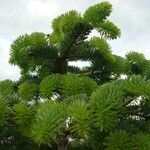
Abies nordmanniana
Caucasian fir · Nordmann Christmastree · Nordmann fir · Turkey fir · Kazazdagi Fir
Description
Source: leafsnapAbies nordmanniana, the Nordmann fir or Caucasian fir, is a fir indigenous to the mountains south and east of the Black Sea, in Turkey, Georgia and the Russian Caucasus. It occurs at altitudes of 900–2,200 m on mountains with precipitation of over 1,000 mm. The current distribution of the Nordmann fir is associated with the forest refugia that existed during the Ice Age at the eastern and southern Black Sea coast. In spite of currently suitable climate, the species is not found in areas of the Eastern Greater Caucasus, which are separated from the Black Sea Coast by more than 400–500 km.
🌳 During the winter holidays, caucasian fir is in demand for its dense, aromatic foliage used in festive decorations. Surprisingly, its value goes beyond appearance: caucasian fir is also a source of essential oils. Those oils, obtained from the needles, are used in aromatherapy and as fragrant ingredients in perfumes and cleaning products, showing that caucasian fir can provide both visual pleasure and sensory delight.
Care Guide
💧 Water
The Caucasian fir, originally from the Caucasus region, flourishes in consistently moist conditions and prefers soil that remains evenly moist. For the best results, water it weekly. As an evergreen, the Caucasian fir retains its foliage throughout the year, so it's important to water it carefully during the growing season to support photosynthesis, especially when it is grown outdoors.
How should I water my Caucasian fir tree?
Watering your Caucasian fir is a simple task. The easiest way to do it is by using a garden hose to slowly soak the soil. This is especially useful for larger trees, as they require more water. However, for smaller trees, a watering can or other smaller tool will suffice. It's important to avoid overhead watering, as it can cause disease, particularly in young trees.
What do I need to do if I give my Caucasian fir tree too much or too little water?
Overwatering can be caused by poor soil, which prevents effective drainage. If your Caucasian fir is experiencing this, you can either improve the soil's drainage or move the tree to a better location. If you have the tree potted, you may need to use looser soil in a container with better drainage. An overwatered plant can also contract diseases, which should be treated promptly. To remedy an underwatered Caucasian fir, simply water it more frequently. You can determine if your tree is overwatered by looking at its foliage, especially new growth. If the new growth is discolored or easily breaks, it's likely due to excess moisture. Standing water or slow drainage in the plant's area also indicates excessive moisture. Conversely, underwatered fir trees will have sparse, brown leaves. If you notice these symptoms, consider if there has been excessive rainfall or consistently high temperatures.
How often should I give water to my Caucasian fir tree?
A mature Caucasian fir can survive with minimal water, relying mainly on rainfall. It may only need watering once a week during the hottest months, and no watering at all during other seasons. However, newly planted trees require regular watering to establish their roots. It's important to avoid overwatering, as the Caucasian fir does not tolerate standing water. When uncertain, it's better to err on the side of not watering too much.
How much water does my tree need?
During the height of summer, you will need to water your Caucasian fir. Normally, it requires about one inch of water per week. However, if it has rained one inch or more during that week, you won't need to water it. Keep in mind that newly planted Caucasian firs need more water during the establishment period. This usually means watering them once every one to two weeks for the first few growing seasons.
How do I water my Caucasian fir tree throughout the year?
During the summer months, when it's hottest, the Caucasian fir tree needs the most water. If it's not raining, you should water it once a week. In other seasons, this plant can survive without any water. Occasionally, in spring and fall, you may need to water it if the weather is unusually hot, but this is rare. Unlike many other plants, the Caucasian fir doesn't go into full dormancy in winter, so it keeps growing even in the coldest months. However, the water needs are still low during winter because the soil doesn't dry out quickly in cool temperatures.
☀️ Light Full sun
Caucasian fir does best with plenty of light, which promotes healthy growth and development, although it can also tolerate sites with limited light. It comes from well-lit habitats. Both too little light and excessively long periods of light can hinder its growth.
What are the sunlight requirements for Caucasian fir?
Caucasian fir, or Abies nordmanniana, thrives in environments with an abundance of light exposure for healthy development and growth but can also tolerate areas with limited light. It necessitates full sun, which is above 6 hours of sunlight daily, or partial sun, about 3-6 hours of sunlight daily. It's vital to observe how sunlight moves through your garden to ensure plants receive the appropriate balance of light and shade, promoting their well-being.
How essential is lighting for the growth of indoor Caucasian fir plants?
Lighting is critical for the growth of indoor Caucasian fir plants, especially when natural sunlight is insufficient, like during winter or in less sunny spaces. Artificial lighting becomes essential in promoting faster and healthier growth. LED lights are recommended due to their customization to provide specific wavelengths needed by plants. For optimal growth, full sun plants require 30-50W/sq ft, partial sun plants need 20-30W/sq ft, and full shade plants need 10-20W/sq ft of artificial light. The artificial light source should be placed 12-36 inches above the plant, mimicking natural sunlight for 8-12 hours per day.
What symptoms indicate light deficiency in Caucasian firs?
Symptoms of light deficiency in Caucasian firs include smaller new leaves compared to previous ones, leggy or sparse growth with longer spaces between leaves or stems, faster leaf drop, slower or halted new growth, lighter-colored new leaves indicating lack of chlorophyll, chlorosis where leaves lose their green color and turn yellow, sunscald with pale or necrotic areas on the plant tissue, leaf curling as a defense mechanism against excessive sunlight, wilting due to loss of turgor pressure, and leaf scorching characterized by brown, crispy edges on leaves due to excessive sunlight.
What solutions can address light deficiency in Caucasian firs?
To address light deficiency in Caucasian firs, indoor plants should be gradually moved to a sunnier location each week until they receive at least 6 hours of direct sunlight daily, ideally near a south-facing window. Additionally, using artificial light, such as keeping a desk or ceiling lamp on for at least 8 hours daily or investing in professional grow lights, can provide ample light. Outdoor plants should be moved gradually to sunnier spots to avoid sunburn. If trees block sunlight, pruning branches and leaves may help. For smaller plants, transplanting during their dormant period to a location with ample sunlight and good drainage is advisable. It's important to note that parts of the plant affected by insufficient sunlight may not recover, but new growth should be healthy once light exposure increases.
🌡️ Temperature 20–37.8°C
Caucasian fir is native to regions where temperatures range from 68 to 100 °F (20 to 38 ℃) and grows best within that span. Seasonal adjustments may be necessary for optimal growth, mainly in areas that undergo extreme temperature fluctuations.
What is the native temperature range for Caucasian fir?
Caucasian fir, or Abies nordmanniana, is native to regions where temperatures range from 68 to 100 °F (20 to 38 °C). It thrives best within this temperature range. To ensure optimal growth, especially in areas with significant temperature fluctuations, seasonal adjustments may be necessary. Caucasian fir loves heat and can be harmed by cold temperatures. Therefore, in autumn, it is advisable to bring outdoor-grown Caucasian firs indoors, placing them near a bright window but away from heaters, and maintain temperatures above 20°C during the winter. Temperatures nearing 0°C are harmful to the plant.
How does low temperature affect Caucasian fir, and what are the recommended solutions?
Caucasian fir is sensitive to low temperatures and thrives best when the temperature remains above 20°C. During winter, it is crucial to keep it above 0°C to prevent damage. Exposure to temperatures below -5°C may cause the leaves to lighten in color, eventually turning brown or black after frost damage, accompanied by wilting and drooping. The recommended solution for frost damage includes trimming off the frost-damaged parts and moving the plant indoors to a warm environment for protection. Placing the plant near a south-facing window ensures ample sunlight, but it should not be placed near heaters or air conditioning vents to avoid air dryness.
What are the effects of high temperature on Caucasian fir and the proposed solutions?
During the summer, it's essential to keep the temperature below 38°C to prevent heat stress on Caucasian fir. Temperatures exceeding 43°C can cause the leaves to lighten and increase susceptibility to sunburn. To mitigate damage, trim away the sunburned and dried-up parts and relocate the plant to a shaded area during the midday and afternoon sun. It's also beneficial to water the plant in the morning and evening to maintain soil moisture.
💨 Humidity normal (40-60%)
This plant will thrive in moderate humidity, which is probably the level in your home. However, misting it a few times a week can be very beneficial. Make sure the room has good ventilation.
🪴 Soil 5-7
🌱 Fertilizer Every 30 days
Caucasian fir has specific nutrient needs and does not require excessive fertilization. Spring is the best time to apply fertilizer for optimal growth. Providing nutrients improves its health, increases its resistance to pests and diseases, and helps sustain its long lifespan.
Why should I put plant food on my Caucasian fir tree?
To promote healthy growth of the Caucasian fir, it is beneficial to fertilize it in the spring. Keep in mind that this plant lives for a long time and requires support. Adding nutrients to the soil can enhance its overall health, enabling it to better fend off common pests and diseases that can hinder growth or reduce its lifespan.
When should I fertilize my Caucasian fir tree?
The growing medium may not have enough nutrients for healthy growth, but Caucasian fir has different nutrient needs compared to garden annuals and perennials. It doesn't need many extra nutrients, and the best time to fertilize it is in the spring before new growth starts.
When is it not a good idea to add fertilizer to my Caucasian fir tree?
Caucasian fir is a plant that doesn't need much fertilizer and too much can be harmful. Unlike other plants, it doesn't require monthly or weekly fertilization. It's best to only apply fertilizer in the spring and not add any during the summer, fall, and winter.
What kind of fertilizer does my Caucasian fir tree need?
The age of your plant affects the fertilizer it needs. However, Caucasian fir doesn't require excessive nutrients. To promote healthy root development and growth, choose a balanced plant food. Avoid fertilizers with high nitrogen content.
How can I make my Caucasian fir tree grow better?
To ensure the proper fertilization of Caucasian fir, it is crucial to consider both the application timing and method. Apply the fertilizer once in the spring, ensuring it is placed around the base of the plant. Be careful not to get any fertilizer on the trunk. If you are using granulated fertilizer, cover the pellets with a thin layer of soil. This helps to ensure that the fertilizer is effectively absorbed into the soil.
🪴 Pot & Repot 2-3 years
When repotting Caucasian fir, select a pot 1-2 inches (2.5–5.1 cm) larger that provides good drainage. Use a well-draining potting mix. Repot in spring or autumn, making sure the root ball sits slightly below the rim of the flower pot. Water thoroughly afterward and keep it in a warm spot with indirect sunlight.
✂️ Pruning
The Caucasian fir is an evergreen tree known for its symmetrical shape. To maintain its health, prune it during the winter by removing any dead or damaged branches, which helps minimize sap loss. Concentrate on thinning the branches to improve airflow within the tree. Make sure to use sharp tools for clean cuts, as this promotes faster healing and healthier growth while preventing pest infestations.
🌿 Propagating
🐛 Diseases & pets
☠️ Toxicity
Characteristics
- Plant Type
- Tree
- Life Cycle
- Perennial
- Genus
- Abies
- Family
- Pinaceae
- Hardiness Zone
- 9-11
- Mature Height
- 12.19 m to 18.29 m
- Mature Spread
- 4.57 m to 7.62 m
- Leaf Color
- Green, White
- Leaf Type
- Evergreen
- Flower Color
- Red, Green
- Bloom Time
- Early summer, Mid summer
- Planting Time
- Autumn
- Harvest Time
- Mid summer, Late summer, Fall