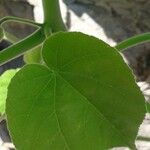
Abutilon theophrasti
گاو پنبه · Velvetleaf · Indian-mallow · Chingma-lantern · Abutilon-hemp
Description
Source: leafsnapAbutilon theophrasti, commonly known as velvetleaf or Indian mallow, is an annual plant in the Malvaceae family. Though native to Asia, it has spread globally as a weed. This plant can reach up to 2 meters in height and features large, heart-shaped leaves covered in soft hairs, giving them a velvety texture. The yellow, bell-shaped flowers of Abutilon theophrasti have five petals and bloom from July to September. These flowers are followed by round seed pods containing numerous seeds, which are distinctive due to their ridged shape and fine hairs. Velvetleaf is considered an invasive species because it can quickly colonize disturbed areas such as agricultural fields, roadsides, and waste areas. It competes with crops for nutrients and water, potentially reducing crop yields. Despite its invasive nature, Abutilon theophrasti has been used for medicinal purposes in traditional Chinese medicine for centuries. The leaves have been utilized to treat coughs, while the seeds have diuretic properties. In summary, Abutilon theophrasti is a plant with both beneficial medicinal properties and negative agricultural impacts. Proper management and control by farmers and gardeners are necessary to mitigate its invasive tendencies.
💡 According to legend, velvetleaf was relegated to the realm of humans due to its unremarkable appearance. However, the moon goddess recognized velvetleaf's extraordinary ambition and always nurtured it with her moonlight. In gratitude, velvetleaf dedicated itself to hard work and sought to give back to the world. As a result, it became a valuable ingredient in Chinese medicine.
🌳 Apart from its familiar uses, velvetleaf has shown an unexpected capacity to accumulate heavy metals from soil, particularly cadmium. This quality makes it a possible candidate for phytoremediation, which involves using plants to remove, transfer, stabilize, or break down contaminants in soil and groundwater. These environmental applications are often overshadowed by its reputation as an invasive species.
🎭 Appreciation, endeavor
Care Guide
💧 Water Every 7 days
Velvetleaf flourishes in warm, temperate areas with moderate moisture levels. It needs to be watered weekly to ensure the soil remains consistently moist, although it can withstand short periods of dryness. Typically cultivated outdoors, velvetleaf grows vigorously during the rainy season, taking advantage of the natural rainfall.
When Should I Water My Velvetleaf?
Watering your velvetleaf appropriately is crucial for its health and growth. Look for signs like dry soil at the top 1 inch, unusual droopiness in the leaves, slower growth rates, and any yellowing or browning of leaves as indicators that your plant needs water. It's essential to regularly check these signs to ensure you're watering your velvetleaf correctly. Remember, it's generally better to under-water than to over-water this type of plant.
How Should I Water My Velvetleaf?
To water velvetleaf efficiently, consider bottom-watering by placing the pot in a tray of water, allowing the plant to absorb moisture from the bottom. Use a watering can with a narrow spout to avoid wetting the foliage directly and consider employing a moisture meter to gauge soil wetness accurately. It's crucial to avoid excessive moisture on leaves to prevent fungal diseases. Adjust watering frequency according to the velvetleaf's growth stage and environmental conditions, ensuring well-draining soil to avoid waterlog.
How Much Water Does Velvetleaf Really Need?
Velvetleaf requires moist but well-drained soil, with the quantity of water depending on the plant and pot size, and root depth. Water until the top 2 inches of soil are moist, and adjust the frequency to prevent waterlogging conditions, ranging from every few days in dry conditions to once a week in moderate climates. Monitor the plant's hydration by checking for vibrant green leaves and active growth, and adjust watering depending on signs of under or overwatering.
What Kind of Water is Best for Velvetleaf?
Rainwater is ideal for velvetleaf as it mimics the plant's natural environment and is free from additives. If rainwater is not available, filtered or distilled water is a good alternative. While tap water is acceptable, letting it sit to evaporate chlorine and reach room temperature can benefit the plant's growth. Be mindful of high levels of chlorine and fluoride in tap water, as these can be harmful to velvetleaf.
How Do Velvetleaf's Watering Needs Change with the Seasons?
Velvetleaf's watering needs vary throughout the year. In spring, aim for moist but not waterlogged soil to support growth. During the active growth phase in summer, ensure consistent soil moisture due to higher evaporation rates, but allow the plant to dry slightly between waterings. Autumns require reduced watering as growth slows, and in winter, watering is virtually nonexistent after the plant completes its lifecycle unless late sprouting occurs.
☀️ Light Full sun
Velvetleaf performs best in places that are routinely exposed to plentiful sunlight, though it can also adapt to sites with only occasional sun. Its persistence and health depend on this bright, strong light, consistent with a native habitat that provides such conditions. Insufficient or excessive sun exposure can harm its growth.
What are the sunlight requirements for Velvetleaf?
Velvetleaf requires full sun, meaning it thrives in areas that receive above 6 hours of sunlight daily. However, it can also adapt to partial sun conditions, where it gets about 3-6 hours of sunlight. It's important to watch how sunlight moves through your garden to ensure you place your Velvetleaf in spots that offer the right balance of light and shade, ensuring optimal growth and health.
How does Velvetleaf adapt to different lighting conditions?
Velvetleaf is highly adaptable to various sunlight exposures. It flourishes in consistent, abundant sunshine but can also manage in places with intermittent sun exposure. The plant originates from habitats that support such diverse lighting conditions. Nevertheless, both insufficient and excessive sunlight can adversely affect its growth, highlighting the need for a well-thought-out lighting environment, whether natural or artificial.
What are the essentials for growing Velvetleaf?
For optimal growth, Velvetleaf requires clear, strong light. In conditions where natural sunlight is limited, such as during winter or in less sunny indoor spaces, artificial lighting can be a significant aid. It's advisable to choose the right type of artificial light, like LED lights, which can be customized to provide the necessary wavelengths. The amount of artificial light required varies depending on the plant's sunlight needs, with recommendations for full sun plants being 30-50W/sq ft, partial sun plants 20-30W/sq ft, and full shade plants 10-20W/sq ft. Additionally, the light source should be placed 12-36 inches above the plant, and the lighting duration should mimic natural daylight hours, typically 8-12 hours per day.
What are the symptoms of light deficiency in Velvetleaf?
When Velvetleaf does not receive adequate light, it displays several symptoms indicative of light deficiency. These include smaller new leaves, leggy or sparse growth, faster leaf drop, slowed or halted new growth, and lighter-colored new leaves. Additionally, excessive sunlight can cause chlorosis, sunscald, leaf curling, wilting, and leaf scorching, indicating the importance of regulating light exposure for healthy plant development.
How can I address insufficient sunlight for my Velvetleaf?
To address insufficient sunlight, gradually move your Velvetleaf to a location that receives at least 6 hours of direct sunlight daily, using a south-facing window for indoor plants to maximize sunlight exposure. For larger or less mobile plants, consider supplementing with artificial light for at least 8 hours daily. For outdoor plants, it's critical to relocate them gradually to avoid sunburn. Removing obstructions and transplanting smaller plants to more sunlit areas during their dormant period can also significantly improve sunlight access. Despite these efforts, parts of the plant already affected may not recover, but new growth should be healthy with corrected light exposure.
🌡️ Temperature 5–35°C
Velvetleaf is a plant from temperate climates that needs temperatures of 68 to 95 °F (20 to 35 ℃) to grow optimally. During cooler seasons, keep the temperature toward the lower end of that range for the best results.
What is the optimal temperature range for Velvetleaf growth?
Velvetleaf thrives in temperate climates, requiring temperatures between 68 to 95 °F (20 to 35 °C) for optimal growth. To achieve the best results, it's advisable to maintain the temperature near the lower end of this range during cooler seasons. Despite its strong cold resistance, meaning special frost protection measures are not usually necessary, attention should be given if winter temperatures are expected to drop below -30°C by covering the plant with soil or straw and watering it abundantly before the first freeze in autumn to keep the soil moist.
How does Velvetleaf respond to low and high temperatures?
Velvetleaf is cold-tolerant and prefers temperatures above 20°C. In winter, it's important to keep it above 0°C. Should temperatures fall below -30°C, while there may not be noticeable changes during winter, a decrease in sprouting or a complete lack of sprouting may occur in spring. For high temperatures, during summer, it's crucial to keep Velvetleaf below 35°C. Exceeding 38°C can cause leaves to lighten in color, become prone to curling, suffer from sunburn, and in severe cases, the plant may wilt and dry out. Solutions include removing unsprouted parts in spring, trimming sunburned and dried parts for high temperature stress, relocating the plant to a shaded area or using a shade cloth, and watering the plant in the morning and evening to maintain soil moisture.
What are the botanical details of Velvetleaf?
Velvetleaf is known scientifically as Abutilon theophrasti. It is a plant native to temperate climates and is recognized for its resilience to different temperature ranges, strong cold resistance, and distinct growth requirements based on seasonal temperatures.
💨 Humidity
🪴 Soil 6-7
🌱 Fertilizer
Velvetleaf responds well to regular, dilute applications of fertilizer to encourage healthy leaf growth. Fertilize Velvetleaf about once a month during the summer. Nitrogen is important for foliage, and providing nitrogen-rich sources helps Velvetleaf thrive.
🪴 Pot & Repot Every 12 months
✂️ Pruning
🌿 Propagating
🐛 Diseases & pets
☠️ Toxicity
Abutilon theophrasti has no toxic effects reported.
Characteristics
- Plant Type
- Herb
- Life Cycle
- Annual
- Genus
- Abutilon
- Family
- Malvaceae
- Hardiness Zone
- 4-9
- Mature Height
- 0.91 m to 2.13 m
- Mature Spread
- 30 cm to 91 cm
- Leaf Color
- Green
- Leaf Type
- Evergreen, Deciduous
- Flower Color
- Yellow
- Flower Size
- 1.02 cm
- Bloom Time
- Early summer, Mid summer
- Planting Time
- Spring, Summer, Autumn
- Harvest Time
- Mid summer
- Native Area
- Egypt, Montenegro, Pakistan, Uzbekistan, Russia, Indonesia, Saudi Arabia, Tajikistan, Armenia, Turkmenistan, Greece, Ukraine, China, Afghanistan, Kyrgyzstan, Kazakhstan, Mongolia, Iran, Albania, Azerbaijan, Thailand