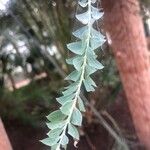
Acacia cultriformis
Knife Acacia · Knife-leaf wattle · Dogtooth Wattle · Golden-glow Wattle · Half-moon Wattle
Description
Source: leafsnapAcacia cultriformis, commonly known as the knife-leaf wattle or dogtooth wattle, is a small to medium-sized evergreen tree or shrub belonging to the family Fabaceae. Native to southeastern Australia, this plant thrives in various habitats, including woodlands, heathlands, and coastal areas. Typically, Acacia cultriformis grows up to 6 meters in height with a spread of about 3 meters. It features distinctive triangular leaves that resemble knives or teeth, which is how it got its common name. The gray-green leaves are about 6-10 cm long and 1-2 cm wide. From late winter to early spring (July-August), Acacia cultriformis produces bright yellow flowers that are highly attractive to bees and other pollinators. Following the flowering period, long seed pods form, containing small black seeds. This plant is highly valued for its ornamental qualities and its ability to fix nitrogen in the soil through symbiotic relationships with nitrogen-fixing bacteria present on its roots. It can be grown as an attractive specimen tree or used in mixed borders, rock gardens, or containers. Acacia cultriformis prefers well-drained, slightly acidic soils but can tolerate a range of soil types, including sandy soils and clay loams. While it requires full sun exposure, it can also handle some shade during the hot summer months. Overall, Acacia cultriformis is an attractive ornamental plant with unique foliage that stands out in any garden landscape. Additionally, it provides important ecological benefits such as nitrogen fixation, enriching the soil ecosystem.
Care Guide
💧 Water Every 7 days
The knife acacia is well-suited to arid environments, as it can thrive with minimal moisture due to its strong drought tolerance. For optimal growth, it is best to provide deep watering every 1 to 2 weeks. Additionally, planting it in well-draining soil helps prevent root rot, allowing the tree to grow even during periods of limited rainfall.
☀️ Light Full sun
Knife acacia is native to open habitats, such as sunny meadows and forest edges, which supply abundant light. It performs best in Full Sun but will also tolerate Partial Sun, showing good adaptability to different light conditions.
🌡️ Temperature 20–37.8°C
Knife acacia shows strong adaptability to different climate conditions, from blistering summers to cold winters. Nevertheless, it has a preferred temperature range for growth. If temperatures get too high, the plant becomes vulnerable to heat and humidity stress, which can lead to its death. In areas where temperatures reach the lower limit of its cold tolerance, it is necessary to apply insulation measures to protect the plant.
💨 Humidity
🪴 Soil 6-7
🌱 Fertilizer
Timing is important for fertilizing Knife acacia. Apply fertilizer in early spring and continue once a month until early summer. Fertilizer encourages lovely blooms and supplies energy during both dormant periods and active growth phases.
🪴 Pot & Repot Every 12 months
✂️ Pruning
The knife acacia is a resilient shrub known for its dense foliage and bright yellow flowers. To maintain its shape and encourage growth, it is best to prune the plant from early to late winter. During pruning, remove any dead branches and trim back vigorous shoots. This will improve air circulation and light penetration, enhancing the plant's health and aesthetic appeal.
🌿 Propagating
🐛 Diseases & pets
☠️ Toxicity
Characteristics
- Plant Type
- Tree, Shrub
- Life Cycle
- Perennial
- Genus
- Acacia
- Family
- Fabaceae
- Hardiness Zone
- 9-11
- Mature Height
- 3.05 m to 4.88 m
- Mature Spread
- 2.13 m to 3.96 m
- Leaf Color
- Green Yellow
- Leaf Type
- Evergreen
- Flower Color
- Gold, Yellow
- Flower Size
- 0.51 cm to 0.76 cm
- Bloom Time
- Spring
- Planting Time
- Spring, Summer, Autumn
- Harvest Time
- Summer