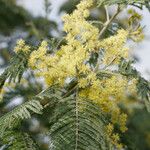
Acacia mearnsii
Black wattle · Tan wattle · Late black wattle · Green wattle · Wattle
Description
Source: leafsnapAcacia mearnsii, commonly known as black wattle, is a fast-growing tree species native to southeastern Australia. It belongs to the family Fabaceae and is widely cultivated for its high-quality wood and tannin-rich bark. The tree can reach up to 30 meters in height with a trunk diameter of up to 1 meter. It features bipinnate leaves with small, dark green leaflets. Black wattle has been introduced to numerous regions worldwide, including South Africa, South America, and Asia, due to its commercial value. It is extensively used in producing paper pulp, furniture, construction materials such as poles and posts, and fuelwood. The bark of Acacia mearnsii contains high levels of tannins traditionally used for leather tanning. Tannins also have medicinal properties, such as anti-inflammatory effects, which make them useful in treating various ailments. Despite its economic importance, black wattle has become an invasive species in some parts of the world, displacing native vegetation due to its rapid growth rate and adaptability to different environmental conditions. Overall, Acacia mearnsii is a significant plant species that provides numerous benefits, including economic value through wood production and medicinal properties from its bark extracts. However, it requires careful management to prevent it from becoming invasive and disrupting native ecosystems.
Care Guide
💧 Water Every 7 days
Native to arid regions, the black wattle is drought-tolerant and requires only minimal watering, about every two to three weeks. It thrives in open landscapes and prefers well-draining soil that replicates the infrequent rainfall of its natural habitat.
☀️ Light Full sun
Black wattle thrives with ample light, preferring unobstructed exposure throughout the day. Its native habitat is usually well-lit, so its growth and overall health depend on unhindered light penetration. Both insufficient and excessive light can impede its normal development.
What are the sunlight requirements for Black Wattle (Acacia mearnsii)?
Black Wattle (Acacia mearnsii) thrives in areas with copious amounts of light and prefers to be exposed to unobscured sunlight throughout the day. It requires full sun, which means above 6 hours of direct sunlight per day, but can also tolerate partial sun, about 3-6 hours of sunlight per day. It's important to watch how sunlight moves through your garden to ensure that your plants receive the perfect balance of light and shade, ensuring their well-being. Insufficient or excessive light may hinder the plant's normal development.
How can artificial lighting be used for indoor Black Wattle plants?
For indoor Black Wattle plants, artificial lighting can be a vital solution for optimal growth, especially when natural sunlight is insufficient. LED lights are a recommended choice because they can provide specific wavelengths needed by the plants. Full sun plants need 30-50W per square foot, partial sun plants need 20-30W per square foot, and full shade plants need 10-20W per square foot of artificial light. The light source should be placed 12-36 inches above the plant to mimic natural sunlight and left on for 8-12 hours per day to simulate the length of natural daylight hours.
What symptoms indicate Black Wattle is receiving insufficient sunlight?
When Black Wattle receives insufficient sunlight, it may exhibit several symptoms including small leaves, leggy or sparse growth, faster leaf drop, slower or no new growth, lighter-colored new leaves, and symptoms of overexposure like chlorosis, sunscald, leaf curling, wilting, and leaf scorching. These symptoms reflect the plant's struggle with suboptimal lighting conditions, impacting its growth, health, and appearance.
What solutions can help Black Wattle suffering from insufficient sunlight?
To address insufficient sunlight for Black Wattle, you can gradually move plants to sunnier locations to receive at least 6 hours of direct sunlight daily. For indoor plants, using a south-facing window or artificial light like desk or ceiling lamps for at least 8 hours daily can provide additional light. Outdoors, it's important to move plants gradually to avoid sunburn. Reducing obstructions like pruning tree branches can increase sunlight exposure. For small plants, consider transplanting during their dormant period to a location with ample sunlight. Although parts of the plant affected by low light may not recover, new growth should be healthy after increasing light exposure.
🌡️ Temperature 5–35°C
Black wattle is suited to temperatures between 41 and 95 °F (5 and 35 ℃). Native to temperate regions, it performs best in the warmer months. During colder periods, seasonal measures are needed to keep it within its preferred temperature range.
What climate does Black Wattle thrive in?
Black Wattle, scientifically known as Acacia mearnsii, is adapted to a climate ranging from 41 to 95 °F (5 to 35 °C). It is native to temperate climates and thrives in warmer seasons. The plant has strong cold resistance, making it well-suited for various environments without the need for special frost protection measures in most cases. However, during extremely cold winters where temperatures are expected to drop below -30°C, it's important to take measures to protect the plant, such as wrapping the trunk and branches and ensuring the soil is moist before the first freeze to prevent drought and water scarcity during the colder months.
How does Black Wattle respond to low temperatures?
Black wattle is cold-tolerant, thriving best when temperatures remain above 5°C. It typically requires no special attention in winter unless temperatures fall below -25°C. In cases where temperatures drop below -30°C, the plant's branches may become brittle and dry, particularly noticeable in spring when no new shoots emerge. To address this issue, it's recommended to prune away any dead branches that have failed to produce new leaves in the spring.
What care does Black Wattle require in high temperatures?
During the summer, Black Wattle should be kept below 35°C to avoid stress. If temperatures exceed 38°C, the leaves may lighten in color, and the tips could become dry and withered, making the plant more susceptible to sunburn. To mitigate these issues, it's advisable to trim away any sunburned and dried parts of the plant. Moving the plant to a shady location during the midday and afternoon sun or using a shade cloth can provide necessary protection. Additionally, watering the plant in the morning and evening helps keep the soil moist and supports plant health.
💨 Humidity
🪴 Soil 6-8
🌱 Fertilizer
The timing of fertilization is important for Black wattle. Apply fertilizer in early spring and continue monthly until early summer. Fertilizer encourages attractive blooms and provides energy during both dormant and active growth periods.
Why do I have to add fertilizer to my Black wattle plant?
Fertilizing your Black wattle is essential for several reasons. Firstly, it will help the tree produce beautiful blooms. To ensure excellent flowers in spring, it is best to fertilize it early on. Additionally, fertilizer provides your Black wattle with ample energy that it can store in the ground during dormant growth periods. By giving it extra nutrients during fall planting or late spring, you can ensure the tree has more energy to utilize once it resumes active growth.
When should I put fertilizer on my Black wattle tree?
To effectively fertilize Black wattle, timing is crucial. Using fertilizer too early, while the tree is still dormant, is ineffective and may be washed away by rainwater, leading to waste and pollution. The first application of fertilizer should be done in early spring, followed by monthly fertilization until early summer.
When is it not a good idea to fertilize my Black wattle tree?
To ensure healthy growth and blooming of Black wattle, it is important to be mindful of the nitrogen levels in the fertilizer. Too much nitrogen can result in an abundance of leaves but few blooms. Look for fertilizers with lower nitrogen levels compared to other nutrients. Timing is also crucial when it comes to fertilizing Black wattle. Avoid fertilizing in late autumn, as this can lead to excessive growth just before winter. Additionally, refrain from fertilizing during hot and dry periods, as dry soil does not effectively deliver nutrients and can stimulate growth that requires more water. It is best to apply fertilizer earlier in the season when temperatures are cooler. Be aware that Black wattle can absorb fertilizer from nearby plants or lawns. Take care not to inadvertently provide the tree or shrub with a double-dose of fertilizer.
What kind of fertilizer does my Black wattle tree need?
To ensure healthy growth and blooming of Black wattle, it is recommended to use a fertilizer with a balanced mix of the main plant nutrients, particularly higher amounts of phosphorus. Alternatively, adding organic materials like compost, worm castings, and manure can also improve the soil. Some experienced gardeners choose to supplement with water-soluble fertilizers containing phosphorus when flower buds appear to enhance flower development, size, and duration. There are various forms of fertilizers that work well for Black wattle, with liquid or powdered forms often being the best options. In any case, make sure to dilute the fertilizer and apply it while watering the plant.
How should I fertilize my Black wattle tree?
To properly fertilize your Black wattle, it is important to follow the specific instructions for the type of fertilizer you are using. To avoid over-fertilization, it is crucial to determine the right amount to apply. One helpful guideline is to use the tree's age or trunk diameter as a reference. You can estimate using one-tenth of a pound of fertilizer per year or per inch of trunk, with a maximum of one pound. To apply granular or organic fertilizers like blood meal, simply sprinkle the substance around the base of the tree, extending it to the drip line (the area beneath the outermost branches). Avoid letting the fertilizer come into contact with the tree trunk. With time, the granules will break down and seep into the soil, ultimately being absorbed by the roots. After fertilizing, spread a layer of compost around the base of the tree, approximately one inch deep. Be sure to water thoroughly to promote proper absorption.
🪴 Pot & Repot
✂️ Pruning
The black wattle is a fast-growing plant that produces fragrant yellow flowers. To maintain its health, prune it from early to late winter. Start by removing any dead or crossing branches, and thin out crowded areas to improve airflow. Eliminate any weak or diseased branches to prevent pests and promote growth. For more detailed pruning techniques, consult the Royal Horticultural Society.
🌿 Propagating
🐛 Diseases & pets
☠️ Toxicity
Characteristics
- Plant Type
- Tree, Shrub
- Life Cycle
- Perennial
- Genus
- Acacia
- Family
- Fabaceae
- Hardiness Zone
- 4-9
- Mature Height
- 9.14 m to 14.94 m
- Mature Spread
- 7.92 m
- Leaf Color
- Dark Green
- Leaf Type
- Evergreen
- Flower Color
- Yellow, Green, Cream
- Flower Size
- 0.51 cm to 0.76 cm
- Bloom Time
- Summer
- Planting Time
- Spring, Summer
- Harvest Time
- Late summer, Early fall, Mid fall