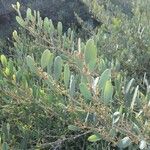
Acacia redolens
Bank catclaw
Description
Source: leafsnapAcacia redolens is a low-growing evergreen shrub that belongs to the Fabaceae family. Native to Western Australia, it has gained popularity worldwide as an ornamental plant due to its attractive foliage and minimal maintenance needs. The plant exhibits a spreading habit, with branches extending up to 2 meters in length, forming dense mats of foliage. The leaves of Acacia redolens are small, narrow, and gray-green in color, arranged alternately along the stems, and have a leathery texture. The flowers are small, yellow spheres that bloom in clusters from late winter to spring. Acacia redolens thrives in well-drained soils with full sun exposure but can also tolerate some shade and drought conditions once established. It is often used for erosion control on slopes or embankments due to its extensive root system, which helps stabilize the soil. Overall, Acacia redolens is an attractive, low-maintenance shrub, making it an ideal choice for landscaping projects or garden beds. It adds color and texture while offering practical benefits like erosion control.
Care Guide
💧 Water Every 7 days
☀️ Light Full sun
Bank catclaw comes from open habitats, for example sunlit meadows and forest margins, where light is plentiful. It does best in Full Sun but will tolerate Partial Sun, showing good adaptability to different light conditions.
🌡️ Temperature 20–37.8°C
Bank catclaw is quite adaptable to temperature, tolerating higher heat and wide temperature swings. In hot weather, care must be taken to water it and provide proper shade to avoid sunburn. On the other hand, Bank catclaw is relatively sensitive to low temperatures. Although it can endure some cold, very cold conditions may cause frost damage.
💨 Humidity
🪴 Soil 6-8
🌱 Fertilizer
Fertilize your Bank catclaw in early spring to encourage healthy growth. Regular feeding boosts overall health, leading to vigorous growth, greater tolerance of harsh conditions, and increased resistance to pests and diseases. Follow a consistent fertilization schedule for your Bank catclaw to keep the foliage vibrant, richly colored, and lush in appearance.
🪴 Pot & Repot
✂️ Pruning
🌿 Propagating
🐛 Diseases & pets
☠️ Toxicity
Characteristics
- Plant Type
- Shrub
- Life Cycle
- Perennial
- Genus
- Acacia
- Family
- Fabaceae
- Hardiness Zone
- 9-11
- Mature Height
- 0.91 m to 3.05 m
- Mature Spread
- 3.05 m to 6.1 m
- Leaf Color
- Dark Green, Olive Drab
- Leaf Type
- Evergreen
- Flower Color
- Yellow
- Flower Size
- 0.51 cm to 0.76 cm
- Bloom Time
- Early spring, Mid spring
- Planting Time
- Spring, Autumn
- Harvest Time
- Summer