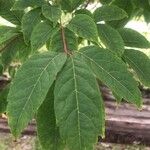
Acer cissifolium
Japanese box-elder · Ivy-leaf maple · Ivyleaf maple · Vine-leaf maple · Ivy-leaved Maple
Description
Source: leafsnapAcer cissifolium (vine-leafed maple, vineleaf maple, and variations thereof; Japanese: ミツデカエデ, romanized: mitsudekaede) is a maple native to Japan, from southern Hokkaidō south through Honshū and Shikoku to Kyūshū. It is a deciduous small tree or large shrub growing to 5–10 m (rarely 15 m) in height, with smooth grey bark. The young shoots are green, often tinged pink, hairy at first with whitish hairs, becoming grey in the second year. The leaves are trifoliate, with a very slender red petiole up to 10 cm long; the three leaflets are 4–10 cm long and 2–4 cm broad, with 1–2 cm petiolules, and coarsely serrated margins. They are matte green above, paler and slightly shiny below, and turn pale yellow to pinkish in autumn. The flowers are produced in pendulous racemes 10–16 cm long, each flower with four sepals and petals; it is dioecious with male and female flowers on separate trees. The fruit is a paired samara, the nutlets are 7 mm long, the wings 15–25 mm long, spreading at an acute angle.Both the scientific and English names refer to the resemblance of its leaves to those of Cissus, a genus in the vine family.
Care Guide
💧 Water Every 1 week
The Ivyleaf maple thrives in moderate humidity and should be watered every 1-2 weeks. Keep the soil slightly moist, but be careful not to overwater. As an outdoor deciduous plant, it goes dormant during the colder months, which means you should water it less frequently during this time.
☀️ Light Partial sun
Ivyleaf maple naturally occurs in habitats like forest understories and rocky areas, where it grows in natural shade. It favors partial sun but can tolerate both full sun and full shade, reflecting its versatile and hardy nature.
What are the sunlight requirements for Ivyleaf maple (Acer cissifolium)?
Ivyleaf maple (Acer cissifolium) requires varying amounts of sunlight depending on its growing conditions. For those plants that need 'Full sun', they should receive above 6 hours of sunlight daily. Alternatively, if the plant thrives in 'Partial sun', it should get about 3-6 hours of sunlight. It's important to observe the movement of sunlight through your garden carefully. Ensuring you select locations that provide an optimal balance of light and shade will contribute significantly to the health and happiness of your Ivyleaf maple.
🌡️ Temperature 5–32.2°C
Ivyleaf maple shows strong adaptability to a wide range of climatic conditions, from blistering summers to cold winters. Still, it has a preferred temperature range for growth. When temperatures become too high, the plant is vulnerable to heat and humidity stress, which can lead to its death. In areas where temperatures approach the lower limit of its cold tolerance, it is important to use insulation to protect the plant.
💨 Humidity
🪴 Soil 6-7
🌱 Fertilizer
Fertilize your Ivyleaf maple in early spring to encourage healthy growth. Consistent fertilization boosts overall health, producing vigorous growth, greater resilience in challenging conditions, and stronger resistance to pests and diseases. Keep a regular fertilization regimen for your Ivyleaf maple to maintain lush, deeply colored, and vibrant foliage.
🪴 Pot & Repot
✂️ Pruning
The Ivyleaf Maple is a deciduous tree known for its trifoliate leaves and vibrant fall colors. To shape the tree and ensure good air circulation, it's best to prune in early spring. Regular pruning encourages healthier growth, but be careful not to trim too much, as excessive cutting can cause stress and reduce flowering.
🌿 Propagating
🐛 Diseases & pets
☠️ Toxicity
Characteristics
- Plant Type
- Tree
- Life Cycle
- Perennial
- Genus
- Acer
- Family
- Sapindaceae
- Hardiness Zone
- 5-8
- Mature Height
- 6.1 m to 9.14 m
- Mature Spread
- 6.1 m to 9.14 m
- Leaf Color
- Yellow, Red, Green, Bronze
- Leaf Type
- Deciduous
- Flower Color
- Green, Yellow
- Flower Size
- 0.51 cm to 0.76 cm
- Bloom Time
- Mid spring, Late spring
- Planting Time
- Spring, Autumn
- Harvest Time
- Late summer, Early fall, Mid fall
- Native Area
- Japan