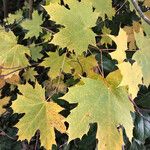
Acer platanoides
افرا · Αγριοπλάτανος · Σφένδαμος πλατανοειδής · Norway maple · Aieresse
Description
Source: leafsnapAcer platanoides, commonly known as the Norway maple, is a deciduous tree native to Europe and western Asia. This tree is a popular ornamental choice in North America, appreciated for its attractive foliage and tolerance of urban conditions. The Norway maple can grow to a height of 40-50 feet with a spread of 30-40 feet. Its leaves are large, dark green, and feature five lobes with pointed tips. In the fall, the leaves change to a yellow or orange hue before dropping for winter dormancy. In the spring, the tree produces small yellow flowers before the leaves emerge. These flowers are followed by winged seeds called samaras, which spin as they fall from the tree in late summer or early fall. Norway maples prefer full sun but can tolerate partial shade and a variety of soil types, including clay soils. This adaptability makes them ideal for urban landscapes where soil conditions may not always be perfect. While it is an attractive ornamental plant, the Norway maple has become invasive in some areas. It can outcompete native species for resources such as light and water, and it produces chemicals that inhibit the growth of other plants around it. Overall, Acer platanoides is an attractive deciduous tree that provides ample shade during the summer months. However, it should be planted with caution due to its invasive tendencies if not properly managed.
💡 The Norway maple holds a special place in the hearts of Canadians, symbolizing their spirit. It is said that catching one of its leaves brings good luck and blessings. Additionally, witnessing the leaves falling alongside a loved one is thought to bring special blessings.
🌳 Nature offers us a range of resources, like the sap of the norway maple, which is used to make a distinct kind of maple syrup. Although it is not as sweet as the syrup from its relative, the sugar maple, syrup made from the norway maple has a bold flavor that appeals to people with adventurous palates. It demonstrates the variety found in natural products.
🎭 Persistence, resilience, fierce competitiveness
Care Guide
💧 Water Every 7 days
The Norway maple, which comes from a temperate climate, prefers moderate moisture levels but can withstand short periods of drought. It is recommended to water the tree every 1 to 2 weeks, providing more water during the spring when it is actively growing, and reducing water in the fall when it is entering dormancy.
When Should I Water My Norway Maple?
Watering your Norway Maple is vital for its health, promoting strong roots, preventing drought stress, and leading to vibrant foliage. Look for signs like wilting or curling leaves, which may indicate dehydration. Soil conditions also offer clues; dry soil 2-3 inches deep means it's time to water. Seasonal changes affect water needs too; more water is needed during active growth in spring and early fall than in the dormant seasons. Growth stagnation or delayed budding can also signal insufficient watering. However, balance is key as both underwatering and overwatering can cause harm, such as drought stress or root rot respectively.
How Should I Water My Norway Maple?
Watering your Norway Maple correctly involves several techniques to prevent moisture-related issues and encourage healthy growth. Given the tree's shallow and wide-ranging roots, deep and infrequent watering is recommended to support root health without causing water stress. Methods like watering at the base with a soaker hose or using drip irrigation ensure that water is applied directly to the root zone, minimizing disease risk. Tools such as a moisture meter can help you gauge soil moisture and water as needed. Remember to avoid getting water on the foliage to reduce disease risk, and consider applying mulch to help keep soil moisture levels consistent.
How Much Water Does Norway Maple Really Need?
Norway Maple requires moderate watering, influenced by factors like pot size, root depth, and plant size. Typically, it needs about 2 to 3 inches of water per week to thoroughly wet the root zone without causing waterlogging. Proper hydration is indicated by vibrant and healthy leaves, with improper watering leading to yellowing leaves if overwatered, or wilting and leaf drop if underwatered. The key is to achieve a balance to encourage strong growth and prevent root rot or drought stress. Deep watering, allowing the soil to dry out slightly between waterings, and using a well-draining mix are all part of maintaining this balance.
What Kind of Water is Best for Norway Maple?
Norway Maple does best with natural rainwater due to its balanced pH and lack of chemicals. Distilled and filtered water are also good options as they are free from impurities. Tap water is least preferred due to its potential chlorine and fluoride content, which can harm the plant. If using tap water, it's advisable to let it sit out for 24 hours for chlorine to evaporate or use a filtration system to remove fluoride for the safest watering practice. Water temperature should be moderate, ideally room temperature, to avoid shocking the plant.
How Do Norway Maple's Watering Needs Change with the Seasons?
Norway Maple's water needs vary with the seasons. Spring marks increased growth and water needs to support new development. Summer demands the most water due to higher temperatures and evaporation rates, while autumn's cooling temperatures reduce the tree's water requirements as it prepares for dormancy. During winter, water much less but don't let the roots dry out completely. Adjusting your watering routine according to these seasonal needs ensures the Norway Maple remains healthy and vibrant throughout the year.
☀️ Light Full sun
Norway maple grows best with plenty of daily sunlight. It can tolerate some shade but not too much, because a lack of light can restrict its growth and harm its overall health. Its native habitat encourages this adaptation, as it typically has abundant light.
What are the sunlight requirements for the Norway maple?
The Norway maple (Acer platanoides) thrives best in full sun, requiring more than 6 hours of sunlight daily. It can also tolerate partial sun, which is about 3-6 hours of sunlight. It's essential to observe your garden to find spots that offer a balance of light and shade suitable for the maple, ensuring its overall health and happiness.
How important is sunlight for the growth and health of Norway maple?
Sunlight is crucial for the Norway maple's growth and health, as it optimally thrives with a significant amount of daily sun exposure. While it can cope with some shade, inadequate light can hinder its growth and affect its overall health negatively. The species' origin in habitats with plentiful light access supports this need. In situations where natural sunlight is insufficient, especially during winter or in less sunny spaces, artificial lighting can provide a critical solution for optimal growth.
What are the artificial lighting requirements for indoor Norway maples?
Indoor Norway maples require adequate lighting to grow well, with LED lights being a popular choice due to their customizability for the plant's specific light wavelength needs. Full sun plants need 30-50W/sq ft, partial sun plants need 20-30W/sq ft, and full shade plants need 10-20W/sq ft of artificial light. The light source should be placed 12-36 inches above the plant, mimicking natural sunlight, and most plants need 8-12 hours of light per day.
What symptoms indicate a Norway maple is receiving insufficient light?
When a Norway maple doesn't get enough light, it may show symptoms like small leaves, leggy or sparse growth, faster leaf drop, slower or no new growth, and lighter-colored or chlorotic new leaves. These symptoms reflect the plant's struggle in suboptimal lighting conditions. Additionally, symptoms from excessive sunlight, such as chlorosis, sunscald, leaf curling, wilting, and leaf scorching, can affect the plant, indicating that careful balance of light exposure is essential.
How can I address light-related issues in Norway maple care?
To address light deficiency in Norway maples, gradually move indoor plants to sunnier locations each week, aiming for at least 6 hours of direct sunlight daily, using south-facing windows and artificial light if necessary. For outdoor plants, also move them gradually to sunnier spots to prevent sunburn. Reducing obstructions like pruning trees can help outdoor plants get better sunlight. During transplanting, do so during the plant's dormant period to a location with ample sunlight and good drainage. Remember, while damaged parts may not recover, new growth after adjusting light exposure should be healthy.
🌡️ Temperature 0–32.2°C
In its native growth environment, the norway maple favors cool to moderate temperatures of about 0 to 32 ℉ (-18 to 0 ℃) and, once established, can tolerate sub-zero conditions. In warmer climates it needs sufficient moisture to remain healthy. Gardeners should avoid pruning in winter to prevent frost damage. In summer, maintaining adequate watering and soil moisture is important for optimal growth and performance.
What are the ideal growing conditions for Norway maple?
The Norway maple (Acer platanoides) thrives in cool to moderate temperatures, ideally ranging from 0 to 32°F (-18 to 0°C). It possesses strong cold resistance and is capable of withstanding sub-zero temperatures once fully established. In warmer climates, the Norway maple requires adequate moisture to maintain its health. It is important to ensure that the soil remains moist, particularly during the winter before the first freeze, to prevent drought and water scarcity during the colder months and early spring. Additionally, gardeners are advised to avoid pruning during the winter season to prevent frost damage.
How should Norway maple be protected in extremely cold temperatures?
While the Norway maple is highly resistant to cold and typically does not require special frost protection measures, when winter temperatures are expected to drop below -35°C, it is crucial to provide additional protection. This can include wrapping the tree's trunk and branches with non-woven fabric or cloth to help guard against the extreme cold. Such measures help prevent the branches from becoming brittle and dry which could occur during spring, following extremely low winter temperatures.
What should be done if the Norway maple experiences low temperatures?
Norway maples are cold-tolerant and generally thrive when temperatures are above 0°C, but should be protected if temperatures fall below -30°C. In the event that temperatures plummet below -35°C, it may not show immediate signs of distress during winter, but come spring, branches may turn brittle and dry, and new shoots might fail to emerge. In such cases, it is advisable to prune away the dead branches that have failed to produce new leaves as a part of springtime care.
How does high temperature affect Norway maple, and what remedies are suggested?
During the summer, optimal temperatures for the Norway maple should remain below 32°C. Exceeding 35°C may result in the leaves becoming lighter in color, the appearance of dry and withered tips, and an increased susceptibility to sunburn. To mitigate these effects, trim away sunburned and dried-up parts of the plant. Relocate the plant to a shaded area or use a shade cloth to protect it from the midday and afternoon sun. Ensuring the plant is watered in the morning and evening will help keep the soil moist, further aiding in its health and growth during high temperatures.
💨 Humidity normal (40-60%)
This plant will thrive in moderate humidity, which is probably the level in your home. However, misting it a few times a week can be very beneficial. Make sure the room has good ventilation.
🪴 Soil 6-7
🌱 Fertilizer
Fertilize your Norway maple in early spring to encourage healthy growth. Regular feeding boosts overall health, producing vigorous growth, better tolerance of harsh conditions, and increased resistance to diseases and pests. Stick to a consistent fertilization schedule for your Norway maple to maintain vivid foliage with rich color and a full, lush appearance.
Why is it necessary to put fertilizer on my Norway maple?
No matter what type of Norway maple you have, regular fertilization is crucial for overall plant health. Providing the right nutrients promotes strong growth, making your Norway maple more resilient to challenging growing conditions and better able to fight off diseases and pests. Your Norway maple's foliage is one of its most appealing aspects, so it's important to maintain it. To do this, establish and stick to a regular fertilization schedule tailored to your Norway maple, resulting in vibrant leaves and a lush appearance.
What is the best time to put fertilizer on my Norway maple?
To promote healthy growth in your Norway maple, fertilize it during late winter or early spring. This will provide the necessary nutrients for the tree to thrive once the weather warms up. If you live in a warm climate region, consider another round of fertilization in early fall. This will add nutrients to the soil for the following growing season and improve the tree's ability to withstand winter without damage. Early fertilization also allows new branches to grow and become more resilient against the cold.
When is not a good time to add fertilizer to my Norway maple tree?
There are specific times of the year when it is not recommended to fertilize your Norway maple. Firstly, during the early and mid-winter months when the tree is dormant and does not require feeding. Additionally, it is not advisable to fertilize the tree in late spring and throughout summer due to hotter and drier weather conditions. Fertilizing during these periods increases the likelihood of a negative response from the tree. To avoid any issues, it is best to stick to a fertilization schedule that only involves feeding in early spring and early fall.
What kind of fertilizer does my Norway maple tree need?
In most cases, nitrogen is the most important nutrient for a Norway maple. However, phosphorus and potassium are still significant for its overall health. So, a balanced fertilizer like a 10-10-10 can be effective because it provides decent amounts of all three nutrients. Nevertheless, a slightly higher nitrogen ratio often leads to the best growth for a Norway maple. For instance, a ratio of 10-6-4 is often successful. When it comes to fertilizing, you can choose between granular or liquid-based options.
How can I provide nutrients to my Norway maple to help it grow?
To fertilize your Norway maple, you have two options: using granular fertilizer or liquid fertilizer. If you choose granular fertilizer, simply sprinkle it on the soil at the right time. This type of fertilizer releases nutrients slowly over time. Before applying granular fertilizer, it's generally a good idea to lightly water your Norway maple. On the other hand, liquid fertilizer is less common but still an option. To use liquid fertilizer, mix it with water and pour the mixture onto the soil around the base of your Norway maple. Before fertilizing, it can be beneficial to perform a soil test to check the pH levels and determine if any adjustments are necessary.
🪴 Pot & Repot Every 2 years
✂️ Pruning
The Norway maple benefits from early spring pruning, which removes dead branches and improves air circulation. This promotes vigorous growth. Regular maintenance helps prevent weak branches and storm damage, while avoiding excessive pruning reduces stress on the tree. This ensures a healthier, more attractive tree with better light penetration.
🌿 Propagating
🐛 Diseases & pets
☠️ Toxicity
Acer platanoides leaf effect on horse poisoning. The toxic ingredient in red maple leaves is believed to be gallic acid. Gallic acid causes methemoglobinemia and is plentiful in both water and methanol extracts of red maple, sugar maple and silver maple, and in the extract fractions from these species that oxidize blood cells. Ingestion of wilted or partially dried red maple leaves from fallen or pruned branches causes lysis of the red blood cells with the subsequent development of a hemolytic anemia, which can be deadly.
Characteristics
- Plant Type
- Tree
- Life Cycle
- Perennial
- Genus
- Acer
- Family
- Sapindaceae
- Hardiness Zone
- 3-8
- Mature Height
- 9.14 m to 29.87 m
- Mature Spread
- 14.94 m to 20.12 m
- Leaf Color
- Green, Yellow, Brown, Orange, Red, Variegated, Gold
- Leaf Type
- Deciduous
- Flower Color
- Yellow
- Flower Size
- 0.25 cm to 0.51 cm
- Bloom Time
- Mid spring, Late spring
- Planting Time
- Spring, Summer, Autumn, Winter
- Harvest Time
- Early summer, Mid summer
- Native Area
- Turkey, Austria, Sweden, Slovakia, Croatia, Slovenia, Belarus, Germany, Estonia, Romania, Latvia, Moldova, France, Czech Republic, Cyprus, Bulgaria, Poland, Armenia, Greece, North Macedonia, Ukraine, Serbia, Lithuania, Norway, Afghanistan, Kyrgyzstan, Italy, Switzerland, Finland, Bosnia and Herzegovina, Iran, Albania, Azerbaijan, Hungary, Turkmenistan