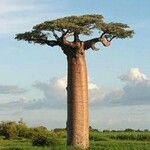
Adansonia madagascariensis
Madagascar Baobab · Baobab
Description
Source: leafsnapAdansonia madagascariensis, commonly known as the Madagascar baobab, is a large deciduous tree native to Madagascar. Belonging to the Malvaceae family, this remarkable tree can reach heights of up to 25 meters and develop a trunk diameter of up to 3 meters. One of its most distinctive features is its bottle-shaped trunk, which can store water during periods of drought. The leaves of the Madagascar baobab are palmate and deciduous, meaning they fall off during the dry season. Its flowers are large, white, and composed of five petals, blooming at night. These flowers are primarily pollinated by bats. The fruit of Adansonia madagascariensis is an oval-shaped capsule containing numerous seeds embedded in a powdery pulp. Although the fruit is edible, it has an acidic taste. This species plays a significant role in traditional medicine. Various parts of the plant have medicinal properties and are used to treat a range of ailments, including fever, diarrhea, dysentery, and respiratory infections. However, habitat loss due to deforestation for agriculture, logging for timber and charcoal production, and climate change-induced droughts have placed Adansonia madagascariensis on the IUCN Red List as a vulnerable species. This status highlights the urgent need for conservation efforts to protect it from extinction threats in its natural habitat.
Care Guide
💧 Water Every 7 days
☀️ Light Full sun
The grey baobab is native to open habitats, such as sunny grasslands and forest margins, which provide plenty of light. It performs best in full sun but can also tolerate partial sun, adapting well to a range of light levels.
🌡️ Temperature 20–37.8°C
Grey baobab comes from tropical areas, where the climate is usually warm and humid. Therefore it is well adapted to high temperatures and moisture. It does not tolerate sudden temperature changes and prefers a steady temperature environment, so avoiding temperature fluctuations indoors is important. It generally cannot endure cold temperatures and needs warmer conditions for growth. If the ambient temperature falls too low, the plant may stop growing or even die.
💨 Humidity
🪴 Soil 6-8
🌱 Fertilizer
Fertilizing a Grey baobab is best done in early spring, when it comes out of dormancy. This encourages overall growth and the development of flowers. Feeding the plant improves its foliage, stems, and branches, and supports the formation of large, vibrant, long-lasting flowers. It also helps move nutrients from the roots to the flowers and enhances the plant's health and resistance to disease.
🪴 Pot & Repot
✂️ Pruning
To maintain the shape and health of a grey baobab tree, it is important to prune it in early spring. Begin by removing any dead or diseased branches. Next, thin out any excessive growth to improve air circulation, which helps prevent fungal problems. For the best results, use clean, sharp tools to make precise cuts, ensuring both safety and the preservation of the tree's iconic silhouette.
🌿 Propagating
🐛 Diseases & pets
☠️ Toxicity
Characteristics
- Plant Type
- Tree
- Life Cycle
- Perennial
- Genus
- Adansonia
- Family
- Malvaceae
- Hardiness Zone
- 10-12
- Mature Height
- 24.99 m
- Mature Spread
- 11.89 m
- Leaf Color
- Green, Dark Green
- Leaf Type
- Deciduous
- Flower Size
- 10.16 cm to 15.24 cm
- Bloom Time
- Mid summer, Late summer
- Planting Time
- Spring, Summer, Autumn
- Harvest Time
- Fall
- Native Area
- Madagascar