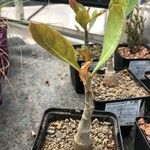
Adenium multiflorum
آدنیوم · Impala-lily · Sabi-star · Calachuchi · सदाबहार
Description
Source: leafsnapAdenium multiflorum, commonly known as the Desert Rose, is a succulent plant native to East Africa and the Arabian Peninsula. This small tree or shrub can reach heights of up to 3 meters and features a thick, swollen stem that stores water. The glossy green leaves are oval-shaped with pointed tips, adding to the plant's appeal. The Desert Rose produces stunning flowers in shades of pink, red, or white, each with five petals arranged in a trumpet shape. These flowers bloom in clusters at the end of branches during the spring and summer months. Due to its attractive appearance, Adenium multiflorum is often grown as an ornamental plant. It thrives best in well-draining soil and requires full sun exposure for optimal growth. Propagation can be achieved through seeds or stem cuttings. While Adenium multiflorum is relatively easy to care for, it is important to note that all parts of the plant are toxic if ingested by humans or animals. As such, it should be kept out of reach of children and pets. Overall, Adenium multiflorum is a striking succulent tree with beautiful blooms, making it a fantastic addition to any garden or indoor space with ample sunlight.
Care Guide
💧 Water Every 7 days
☀️ Light Full sun
Originating from arid regions, Adenium obesum subsp. multiflorum performs best in full sun, as its natural habitat has intense sunlight and very little shade. It will also tolerate partial sun, giving it some flexibility in growth.
🌡️ Temperature 20–37.8°C
Adenium obesum subsp. multiflorum does best in warm conditions and needs relatively high temperatures during the growing season to support growth and metabolic activity. It prefers plenty of sunlight, suitable moisture, and good air circulation. However, it can be harmed by excessively low temperatures and by overwatering. It is important to maintain balance and to avoid both overly high temperatures and excessively dry conditions.
💨 Humidity dry (<40%)
This plant prefers dry conditions, so don't mist it. However, watering it less often can also thrive in higher humidity.
🪴 Soil 6-7
🌱 Fertilizer
Adenium obesum subsp. multiflorum only requires light fertilizer applications once or twice a year during the growing season. Do not fertilize in winter or in summer when it is dormant. Cut back on fertilizer for plants that have been repotted and wait a couple of months after repotting before feeding. Fertilizing promotes healthy growth and encourages flowering.
🪴 Pot & Repot Every 2 years
When repotting Adenium obesum subsp. multiflorum, choose a pot only slightly bigger than the current one that provides good drainage. Use a gritty, well-draining succulent or cactus mix. Gently remove the plant from its old container, brush away excess soil, and set it back in at the same depth. Delay watering for a few days to allow any root damage to heal. Repot in spring or fall and place it in a brightly lit location.
✂️ Pruning
🌿 Propagating
🐛 Diseases & pets
☠️ Toxicity
Characteristics
- Plant Type
- Succulent, Shrub
- Life Cycle
- Perennial
- Genus
- Adenium
- Family
- Apocynaceae
- Hardiness Zone
- 10-12
- Mature Height
- 0.91 m to 3.05 m
- Mature Spread
- 0.91 m to 2.13 m
- Leaf Color
- Dark Green
- Leaf Type
- Deciduous
- Flower Color
- Pink, White
- Flower Size
- 5.08 cm to 6.35 cm
- Bloom Time
- All year round
- Planting Time
- Spring, Summer, Autumn
- Harvest Time
- All year round
- Native Area
- Malawi, Mozambique, South Africa, Zambia, Eswatini, Zimbabwe