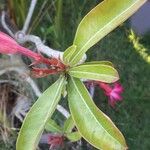
Adenium obesum
آدنیوم · آدنیوم (رز صحرایی) · العَدَنَةُ · Desert-rose · Impala-lily
Description
Source: leafsnapAdenium obesum is a poisonous species of flowering plant belonging to the tribe Nerieae of the subfamily Apocynoideae of the dogbane family, Apocynaceae. It is native to the Sahel regions south of the Sahara (from Mauritania and Senegal to Sudan), tropical and subtropical eastern and southern Africa and also the Arabian Peninsula. Common names include Sabi star, kudu, mock azalea, impala lily and desert rose. Adenium obesum is a popular houseplant and bonsai in temperate regions.
💡 The desert rose forms over centuries, creating a timeless treasure that can be enjoyed throughout one's life and passed down to future generations as a symbol of family happiness. These stunning formations are rich in aesthetic appeal, enhancing one's appreciation for beauty and sparking imagination, which can be particularly inspiring for artists and creators. Additionally, desert roses make meaningful gifts for young couples, serving as expressions of love and affection.
🌳 Besides being grown for its decorative value, the desert rose is well known for how well it adapts to bonsai cultivation. Hobbyists value the desert rose for its stout, swollen stem and bright flowers, creating small landscapes that mirror the stark beauty of the plant’s natural desert habitats. Beyond its looks, the plant’s sap has been examined for possible use in organic pesticides because of its toxic qualities, suggesting it could have a role in sustainable agriculture.
🎭 Steadfast dedication to love, wealth, and good fortune
Care Guide
💧 Water Every 3 weeks
The desert rose is well-suited for arid regions because it thrives with very little moisture, needing water only once every three weeks. Its strong drought tolerance makes it an ideal choice for dry climates with plenty of sunlight, where rain is scarce.
When Should I Water My Desert Rose?
Watering your Desert Rose should be based on a few key indicators rather than a strict schedule. Proper and timely watering is essential for the plant's health, contributing to optimal growth, vibrant flower production, and disease resistance. The primary sign that your Desert Rose needs watering is the dryness of the top 1 to 2 inches of soil. Additionally, the condition of the leaves, such as wilting or color fading, can indicate the need for water. During the pre-flowering stage, consistent watering is crucial to avoid bud drop. The plant also requires more water in warmer temperatures and under high sunlight exposure. However, watering too early or late can pose risks such as root diseases or stunted growth, respectively. It's vital to recognize these signs to manage the watering schedule effectively, ensuring the plant's health and longevity.
How Should I Water My Desert Rose?
Watering your Desert Rose correctly involves avoiding over-watering and ensuring the water reaches where it's most needed. Since Desert Rose is native to arid climates, it's adapted to survive with less water, making it sensitive to overwatering which can cause root rot or fungal diseases. Using a watering can with a long, narrow spout helps target the root zone directly and prevents water from getting on the leaves, which can lead to fungal problems. Top-watering is recommended, ensuring the soil around the base of the plant is moist without waterlogging. Do not use bottom-watering as it retains too much moisture. Also, avoid misting the plant as Desert Rose doesn’t require added humidity. After watering, make sure the plant is placed somewhere with good drainage to prevent excess water retention.
How Much Water Does Desert Rose Really Need?
The Desert Rose, with its succulent leaves and thick stem, stores water efficiently, making it crucial to avoid overwatering. The plant's watering needs vary depending on several factors such as pot size, root depth, plant size, and environmental conditions. Generally, allow the soil to completely dry out between waterings, and when you do water, ensure thorough soil saturation, letting excess water drain away. Smaller pots and younger plants require less water compared to larger or mature plants. Signs of proper hydration include firm, plump, and glossy leaves. Conversely, signs of underwatering include wilting and yellow or brown, dry leaves, while overwatering may cause soft, mushy leaves and root rot. Regularly monitoring the soil moisture and adjusting your watering strategy accordingly is key, preferably erring on the side of underwatering.
What Kind of Water is Best for Desert Rose?
Desert Rose plants exhibit moderate sensitivity to water quality, with a high sensitivity particularly to chlorine. The ideal types of water for Desert Rose include distilled water, which is free of impurities and minerals, and rainwater, as it contains minimal contaminants. While tap water can be used, it should be treated to remove chlorine and other harmful elements. Filtering the water or letting tap water sit out for 24 hours before use can help evaporate the chlorine. The use of a water filter or reverse osmosis can also remove harmful contaminants. It's important to provide water at room temperature to avoid shocking the plant, with the best range being around 68-72°F (20-22°C).
How Do Desert Rose's Watering Needs Change with the Seasons?
The watering needs of Desert Rose change significantly with the seasons. In spring, as the plant enters a growth phase, it requires more frequent watering to support new growth, always allowing excess water to drain and avoiding waterlogged soil. During summer, the peak growing season, the soil dries out faster, necessitating more frequent watering while ensuring proper drainage. In autumn, as growth slows, reduce the frequency of watering, allowing the topsoil to dry out between sessions. Winter marks the plant's dormancy period, drastically reducing its watering needs; water sparingly, only when the soil is very dry. These seasonal adjustments prevent stresses such as over or underwatering.
☀️ Light Full sun
Desert rose performs best in intense sunlight that mirrors its native desert habitat. Strong light encourages vigorous growth, although it can tolerate some shade. Excessive shading can harm its health, producing weak growth and fewer blooms. While young, it requires a suitable balance of light and shade. Too much brightness can sunburn the plant, and too little light can lead to leggy growth.
What are the sunlight requirements for a desert rose plant?
The desert rose plant thrives under conditions that replicate its native desert environment, requiring strong illumination for robust growth. It benefits from full sun, defined as above 6 hours of sunlight per day, or partial sun, which is about 3-6 hours of sunlight daily. While the desert rose can tolerate some shade, excessive shading can lead to weak growth and fewer flowers. It's important to watch how sunlight moves through your garden to ensure plants receive the ideal balance of light and shade.
How does artificial lighting support desert rose growth?
For indoor desert rose plants, artificial lighting can be crucial for optimal growth, especially when natural sunlight is insufficient. LED lights are favored for indoor plant lighting as they can provide specific wavelengths needed by plants. The intensity of artificial light required varies with full sun plants needing 30-50W/sq ft, partial sun plants 20-30W/sq ft, and full shade plants 10-20W/sq ft. The light should be placed 12-36 inches above the plant and kept on for 8-12 hours per day to mimic natural sunlight duration.
What symptoms indicate a desert rose is receiving insufficient light?
Symptoms of insufficient light in desert rose plants include faster leaf drop, leggy or sparse growth, smaller new leaves, and negative impacts on flowering and fruiting. Additional symptoms may include chlorosis, where leaves lose their green color, sunscald from intense sunlight exposure, leaf curling as a defense mechanism against excessive sunlight, wilting due to increased water loss, and leaf scorching characterized by brown, dry edges on leaves.
How can I address insufficient light exposure for my desert rose plant?
To address insufficient light exposure, gradually move indoor plants to sunnier locations to receive at least 6 hours of direct sunlight daily, using a south-facing window for the best light. For plants that are large or hard to move, consider using artificial light, keeping a desk or ceiling lamp on for a minimum of 8 hours a day or investing in professional plant grow lights. For outdoor plants, move them gradually to avoid shock and sunburn. It's also helpful to reduce obstructions like overhanging branches and consider transplanting smaller plants during their dormant period to places with ample sunlight and good drainage. Note that parts of the plant previously affected by low light may not recover, but new growth should be healthy with improved lighting.
🌡️ Temperature 20–37.8°C
The desert rose is a temperate woody plant native to areas where daytime temperatures range from 68 to 100 ℉ (20 to 38 ℃). It performs best in warm conditions, preferring daytime temperatures above 60 ℉ (15.5 ℃) in winter and above 80 ℉ (26 ℃) in summer. To meet these preferences, provide plenty of sunlight and adjust watering to match the temperature and moisture needs.
What are the ideal growing conditions for Desert Rose (Adenium obesum)?
Desert Rose (Adenium obesum) is a temperate woody plant native to warm environments, preferring day temperatures ranging between 68°F (20°C) and 100°F (38°C). For optimal growth, it requires daytime temperatures above 60°F (15.5°C) in winter and above 80°F (26°C) during summer months. These plants are heat-loving and enter a dormant state in winter, so it's crucial to provide ample sunlight and moderate watering according to the temperature and moisture needs. During colder months, when temperatures drop significantly, Desert Rose should be moved indoors near a south-facing window for enough sunlight or supplemented with additional lighting. It's also important to halt watering when temperatures are low to prevent root rot, especially for outdoor plants. Temporary measures like setting up a greenhouse or wrapping the plant with plastic film or fabric can offer additional insulation against cold.
How should you care for a Desert Rose during low temperatures?
Desert Rose requires care and attention during low temperatures as it thrives best in high temperatures and struggles with cold. When temperatures drop below the plant's comfort range, its growth slows down, and it becomes susceptible to weakness, wilting, and root rot. If mild frost damage occurs, symptoms might not appear immediately, but the plant could begin to wither within a week. In such cases, it's recommended to trim off the frostbitten areas and check for root rot. If the roots are rotted, they should be removed, and the plant can be propagated through cuttings. To recover, the plant should be immediately placed in a warm environment indoors near a south-facing window for sufficient sunlight. If natural light is inadequate, supplemental lighting can be used to ensure the plant's health.
What are the symptoms of Desert Rose being exposed to temperatures too high or too low, and how can they be mitigated?
When exposed to very high temperatures, Desert Rose may cease growing, lose water, wilt, and become susceptible to sunburn. Should the temperature exceed its tolerable maximum, it's vital to prune the sunburned and rotten parts of the plant, and provide protection from the harsh afternoon sunlight until the plant recovers. For sunburn or root rot, cease watering until new growth indicates recovery. Conversely, at too low temperatures, the plant may weaken, wilt, and be prone to root rot. To mitigate low temperature issues, frostbitten areas should be trimmed, with immediate action to cut off rotted roots for plants showing such signs. Relocating the plant indoors to a warm and brightly lit spot near a south-facing window or using supplemental lighting is crucial for its recovery and continued growth.
💨 Humidity dry (<40%)
This plant prefers dry conditions, so don't mist it. However, watering it less often can also thrive in higher humidity.
🪴 Soil 6-7
🌱 Fertilizer
For the Desert rose, light applications of fertilizer 1-2 times a year during the growing season are adequate. Do not fertilize in winter or summer when the plant is dormant. Use less fertilizer for repotted plants and wait a couple of months after repotting before you start feeding. Fertilizing helps maintain healthy growth and promotes blooms.
Why is it important to fertilize my Desert rose?
Fertilizing Desert rose is important for adding nutrients to the growing medium. Although it already stores water and nutrients, applying plant food during the growing season promotes healthy growth. Fertilizing can also stimulate mature specimens to produce blooms during the growing season.
When should I fertilize my Desert rose plant?
Desert rose plants require fewer nutrients compared to other plants. They only need a small amount of fertilizer during the growing season. To ensure proper growth, fertilizer should be applied 1-2 times a year. It is recommended to fertilize your Desert rose in the spring and autumn, avoiding winter and summer when the plant is dormant. If you have recently repotted your plant, be cautious with the amount of fertilizer you use. It is best to wait a couple of months after repotting before applying any fertilizer.
When is it not a good idea to use fertilizer on my Desert rose?
Desert rose, like most plants, has a dormancy period when it stops growing. This is the time to refrain from applying fertilizer. During summer and winter, the plant remains dormant, so it's best to avoid fertilizing. Additionally, after repotting in the spring, it's recommended to wait a couple of months before resuming fertilizer applications.
What kind of plant food should I use for my Desert rose?
When fertilizing Desert rose, it is recommended to use a liquid plant food specifically made for succulents and cacti. To avoid fertilizer buildup, dilute it with water to half-strength. Apply the fertilizer to the base of the plant and water it thoroughly, making sure any extra moisture drains away.
How should I feed my Desert rose plant?
When fertilizing Desert rose, it's recommended to use liquid plant food, but you can also use granules. Follow the instructions on the packaging and dilute liquid fertilizer to half-strength. Regardless of the type of plant food you choose, always apply it to the soil. For granules, cover them with a thin layer of soil and water the plants.
🪴 Pot & Repot Every 2 years
When repotting Desert rose, choose a pot slightly larger than the current one that provides good drainage. Use a gritty, well-draining cactus or succulent mix. Gently lift the plant from its old pot, remove excess soil, and place it at the same depth in the new container. Wait a few days before watering so any root damage can heal. Repot in spring or fall and keep the plant in a brightly lit spot.
✂️ Pruning
The desert rose blooms on new growth, so pruning in the spring and summer encourages more flowers. If needed, you can prune fallen branches in the fall or winter, but make sure the plant is well-watered beforehand. Pruning helps shape the plant and train its branches. Additionally, removing crossing, weak, or dead branches promotes a balanced structure.
🌿 Propagating
🐛 Diseases & pets
☠️ Toxicity
Characteristics
- Plant Type
- Succulent, Shrub
- Life Cycle
- Perennial
- Genus
- Adenium
- Family
- Apocynaceae
- Hardiness Zone
- 10-12
- Mature Height
- 0.91 m to 3.05 m
- Mature Spread
- 0.91 m to 1.52 m
- Leaf Color
- Green, Gray
- Leaf Type
- Evergreen, Deciduous
- Flower Color
- Pink, Red, White
- Flower Size
- 4.06 cm to 6.35 cm
- Bloom Time
- Early summer, Mid summer
- Planting Time
- Spring, Autumn, Winter
- Harvest Time
- Mid summer, Late summer
- Native Area
- Africa