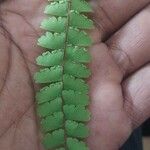
Adiantum caudatum
Tailed maidenhair · Trailing maidenhair · Walking maidenhair
Description
Source: leafsnapAdiantum caudatum, commonly known as the maidenhair fern, is a delicate and graceful plant from the Pteridaceae family. Native to North America, it thrives in moist, shady environments such as forests, canyons, and stream banks. This fern is easily recognizable by its thin black stems that support fronds of bright green, fan-shaped leaves. Each frond features small leaflets arranged symmetrically along the stem. The maidenhair fern is an evergreen perennial that can grow up to 60 cm tall and spread about 30 cm wide. It prefers moist soil but can endure some drought once it is well-established. Optimal growth occurs in indirect light or partial shade. Indigenous peoples have long utilized Adiantum caudatum for its medicinal properties, especially for its anti-inflammatory effects that help alleviate respiratory ailments such as coughs and colds. Beyond its medicinal uses, the maidenhair fern is a favorite among gardeners due to its ornamental appeal. It is an excellent addition to shaded gardens or indoor spaces, where its unique foliage adds texture and visual interest. In summary, Adiantum caudatum is an attractive ornamental plant that combines aesthetic appeal with potential health benefits, making it a popular choice for gardeners worldwide.
Care Guide
💧 Water Every 7 days
The tailed maidenhair plant thrives in humid conditions and needs consistent moisture to stay healthy. Water it twice a week and maintain proper humidity to prevent the fronds from wilting. During dry seasons, the plant may go dormant to conserve water. For successful indoor cultivation, using containers is recommended.
What should I do if I give too much or too little water to my Tailed maidenhair plant?
The Tailed maidenhair, despite its love for water, can be overwatered if it sits in a pool of water or if the planter lacks drainage holes. In these conditions, the roots can't absorb nutrients and moisture, and it may lead to fungal or bacterial diseases. Signs of overwatering include wilted and yellow leaves. The stems may droop, become soft and mushy, or droop and fall over. Check for other causes of these symptoms, as too much water is unlikely for this plant. On the other hand, if not watered enough, the Tailed maidenhair can quickly change from lush and green to brown and crispy. In severe cases, it may appear completely dried up, but there's a chance to save it if some of the roots are still healthy. Trim all dry and dead stems, thoroughly water the plant, and place it back in its usual spot. With proper care, this resilient plant can grow new fronds, although it may take several months to regain its original size.
How do I properly water my Tailed maidenhair?
Your Tailed maidenhair plant needs consistently moist soil that resembles its natural environment. This may require watering every one or two days, as it should never be allowed to dry out. When the top layer of soil starts to feel even slightly dry, it's a sign to water again. And when you do water, make sure to thoroughly soak the soil until water drains out from the bottom of the pot. After that, be sure to discard any excess water to prevent the pot from sitting in a puddle. Following this method will help ensure that the soil remains adequately moist and never becomes too dry.
What do I need to think about when watering my Tailed maidenhair?
The frequency of watering for your Tailed maidenhair depends on the humidity level in the surrounding air. Higher humidity means less frequent watering because evaporation is slower. To prevent the plant from drying out quickly, avoid placing it near heating or cooling vents. Choose a location with no drafts. Tailed maidenhair prefers dappled and indirect sunlight with temperatures ranging from 55-80 degrees F (13-27 degrees C). Placing them on a warm and sunny windowsill could cause them to dehydrate quickly. Rainwater or distilled water is best for this plant, although tap water usually works fine in most places. The minerals and chemicals in tap water can cause brown leaf tips because Tailed maidenhair has thin and delicate leaves. Avoid using small pots as they dry out quickly due to the limited amount of potting medium. It's better to provide more space in the pot for this plant compared to other houseplants. Consider using a self-watering planter for Tailed maidenhair. This type of pot has a wicking system that keeps the soil continuously moist by drawing water from a central reservoir. Not only does it reduce the need for constant watering, but it also provides a consistent water supply for the roots, which is beneficial compared to dry-wet cycles.
☀️ Light Full shade
Tailed maidenhair comes from habitats such as forest understories or rocky areas that provide natural shade. Its preferred light condition is Full Shade, though it can tolerate Partial Sun.
What are the sunlight requirements for Tailed maidenhair?
Tailed maidenhair thrives in full shade conditions, which means it requires less than 3 hours of sunlight daily. It's essential to monitor the movement of sunlight through your garden to choose locations that offer the ideal balance of light and shade, ensuring the plants' well-being. Although naturally found in shaded environments like forest understories or rocky areas, Tailed maidenhair can also tolerate partial sun. When natural sunlight is insufficient, artificial lighting can be used to support plant growth, especially in winter or less sunny spaces. LED lights, providing 10-20W/sq ft for full shade plants, are recommended to mimic natural sunlight conditions.
What artificial lighting requirements do indoor Tailed maidenhair plants have?
Indoor Tailed maidenhair plants require adequate lighting for optimal growth. When natural sunlight is not enough, particularly in winter or less sunny areas, artificial lights are a vital solution. It's important to select the right type of artificial light, with LED lights being a popular choice due to their ability to provide specific wavelengths needed by plants. For full shade plants like Tailed maidenhair, 10-20W/sq ft of artificial light is necessary. The light source should be placed 12-36 inches above the plant, mimicking natural sunlight, and the plants typically need 8-12 hours of light per day.
What are the important symptoms of light deficiency in Tailed maidenhair?
Tailed maidenhair may exhibit several symptoms when exposed to insufficient light, including smaller new leaves, leggy or sparse growth, faster leaf drop, slower or halted new growth, and lighter-colored or chlorotic leaves. Additionally, excessive sunlight can cause symptoms like sunscald, leaf curling, wilting, leaf scorching, and general damage to leaves or stems. It's crucial to provide adequate light to prevent these issues and ensure the plant's overall health and growth.
What solutions can address light-related issues for Tailed maidenhair plants?
To manage light-related issues in Tailed maidenhair plants, consider moving indoor plants to spots where they can receive ample filtered light, including brief periods of direct morning sunlight, ideally 1-2 meters away from a window. Use artificial light if the plant is large or not easily movable, keeping a lamp on for at least 8 hours daily. For outdoor plants, gradually acclimate them to sunnier spots to prevent sunburn. Minimize obstructions like branches and leaves to allow more sunlight to reach the plants. For smaller plants, consider transplanting them during their dormant period to a location with better sunlight and drainage. Note that parts of the plant affected by prior insufficient light may not recover, but new growth should be healthy.
🌡️ Temperature 15–35°C
Tailed maidenhair comes from tropical areas, where the climate is generally warm and humid. As a result, it is well adapted to high temperatures and humidity. It does not tolerate sudden temperature changes and prefers a stable temperature, so avoiding temperature fluctuations indoors is important. It typically cannot withstand cold and needs warmer conditions to grow. If the surrounding temperature falls too low, the plant may stop growing or even die.
What is the common name of Adiantum caudatum?
The common name of Adiantum caudatum is Tailed maidenhair.
What is the botanical name of Tailed maidenhair?
The botanical name of Tailed maidenhair is Adiantum caudatum.
💨 Humidity
🪴 Soil 6-7
🌱 Fertilizer
To ensure optimal growth, Tailed Maidenhair ferns benefit from a high-nitrogen fertilizer application every two weeks during the spring and summer. In the fall, reduce the frequency of feeding, and stop completely in the winter. To prevent root burn, water the plant before applying fertilizer. Make sure the fertilizer is evenly distributed to avoid damaging the foliage.
Why should I put fertilizer on my Tailed maidenhair plant?
Fertilizing Tailed maidenhair is important for a few reasons. Firstly, your plant requires extra nutrients to ensure healthy new growth. Secondly, these additional nutrients also provide support to the existing growth, promoting overall plant health. Lastly, fertilization can aid in the plant's defense against diseases and pests.
When should I fertilize my Tailed maidenhair plant?
The feeding schedule of Tailed maidenhair depends on where it is growing. Although not very hungry, it does need some added nutrients. Outdoor plants should be fertilized once in the spring, while indoor specimens should be fed monthly from spring to summer.
When is it a bad idea to fertilize my Tailed maidenhair?
To ensure optimal growth for Tailed maidenhair, it is important to follow these guidelines for fertilization. Avoid fertilizing after early autumn as this may result in excessive growth just before winter. Similarly, it is not advisable to fertilize during hot and dry periods, as dry soil does not effectively deliver fertilizer like moist soil does. Fertilizing during such times can also stimulate growth, requiring more water that may not be readily available. Instead, it is recommended to apply fertilizer earlier in the season when temperatures are cooler. Additionally, exercise caution to prevent accidentally over-fertilizing Tailed maidenhair, as they can absorb nearby fertilizers applied to other plants or lawns.
What kind of fertilizer does my Tailed maidenhair plant need?
When selecting a fertilizer for Tailed maidenhair, you have a few options to consider depending on whether the plant is growing indoors or in the garden. Outdoor plants will benefit from a layer of mulch or compost. For indoor plants, an ideal fertilizer would have an N-P-K ratio of 3-1-2. However, in some cases, a general-purpose fertilizer with a balanced blend of nutrients can also be effective. It is important to note that when using a balanced fertilizer, the number representing the volume of each nutrient should be 3 or lower.
How can I help my Tailed maidenhair plant grow better?
Fertilizing Tailed maidenhair is not difficult, but the method depends on the plant's location. For outdoor garden plants, it is best to add a layer of mulch or compost to the soil, making sure it is around the base of the plant. On the other hand, indoor plants usually do well with a diluted liquid fertilizer applied before watering. It is recommended to apply the fertilizer monthly in the spring and summer.
🪴 Pot & Repot Every 12 months
✂️ Pruning
The tailed maidenhair plant has delicate fronds and requires minimal pruning. To encourage new growth, trim any dead fronds in early spring. Light pruning helps maintain the plant's health and appearance while also preventing disease. Horticultural experts emphasize that proper timing is crucial for rejuvenating the plant and improving air circulation.
🌿 Propagating
🐛 Diseases & pets
☠️ Toxicity
Characteristics
- Plant Type
- Fern
- Life Cycle
- Perennial
- Genus
- Adiantum
- Family
- Pteridaceae
- Hardiness Zone
- 7-10
- Mature Height
- 15 cm to 40 cm
- Mature Spread
- 30 cm to 61 cm
- Leaf Color
- Green
- Leaf Type
- Evergreen
- Planting Time
- Summer, Autumn
- Native Area
- Nepal, Sri Lanka, India, Malaysia, Indonesia, Cambodia, Vietnam, Vanuatu, Philippines, Bhutan, Bangladesh, Laos, Thailand, China