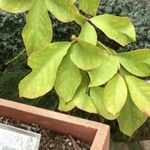
Aegle marmelos
Indian bael · మారేడు · Bael · Bengal-quince · Indian baelfruit
Description
Source: leafsnapAegle marmelos, commonly known as the Bael fruit tree, is a deciduous plant native to India and Southeast Asia. It belongs to the Rutaceae family and can grow up to 15 meters tall. The tree features a straight trunk with thorny branches and clusters of fragrant white flowers. Bael fruit is widely used in traditional medicine due to its numerous health benefits. It is rich in vitamins A, C, and B-complex, as well as minerals such as calcium, potassium, iron, and phosphorus. The fruit has been used for centuries for its anti-inflammatory properties, which help treat various ailments such as diarrhea, dysentery, and respiratory issues like asthma and bronchitis. The leaves of the Aegle marmelos plant are also valued for their medicinal properties, particularly their antibacterial effects, which help treat skin infections like eczema and psoriasis. Moreover, the wood of the Aegle marmelos tree is used to make furniture, while its bark is utilized in tanning leather. Overall, Aegle marmelos plays a significant role not only in traditional medicine but also in various other applications, making it an important part of Indian culture.
Care Guide
💧 Water Every 7 days
Bael fruit thrives in dry climates with minimal rainfall and is highly drought-tolerant. Once the plant is established, it only needs to be watered every two weeks. Its waxy leaves help reduce water loss, making it an excellent choice for xeriscaping and arid gardens.
What's the best way to water my Bael fruit?
To promote excellent root development for your plants, consider placing a garden hose at the base of each plant. Avoid spraying water directly onto the leaves, especially if the plants are outdoors and exposed to direct sunlight. Instead, focus on watering the roots by using bubblers or soaker hoses. If you need to add or remove plants, use soaker hoses that can cover the entire garden or bed to ensure the roots are well-moistened. After watering, make sure to drain any excess water and allow the soil to dry before watering again. To prevent diseases, it is best to water at ground level rather than spraying the leaves. On a sunny day, it can be beneficial to spray the entire bush with water. Whether your plants are potted or in the ground, it's important to remember that Bael fruit prefers deep watering instead of light sprinkling.
What should I do if I give too much or too little water to Bael fruit?
When a Bael fruit is overwatered, its leaves will turn yellow, drop off, and wilt. The plant will look dull with mushy stems. If you notice these signs, try adjusting your watering schedule. However, wilting can also be a sign of under watering. Underwatered leaves will turn crispy and dry, while overwatered leaves will be soft and wilted. If the soil is dry and watering alone is not enough, give the plant a thorough watering. This will help the Bael fruit recover, but the plant may still have dry and yellow leaves due to damage to the root system. Once the plant has returned to normal, the yellowing of the leaves will stop. When growing Bael fruit indoors, always check the moisture levels in the pot and avoid overwatering. Look for signs of black spots, and if present, allow the soil to dry out for a few days before watering again. Overwatering can lead to root rot, so if you see discolored and slimy roots, consider transferring the plant to a different pot. Preventing root rot is important, so avoid letting the soil become too soggy. When planting Bael fruit outdoors, make sure to dig a little deeper. If you find that the soil is too dry when checking with your fingers, it may indicate underwatering. Provide adequate watering to help the plant recover.
How frequently do I need to water my Bael fruit?
The Bael fruit prefers deep and infrequent watering. If you have them planted in pots, it's best to soak them in a gallon of water each time. The soil in pots dries out quickly, so they need to be watered every 3 to 5 days in colder regions. It's ideal to water them early in the morning when the soil is dry, whether they are indoors or outdoors. You can check if watering is needed by examining the moisture of the soil. When the top 2-3 inches of soil is dry, give the plant a thorough watering. On hot days, it's important to check the moisture level daily as the heat can dry out the pot soil rapidly. If you have a garden, irrigation of the soil is also necessary. In hot climates, watering once a week is usually sufficient. Only water when you notice that the top 2 to 3 inches of soil become too dry, both indoors and outdoors. Be mindful of the amount of natural rainfall the plant receives and avoid adding more water to prevent root rot. If there is ample rainfall, additional watering may not be needed. Bael fruit typically grows during spring and fall. When planted outdoors, it's advisable to add a layer of mulch about 3 to 4 inches deep to conserve water. The watering frequency should be increased in sandy soil as it drains faster. For clay soil, the frequency should be reduced, allowing the plant to dry out for 2-3 days to avoid root rot. To keep track of watering, mark the date on a calendar every time you water the plants. If you notice the leaves starting to droop, it may be a sign that you're a day late in watering.
How much water should I give my Bael fruit?
The Bael fruit needs about a gallon of water on a regular schedule. For potted plants, water them deeply until you see water dripping from the bottom of the pot. Wait for the soil to dry before watering again. You can use a water calculator or moisture meter to track how much water you give to your plant each week. During the flowering period, provide plenty of water but let the moisture evaporate to avoid root rot. If the Bael fruit is planted outdoors with sufficient rainfall, it may not need extra watering. When the Bael fruit is young or newly planted, make sure it receives 1-2 inches of rain per week. As it grows, it can rely solely on rainfall. Only during extremely hot weather or if there is no rain for 2-3 weeks, consider watering the Bael fruit fully during cooler times of the day to prevent heat damage. Additional watering will be necessary during prolonged dry spells.
What should I watch out for when watering my Bael fruit in different seasons, climates, or as it grows?
When planting Bael fruit in the ground, it relies mostly on rain. However, if there is no rainfall for 2-3 weeks, you should consider deep watering the plants. In the summer, it's best to water Bael fruit in the morning to avoid stressing the roots with a large temperature difference between the water and the root system. Avoid watering the bushes when it's too hot outside. Start mulching in the spring when the ground is not too cold. The age of the plants is important, as newly planted ones often fail to grow due to lack of water. Once they are established, reduce watering. During fall and winter, especially if there's water-retaining material in the soil, water them less to prevent drying out from dry winds. Windy seasons require more watering. Plants in pots dry out faster and need more watering. Look out for blooming less and drying leaves as signs that they need water. Watering potted plants can be complex and varies in frequency. Avoid having the pots sit in water and avoid containers with saucers, bowls, or trays. Overwatering in the fall can cause mottled or yellowish foliage. Prevent overwatering regardless of the climate or season. Increase watering frequency when Bael fruit begins to flower, but once they are fully grown, give them a rest. Water them every 3 to 5 days, checking soil dryness with your finger or a moisture meter. Be cautious not to overwater or underwater as it can lead to root rot and plant death.
☀️ Light Full sun
Bael fruit prospers in places with abundant sunlight, which it needs for the photosynthesis process. Its origin in sunny environments has given it the capacity to fulfill its growth requirements under intense solar exposure. Irregular or reduced light can obstruct its normal development and may damage its health.
What are the sunlight requirements for Bael fruit?
The Bael fruit requires above 6 hours of sunlight daily for optimal growth, thriving best in environments with full sun exposure. Its success in sunny habitats showcases its need for significant solar exposure to meet its growth needs. Minimal or inconsistent sunlight may hinder its development and overall health. It's crucial to observe the movement of sunlight through your garden to find spots that offer the right balance of light and shade, ensuring the well-being of your plants.
How does artificial lighting support Bael fruit growth indoors?
Indoor Bael fruit plants benefit significantly from artificial lighting, especially when natural sunlight is insufficient, like during winter or in less sunny locations. Artificial lights, particularly LED lights, can be customized to provide specific wavelengths needed by plants, promoting healthier and faster growth. For full sun plants, a range of 30-50W per square foot is recommended, while partial sun plants require 20-30W per square foot, and full shade plants need 10-20W per square foot. The lights should be placed 12-36 inches above the plant to mimic natural sunlight, and most plants will need 8-12 hours of light per day.
What are the symptoms of light deficiency in Bael fruit plants?
Light deficiency in Bael fruit plants manifests as smaller new leaves, leggy or sparse growth, faster leaf drop, slower or halted growth, and leaves that may appear lighter in color or exhibit chlorosis (yellowing). Other symptoms include sunscald, leaf curling, wilting, and leaf scorching, each indicating inadequate sunlight which affects the plant's ability to photosynthesize and maintain its health.
What solutions can correct light deficiency in Bael fruit plants?
To address light deficiency for indoor Bael fruit plants, gradually moving them to sunnier spots each week until they receive at least 6 hours of sunlight daily is recommended. Utilizing a south-facing window and keeping curtains open during the day or employing artificial lighting like desk lamps or professional grow lights can ensure adequate light exposure. For outdoor plants, a careful transition to sunnier locations is crucial to avoid sunburn. Pruning or transplanting may be necessary to minimize obstructions and allow for better sunlight access. It's important to note that while parts of the plant damaged by insufficient light may not recover, new growth should be healthier following these adjustments.
🌡️ Temperature 20–37.8°C
Bael fruit comes from regions with preferred temperatures between 68 and 100.4 °F (20 to 38 ℃). It favors warmer climates. As seasons change, slight modifications to its care may be necessary to satisfy its temperature requirements.
What are the ideal temperature conditions for growing Bael fruit?
Bael fruit thrives in environments that favor temperatures ranging from 68 to 100.4 °F (20 to 38 °C), showing a preference for warmer climates. It is an extremely heat-loving plant, and exposure to cold temperatures can be harmful. During the colder months, particularly in autumn, it is advised to bring outdoor-grown Bael fruit plants indoors, placing them near a bright window while avoiding proximity to heaters. It's crucial to maintain temperatures above 20°C during winter to facilitate growth, as temperatures approaching 0°C can be detrimental to the plant.
How should I care for Bael fruit in low temperatures?
Bael fruit prefers warm temperatures and does not tolerate cold well. It is essential to keep the plant in temperatures above 20°C, especially during winter, ensuring it remains above 0°C. Exposure to temperatures below -5°C may result in leaves lightening in color, with frost damage causing the leaves to turn brown or black and exhibit symptoms like wilting and drooping. In such instances, trim off the frost-damaged parts and move the plant to a warmer indoor environment as soon as possible. Placing the plant near a south-facing window can ensure ample sunlight while avoiding placing it near heaters or air conditioning vents to prevent air dryness.
What steps should be taken if Bael fruit experiences high temperatures?
In the summer, Bael fruit should be maintained at temperatures below 38°C to prevent heat stress. Exposure to temperatures above 43°C can lighten the color of the leaves and make the plant more susceptible to sunburn. If sunburn occurs, it is advisable to trim away the sunburned and dried-up parts of the plant and relocate it to a spot that provides shelter from the intense midday and afternoon sun. To further aid the plant during high temperatures, water it in the mornings and evenings to keep the soil consistently moist and cool.
💨 Humidity normal (40-60%)
This plant will thrive in moderate humidity, which is probably the level in your home. However, misting it a few times a week can be very beneficial. Make sure the room has good ventilation.
🪴 Soil 6-8
🌱 Fertilizer
Prefer organic fertilizers (e.g., fish emulsion, compost) instead of chemical fertilizers for Bael fruit. Give young plants increased nitrogen and phosphorus during spring. Incorporate compost or fertilizer into the soil before or after planting. For mature plants, apply a balanced fertilizer or one aimed at specific deficiencies in spring. Nutrient deficiency results in small leaves, short branches, yellow or bronze leaves, acidic fruits, premature fruit drop, and splitting.
Why should I use fertilizer on my Bael fruit?
Regular fertilization is essential for Bael fruit because their showy leaves require a significant amount of energy to both produce and maintain. Not only do these leaves require energy, but the fruit also needs enough energy to support the growth of its stems, branches, and roots. Neglecting fertilization can result in two likely outcomes. Firstly, the leaves will lose their natural color and texture, giving them an unhealthy appearance that diminishes their ornamental appeal. Secondly, the overall growth of the Bael fruit may slow down or produce weak growth that is susceptible to breakage.
When should I put fertilizer on my Bael fruit?
Bael fruit plants don't require a strict feeding schedule, but they do benefit from occasional feedings. One simple way to fertilize them is to apply fertilizer while watering the plant on occasion. It's also important to provide a good amount of water during the growing season. Feeding the plant every two to three weeks should be sufficient, consistently throughout its period of new growth.
When is it not a good idea to put fertilizer on my Bael fruit?
For most of the year, you can stick to a regular fertilization schedule for your Bael fruit. This includes the active growing season of spring, summer, and early fall. However, in the winter, refrain from giving your plant any fertilizer. During this time, the Bael fruit enters a dormant phase with little to no new growth. Since the plant isn't using much energy during this period, fertilization is unnecessary.
What kind of fertilizer should I use for my Bael fruit?
To help your Bael fruit grow, you need a fertilizer with specific nutrients in low amounts. The best fertilizer has a ratio of 3 parts nitrogen (N), 1 part phosphorus (P), and 2 parts potassium (K). However, a general-purpose fertilizer with a balanced blend can also work. Regardless of the fertilizer type, the ratio number for each nutrient should be 3 or lower. You can choose between granular or liquid fertilizer. For liquid fertilizers, it's best to dilute the strength by half. Granular fertilizer is generally fine, but liquid fertilizer is more practical, especially if you water your Bael fruit at the same time.
How can I make my Bael fruit grow better?
One easy way to fertilize a Bael fruit is to feed it whenever you water it. To do this, get your fertilizer and a watering can. Mix the fertilizer with water to make it weaker. Then, pour this water-fertilizer mixture onto the soil near the roots of the Bael fruit. Let it soak in. Another option is to use granular fertilizer. To do this, sprinkle the granular fertilizer on the soil where the Bael fruit is growing. Granular fertilizers release nutrients slowly, so you won't have to fertilize as often as with liquid fertilizer. Remember to water the Bael fruit when you fertilize it, in either case.
🪴 Pot & Repot Every 12 months
✂️ Pruning
To promote the health and productivity of bael fruit trees, it's best to prune them in late winter. This involves removing dead branches, thinning the tree to improve airflow, and shaping it for balance. By doing this, you minimize sap loss and encourage robust spring growth, which improves fruit quality and reduces the risk of pests. Always use clean, sharp tools to prevent disease.
🌿 Propagating
🐛 Diseases & pets
☠️ Toxicity
Characteristics
- Plant Type
- Tree
- Life Cycle
- Perennial
- Genus
- Aegle
- Family
- Rutaceae
- Hardiness Zone
- 9-11
- Mature Height
- 13.11 m
- Mature Spread
- 4.88 m
- Leaf Color
- Green
- Leaf Type
- Deciduous
- Flower Color
- White
- Flower Size
- 1.52 cm to 2.03 cm
- Bloom Time
- Late spring, Early summer, Mid summer
- Planting Time
- Spring, Summer, Autumn, Winter
- Harvest Time
- Late summer, Fall
- Native Area
- Nepal, Sri Lanka, India, Cambodia, Vietnam, Myanmar, Bangladesh, Pakistan, Laos, Thailand