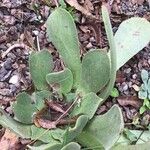
Aeonium canariense
Canary Islands aeonium · Velvet rose · Canary aeonium · Gollum Jade · Cabbage Patch
Description
Source: leafsnapAeonium canariense is a succulent native to the Canary Islands, belonging to the Crassulaceae family. Commonly known as the Canary Island Aeonium, this plant features a rosette-like growth habit, with thick, fleshy leaves arranged in a spiral pattern around its stem. The green leaves are edged in red, with the red becoming more pronounced when exposed to sunlight. Typically, Aeonium canariense grows up to 60 cm tall and 50 cm wide, making it ideal for container gardening or as an accent in rock gardens or dry landscapes. It prefers well-draining soil and full sun exposure but can tolerate partial shade. This succulent produces small yellow flowers on tall stalks during late winter or early spring. Post-flowering, it may produce offsets at its base, which can be easily propagated through stem cuttings. Known for its drought tolerance and low maintenance requirements, Aeonium canariense is an excellent choice for novice gardeners seeking easy-to-care-for plants with unique foliage. Its striking appearance also makes it a popular choice among collectors of rare plants worldwide.
Care Guide
💧 Water Every 7 days
The Canary aeonium is well-suited for subtropical climates, thriving with minimal watering—just once every three weeks. It prefers sunny outdoor conditions and needs well-draining soil to prevent root rot and maintain healthy moisture levels. Its fleshy leaves highlight its adaptation to dry environments.
☀️ Light Partial sun
Canary aeonium comes from habitats with dappled light, such as the understory of forests or rocky areas that provide natural shade. It favors partial sun but can also tolerate full sun.
🌡️ Temperature 20–37.8°C
Canary aeonium originates from climates where temperatures range from 68 to 100 °F (20 to 38 ℃). It prefers moderate to high warmth. In colder seasons, keep temperatures no lower than 68 °F (20 ℃) for optimal growth.
💨 Humidity
🪴 Soil 6-7
🌱 Fertilizer
For Canary aeonium, light applications of fertilizer 1-2 times a year during the growing season are sufficient. Avoid fertilizing in winter and in summer when the plant is dormant. Reduce fertilizer for repotted plants and wait a couple of months after repotting before fertilizing. Fertilizing supports healthy growth and encourages blooms.
🪴 Pot & Repot Every 2 years
Repot the canary aeonium every two years in the spring, using a container that is one size larger. Place it in bright, indirect light and water it sparingly, allowing the top layer of soil to dry out between waterings. Be cautious of overwatering, as the plant can be sensitive to it. This practice will help ensure a healthy recovery and growth.
✂️ Pruning
To keep your canary aeonium in good shape, regular pruning is essential, especially in the spring and fall to remove excess branches. If you want to propagate the plant, start by cutting a sturdy stem with 5-6 leaves. Apply sulfur powder to the cut end, and after it has healed, plant the stem in slightly moist soil.
🌿 Propagating
🐛 Diseases & pets
☠️ Toxicity
Characteristics
- Plant Type
- Succulent
- Life Cycle
- Perennial
- Genus
- Aeonium
- Family
- Crassulaceae
- Hardiness Zone
- 9-11
- Mature Height
- 49 cm
- Mature Spread
- 91 cm
- Leaf Color
- Green, Red
- Leaf Type
- Evergreen
- Flower Color
- Yellow
- Flower Size
- 1.02 cm to 2.03 cm
- Bloom Time
- Mid spring, Late spring
- Planting Time
- Spring, Summer, Autumn
- Harvest Time
- Early summer, Mid summer