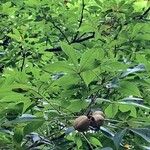
Aesculus glabra
Ohio buckeye · Yellow Buckeye · Buckeye · Texas Buckeye · American Buckeye
Description
Source: leafsnapAesculus glabra, commonly known as Ohio buckeye, is a species of tree in the soapberry family (Sapindaceae) native to North America. Its natural range is primarily in the Midwestern and lower Great Plains regions of the United States, extending southeast into the geological Black Belt of Alabama and Mississippi. It is also found locally in the extreme southwest of Ontario, on Walpole Island in Lake St. Clair.It is found in a variety of natural habitats, including streambanks, upland mesic forests, and along the margins of old fields. It is typically found in calcareous areas.
🌳 Apart from its conspicuous presence in forests, the Ohio buckeye has an interesting application in the textile industry. Tannins drawn from its bark have been used to treat denim, giving popular blue jeans a distinctive leather-like feel and illustrating a fusion of natural resources and fashion.
🎭 Good fortune, consistency
Care Guide
💧 Water Every 1-2 weeks
Adapted to temperate climates, the Ohio buckeye thrives in moderate moisture and well-drained soils. It typically requires watering every 1-2 weeks. This plant is well-suited for outdoor environments and enters dormancy during the colder months, during which its water needs decrease significantly.
How should I water my Ohio buckeye tree?
To ensure excellent root development, consider placing a garden hose at the base of your plants. To avoid any issues, refrain from directly spraying the leaves. If your plants are located outdoors and exposed to direct sunlight, it's important to note that the leaves will require more water. One option to moisten the roots is to use bubblers that can be placed on each plant. Additionally, when adding or removing plants, you can use soaker hoses that cover the entire garden or bed to encourage deep root growth. After watering, make sure to remove any excess water and allow the soil to dry before watering again. To prevent diseases, it's best to water at ground level. On a sunny day, spraying the entire bush with water may be beneficial. It's worth mentioning that whether your plants are in pots or in the ground, Ohio buckeye plants prefer deep watering rather than light sprinkling.
What should I do if I give too much water or too little water to an Ohio buckeye?
An overwatered Ohio buckeye will display certain signs such as yellowing, dropping off, and wilting leaves, as well as a dull and unhealthy appearance with mushy stems. Adjusting your watering schedule is crucial when these signs begin to show. On the other hand, wilting can also indicate under watering, with leaves turning crispy and dry. In such cases, check the soil and provide a thorough watering when it is dry. While sufficient water will help the Ohio buckeye recover, the plant may still exhibit dryness and yellowing leaves due to damage to the root system. Once the plant returns to normal, the yellowing will cease. When caring for an Ohio buckeye indoors, always monitor moisture levels and avoid overwatering, looking out for any black spots. If present, allow the soil to dry by refraining from watering for a few days. Overwatering can cause root rot, which may require transferring the plant to a new pot if discolored and slimy roots are seen. Therefore, it is important to prevent root rot by avoiding overly soggy soil. When planting the Ohio buckeye outdoors, dig a bit deeper and check the soil for dryness with your fingers. If it is too dry, the plant may be underwatered and requires adequate watering to facilitate recovery.
How many times should I give water to my Ohio buckeye tree?
The Ohio buckeye prefers deep and infrequent watering, especially when planted in pots. Potted plants have limited water storage, so they dry out faster and require watering every 3 to 5 days in cold regions. It's best to water in the morning when the soil is dry, both indoors and outdoors. You can check if watering is necessary by feeling the top 2-3 inches of soil - if it's dry, it's time to water. On hot days, check the moisture daily as the heat can quickly dry out the soil in pots. If you have a garden, watering is also necessary, especially in hot climates where once a week is recommended. Only water when about 2 to 3 inches of soil become too dry, and consider the amount of rainfall to avoid overwatering and root rot. During the growing seasons (spring and fall), adding mulch 3 to 4 inches deep can help conserve water when the plants are outdoors. Sandy soil tends to drain faster, so watering should be more frequent, while clay soil requires less frequent watering to avoid root rot. It can be helpful to mark the watering dates on a calendar and observe if the leaves start to droop, which may indicate a need for watering.
How much water does my Ohio buckeye tree need?
The Ohio buckeye has specific watering needs. For potted plants, water them deeply until you see water dripping from the bottom of the pot. Wait for the soil to dry before watering again. You can use a water calculator or moisture meter to determine how much water your plant receives in a week. During the flowering period, provide plenty of water but allow the moisture to evaporate to prevent root rot. If the Ohio buckeye is planted outdoors and there is enough rainfall, it may not need additional watering. However, when the Ohio buckeye is young or newly planted, it should receive 1-2 inches of rain per week. As the Ohio buckeye grows, it can rely on rainfall alone. Only in hot weather or if there is no rainfall for 2-3 weeks, should you consider giving the plant a full watering during the cooler times of the day to prevent heat damage. Additional watering will be necessary during extended dry periods.
Do I need to change how often I water my Ohio buckeye tree depending on the time of year or the weather?
The Ohio buckeye requires outdoor conditions with rain, but may need watering during persistent dry weather. In the spring and fall, the soil should be kept moist but not soggy, with alternating dry and moist conditions being beneficial. In the summer, hot weather can cause water to evaporate quickly, so additional watering is necessary if there is a lack of rain. During winter, the Ohio buckeye needs less water as it goes dormant. Well-draining soil, such as terracotta, can aid in water evaporation. Once the Ohio buckeye begins to leaf out and go dormant, you can skip watering and rely on fall and winter rains. To encourage growth and bloom, cultivate the Ohio buckeye after spring when temperatures warm up. Good drainage is essential, especially in winter, to prevent ponding. When potted, the Ohio buckeye has limited root growth, so it should be well-watered, especially in summer. Deep soaking the entire root system once or twice a week is recommended, avoiding shallow sprinkles that can encourage fungi growth. During fall and winter, do not allow the Ohio buckeye to dry out completely. Avoid overwatering to prevent waterlogging, which can be detrimental in winter. Applying mulch can help reduce stress, conserve water, and promote healthy blooms.
☀️ Light Full sun
The Ohio buckeye does best in full sun, though it can tolerate areas of shade. Plenty of sunlight is important for its healthy development. Too little sun can cause poor growth, while too much sun may cause some leaf scorch.
What are the sunlight requirements for a plant?
Plants have different sunlight needs, categorized as full sun or partial sun. Full sun means a plant needs more than 6 hours of direct sunlight each day, while partial sun refers to about 3-6 hours of sunlight daily. It's important to observe the patterns of sunlight in your garden to ensure you place your plants in spots that have the ideal balance of light and shade, to promote their wellbeing.
How does sunlight affect the growth of the Ohio Buckeye?
The Ohio Buckeye thrives best with full exposure to sunlight, though it can tolerate some shade. Adequate sunlight is crucial for its health and growth; too little sun might result in poor growth, and too much can cause leaf scorch. In locations where natural light is limited, especially during winter or for indoor plants, artificial lighting can be used to fulfill the plant’s light requirements, promoting healthier growth. Various types of artificial lights, like LED, can be adjusted according to the plant's needs, with specific wattage per square foot based on whether the plant is classified for full sun, partial sun, or full shade.
What symptoms indicate the Ohio Buckeye is receiving inadequate light?
When the Ohio Buckeye doesn't get enough light, it may show a range of symptoms. These can include smaller new leaves, leggy or sparse growth, earlier leaf drop, halted new growth, paler new leaves, chlorosis, and symptoms of overexposure like sunscald, leaf curling, wilting, and leaf scorching. These signs suggest that the plant is struggling with the light conditions, either too much or too little, affecting its ability to grow and remain healthy.
What solutions are available for Ohio Buckeye plants that aren't getting enough light?
For indoor Ohio Buckeye plants not receiving enough light, gradually moving them to sunnier spots until they get at least 6 hours of direct sunlight is recommended, alongside using artificial lights for large plants or those in less sunny locations. For outdoor plants, adjusting their location to ensure they get adequate sunlight without sudden changes is crucial to prevent sunburn. Minimizing obstructions to sunlight and transplanting smaller plants during their dormant period to more sunlit areas can also help. While parts of the plant already affected by light deficiency may not recover, ensuring proper light exposure moving forward can promote healthy new growth.
🌡️ Temperature 15–35°C
The ohio buckeye is native to Ohio and grows well in a range of temperatures from 15 ℉ (-9.4 ℃) to 35 ℉ (1.7 ℃). It prefers warmer temperatures, however, and can withstand heat up to 90 ℉ (32.2 ℃). In the summer, it is best to give the ohio buckeye some shade to prevent heat stress. In the winter, it is important to protect the plant from freezing temperatures by providing adequate insulation or by moving it indoors if necessary.
What are the essential care tips for an Ohio buckeye?
The Ohio buckeye is native to Ohio and thrives in temperatures ranging from 15°F (-9.4°C) to 359°F (1.7°C), preferring warmer conditions but able to withstand heat up to 90°F (32.2°C). During summer, it benefits from some shade to prevent heat stress, while in winter, it should be protected from freezing temperatures by insulation or moving indoors, if necessary. Ohio buckeye has strong cold resistance, so specific frost protection measures are not typically needed. However, if winter temperatures are expected to drop significantly, wrapping the trunk and branches with materials like non-woven fabric can offer protection. It is also advisable to water the plant abundantly before the first freeze in autumn to maintain soil moisture, which helps prevent drought and water scarcity during winter and early spring.
How does low temperature affect the Ohio buckeye and what are the solutions?
Ohio buckeye is cold-tolerant and shows optimal growth when the temperature is maintained above a certain minimum suitable for its growth. It should be kept above a certain minimum tolerable growing temperature during winter. If the temperature falls below its growth limit, the plant may not show immediate changes in winter, but by spring, its branches may become brittle and dry, and fail to produce new shoots. To address this, prune away any dead branches that have not produced new leaves in the spring.
What should be done if an Ohio buckeye experiences high temperatures?
In the summer, it's important to keep the Ohio buckeye below a certain maximum suitable growth temperature. Exceeding a tolerable growing temperature can cause the leaves to lighten in color, tips to become dry and withered, and increase susceptibility to sunburn. To mitigate these issues, trim away any sunburned and dried parts. Relocating the plant to provide shade during midday and afternoon sun, or using a shade cloth, can help, as well as watering the plant in the morning and evening to maintain soil moisture.
💨 Humidity
🪴 Soil 6-7
🌱 Fertilizer
Fertilize your Ohio buckeye in early spring to encourage healthy growth. Regular feeding boosts its overall health, leading to vigorous growth, greater tolerance of harsh conditions, and improved resistance to pests and diseases. Keep a steady fertilization schedule for your Ohio buckeye to maintain vibrant, deeply colored, and lush foliage.
Why do I have to put fertilizer on my Ohio buckeye plant?
No matter which type of Ohio buckeye you have, fertilizing regularly will improve the plant's overall health. Providing the right nutrients allows for stronger growth and increases the plant's ability to withstand difficult growing conditions, as well as fight off diseases and pests. Since the foliage is one of the most appealing aspects of an Ohio buckeye, it is important to maintain its integrity. This can be done by following a consistent fertilization schedule that caters specifically to your Ohio buckeye. By doing so, you will encourage the development of vibrant, lush leaves.
When should I fertilize my Ohio buckeye tree?
To ensure healthy growth for your Ohio buckeye, it is recommended to fertilize it in late winter or early spring. This provides the necessary nutrients for the tree to resume healthy growth once the weather warms up. Additionally, if you live in a warm climate region, it is beneficial to provide an extra fertilizer feeding in early fall. This not only adds nutrients to the soil for the following growing season, but also helps the tree withstand the cold winter without foliage damage. Fertilizing earlier in the fall allows the new branches to grow enough to endure the winter cold.
When is not a good time to fertilize my Ohio buckeye tree?
There are a few times during the year when you should avoid fertilizing your Ohio buckeye. Firstly, during the early and mid-winter months, when the tree is dormant and doesn't need any feeding. Secondly, it's not recommended to fertilize it during late spring and summer because the weather is hotter and drier, which can result in a negative response to fertilization. To prevent these issues, it's better to stick to a fertilization schedule of early spring and early fall only.
What kind of fertilizer does my Ohio buckeye tree need?
The most important nutrient for an Ohio buckeye is typically nitrogen, but this doesn't mean that phosphorus and potassium are not important. In fact, your Ohio buckeye needs a decent amount of all three nutrients, which is why a balanced fertilizer like a 10-10-10 can be effective. However, a more nuanced ratio of nutrients often promotes optimal growth for an Ohio buckeye. Fertilizers with slightly higher nitrogen content, such as a ratio of 10-6-4, tend to work well. When fertilizing, you have the option of using granular or liquid-based fertilizer.
How should I fertilize my Ohio buckeye tree?
To fertilize your Ohio buckeye, you have two options: granular fertilizer or liquid fertilizer. If you choose granular fertilizer, simply sprinkle it on the soil at the right time. This type of fertilizer releases nutrients slowly, providing long-lasting nourishment to your buckeye. Before applying granular fertilizer, it's recommended to lightly water your Ohio buckeye. Alternatively, you can use liquid fertilizer, although this is less common. To do so, mix the fertilizer with water and pour the mixture around the base of your buckeye. If you're uncertain about the soil's pH level, it's beneficial to perform a soil test before fertilizing. This will help you determine if any adjustments to the pH are necessary.
🪴 Pot & Repot Every 12 months
✂️ Pruning
The Ohio buckeye showcases clusters of yellow-green flowers and spiny fruit. To encourage healthy growth, prune the tree in early spring by removing dead branches and thinning crowded areas to improve air circulation. Be sure to make clean, angled cuts that prevent water from accumulating, which helps promote a strong structure and vibrant growth.
🌿 Propagating
🐛 Diseases & pets
☠️ Toxicity
Characteristics
- Plant Type
- Tree
- Life Cycle
- Perennial
- Genus
- Aesculus
- Family
- Sapindaceae
- Hardiness Zone
- 7-9
- Mature Height
- 14.94 m to 24.99 m
- Mature Spread
- 6.1 m to 11.89 m
- Leaf Color
- Green
- Leaf Type
- Deciduous
- Flower Color
- Yellow, Green, Orange
- Flower Size
- 2.03 cm to 3.05 cm
- Bloom Time
- Mid spring, Late spring
- Planting Time
- Spring
- Harvest Time
- Mid summer