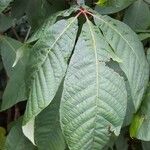
Aesculus parviflora
Bottlebrush buckeye · Shrubby pavia · Dwarf buckeye · Dwarf chestnut · Bottle-brush buckeye
Description
Source: leafsnapAesculus parviflora, commonly known as the bottlebrush buckeye, is a deciduous shrub native to the southeastern United States. It typically grows to a height of 8-12 feet and expands to form a dense thicket. The plant is notable for its large, showy white flowers that bloom in mid-summer, resembling bottlebrushes. The leaves of Aesculus parviflora are dark green and palmately compound, consisting of five leaflets. In the fall, these leaves turn yellow before dropping off for winter dormancy. The plant thrives in moist soils and partial shade, though it can tolerate full sun if provided with adequate water. Aesculus parviflora is an excellent choice for naturalizing areas or as an accent plant in woodland gardens or shady borders. Its nectar-rich flowers attract butterflies and other pollinators, yet its bitter taste makes it unappealing to deer. Overall, Aesculus parviflora is a beautiful, low-maintenance shrub that adds interest to any landscape with its unique blooms and foliage throughout the growing season.
🌳 Bottlebrush buckeye is valued for more than its visual appeal. Its dense clusters of flowers provide nectar for pollinators, supporting local ecosystem services. Additionally, its ability to grow in shaded areas makes it a good option for reforestation efforts and shaded landscape remodeling, presenting a way to enhance the environment and support biodiversity.
🎭 Best of luck
Care Guide
💧 Water Every 7 days
The Bottlebrush Buckeye, a plant native to the southeastern United States, thrives in moist, well-drained soils and needs regular watering every 1-2 weeks. It is well-suited for outdoor cultivation, and mulching is recommended to help retain moisture, especially during its active growing season.
☀️ Light Full sun
The bottlebrush buckeye's vigorous growth needs ample sunlight, although it also tolerates fewer hours of sun fairly well. Its native habitats were open areas with abundant sunlight. Both too little and too much light can impair its growth, respectively stunting its lush foliage or causing leaf scorch.
What are the sunlight requirements for plants?
Plants generally require different amounts of sunlight, categorized into full sun and partial sun. Full sun entails more than 6 hours of sunlight daily, while partial sun refers to about 3-6 hours of sunlight. It's crucial to observe how sunlight moves through your garden to place your plants in ideal spots that offer a suitable mix of light and shade, ensuring they thrive.
What are the essentials for growing Bottlebrush buckeye?
The Bottlebrush buckeye, due to its vigorous growth, needs ample sunlight, which aligns with its origins in open landscapes bathed in sun. Despite its resilience to lower sun exposure, the right balance is vital; too little or too much can stunt growth or cause leaf scorch, respectively. In environments lacking natural light, artificial lighting can support growth, with LED lights being a popular choice for providing specific light wavelengths. Full sun plants need 30-50W per square foot, partial sun plants 20-30W per square foot, and shade plants 10-20W per square foot of artificial light, positioned 12-36 inches above the plant for 8-12 hours per day.
What are the symptoms of inadequate light exposure in Bottlebrush buckeye?
Bottlebrush buckeye shows several signs when suffering from insufficient light, including smaller new leaves, leggy growth, premature leaf drop, halted growth, and paler leaves signifying a lack of chlorophyll. Excessive sunlight can also cause issues, such as chlorosis (leaves turning yellow), sunscald (damaged plant tissue), leaf curling (a defense mechanism against water loss), wilting (loss of turgor pressure), and leaf scorching (browned, dry leaf edges), all of which impact the plant's health and photosynthesis ability.
How can I solve lighting issues for indoor and outdoor Bottlebrush buckeye plants?
To address lighting problems, gradually acclimate plants to more sunlight, aiming for at least 6 hours daily. Indoors, utilize south-facing windows or artificial lights, like desks or professional grow lights, for at least 8 hours daily. Outdoors, avoid sudden exposure shifts to prevent sunburn. If sunlight is blocked, consider pruning obstructions or transplanting to sunnier locations. Note that parts affected by inadequate light may not recover, but new growth will be healthy after adjusting light exposure.
🌡️ Temperature 5–35°C
Bottlebrush buckeye is commonly found in its native habitat, which has a temperature range of 5 to 35 ℃ (41 to 95 ℉). These plants prefer cooler conditions and can tolerate mild frosts. During hot summer months they favor partial shade, though with proper watering they can withstand full sun exposure. In cooler seasons, regular watering and fertilization help maintain their health and encourage strong growth.
What is the native growth environment of bottlebrush buckeye?
Bottlebrush buckeye is typically found in environments with a temperature range of 5 to 35°C (41 to 95°F). These plants do well in cooler conditions and can tolerate mild frosts. During hot summer months, partial shade is preferred, although they can handle full sun exposure if they are properly watered. When the temperature drops in cooler seasons, maintaining health and promoting growth can be achieved through regular watering and fertilization. Bottlebrush buckeye has strong cold resistance, and special frost protection measures are usually not necessary, although attention is needed if winter temperatures are expected to drop below its tolerance levels.
How should you protect bottlebrush buckeye in winter?
Despite its strong cold resistance, if winter temperatures are expected to fall below the plant's growth temperature limit, it's important to provide additional cold protection. This can be done by enveloping the trunk and branches with non-woven fabric or cloth. Also, it's advisable to water the plant abundantly before the first freeze in autumn to ensure the soil is moist and enters a frozen state. This helps prevent the plant from experiencing drought and water scarcity during the winter and early spring.
What are the symptoms and solutions for bottlebrush buckeye experiencing low temperatures?
When the temperature drops below bottlebrush buckeye's tolerance level, there might not be visible changes during winter, but come spring, the branches may turn brittle and dry, and no new shoots will emerge. The solution to this issue is to prune away any dead branches that have not produced new leaves in the spring.
How does high temperature affect bottlebrush buckeye, and what are the solutions?
During the summer, if the temperature exceeds the plant's maximum tolerance level, the leaves may lighten in color, tips may become dry and withered, and the plant may become more susceptible to sunburn. To address these issues, trim away the sunburned and dried-up parts. Relocate the plant to an area that offers shade during the midday and afternoon sun or use a shade cloth to provide protection. Ensure the plant is watered in the morning and evening to keep the soil moist.
💨 Humidity
🪴 Soil 6-6
🌱 Fertilizer
Fertilize your Bottlebrush buckeye in early spring to encourage healthy growth. Regular feeding boosts its overall health, producing vigorous growth, increased resilience to harsh conditions, and improved resistance to diseases and pests. Keep a consistent fertilization schedule for your Bottlebrush buckeye to maintain vibrant, deeply colored foliage and a lush appearance.
🪴 Pot & Repot 2-3 years
When repotting Bottlebrush buckeye, select a pot 1-2 inches (2.5–5.1 cm) larger with ample drainage. Use a well-draining potting mix. Repot in spring or fall, ensuring the root ball sits slightly lower than the rim of the flower pot. Water thoroughly after repotting and place it in a warm spot with indirect sunlight.
✂️ Pruning
Bottlebrush buckeye is a deciduous shrub known for its distinctive white, bottlebrush-like flowers. To encourage healthy growth and blooming, it should be pruned in early spring. Start by removing any dead branches, and thin out overgrown areas to improve air circulation. Be careful to avoid heavy pruning, as this will help maintain the shrub's size and enhance its natural shape.
🌿 Propagating
🐛 Diseases & pets
☠️ Toxicity
Characteristics
- Plant Type
- Tree, Shrub
- Life Cycle
- Perennial
- Genus
- Aesculus
- Family
- Sapindaceae
- Hardiness Zone
- 4-9
- Mature Height
- 1.83 m to 3.05 m
- Mature Spread
- 2.44 m to 4.57 m
- Leaf Color
- Green, Yellow, Bronze
- Leaf Type
- Deciduous
- Flower Color
- White
- Flower Size
- 7.62 cm to 15.24 cm
- Bloom Time
- Mid summer
- Planting Time
- Spring, Autumn
- Harvest Time
- Mid summer, Late summer