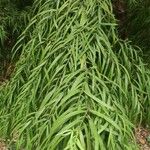
Afrocarpus gracilior
African fern-pine · East African yellowwood · East African yellow wood · Weeping podocarpus
Description
Source: leafsnapAfrocarpus gracilior, commonly known as the African fern pine, is a tall evergreen tree native to the highlands of East Africa. Belonging to the family Podocarpaceae, it can reach heights of up to 30 meters. The tree features a slender trunk, a conical crown, and dark green foliage that resembles fern fronds. The leaves of Afrocarpus gracilior are arranged in spirals along the branches and measure about 5-10 cm in length. They have a glossy texture with pointed tips and are slightly curved downwards. The bark is smooth and grayish-brown, marked with vertical fissures. This tree produces small cones that grow on separate male and female trees. Male cones are cylindrical, while female cones are oval with fleshy scales that turn red upon maturation. Afrocarpus gracilior thrives in well-drained soils rich in organic matter but can adapt to various soil types as long as they receive adequate moisture throughout the year. It grows best under full sun or partial shade, though it can also tolerate low-light conditions. Due to its attractive foliage and conical shape, Afrocarpus gracilior is commonly used for ornamental purposes. It is an excellent choice for landscaping projects in parks, gardens, and large estates, providing shade during hot summer months and adding aesthetic value year-round. Overall, Afrocarpus gracilior is a highly sought-after plant for gardeners worldwide, thanks to its unique appearance and practical benefits like shade during hot summer months. It makes a stunning and functional addition to any garden.
Care Guide
💧 Water Every 7 days
Native to the higher altitudes of Eastern Africa, the African fern pine thrives with moderate rainfall and generally prefers regular watering every one to two weeks. Although typically grown outdoors, it adapts well to temperate climates. During the growing season, natural rainwater often suffices, reducing the need for additional irrigation.
☀️ Light Full sun
African fern pine is native to open habitats, such as sunny meadows and forest margins, which provide abundant light. It thrives in Full Sun but can also tolerate Partial Sun, adjusting well to a range of light conditions.
🌡️ Temperature 20–37.8°C
African fern pine adapts well to temperature, tolerating higher heat and wide temperature fluctuations. In hot conditions, it's important to monitor watering and provide appropriate shade to prevent sunburn. However, it is relatively sensitive to low temperatures. While it can endure some cold, excessively low temperatures can result in frost damage.
What is the common name of Afrocarpus gracilior?
The common name of Afrocarpus gracilior is African fern pine.
What is the botanical name of the African fern pine?
The botanical name of the African fern pine is Afrocarpus gracilior.
💨 Humidity
🪴 Soil 6-8
🌱 Fertilizer
The African fern pine has specific nutrient needs and does not require heavy fertilization. Spring is the best time to apply fertilizer for optimal growth. Providing nutrients improves its health, increases resistance to pests and diseases, and helps sustain its long lifespan.
🪴 Pot & Repot Every 12 months
✂️ Pruning
The African fern pine is a versatile evergreen tree characterized by its fern-like foliage. To ensure healthy growth, it’s best to prune it during its dormant period, from early to late winter. Focus on removing dead branches and thinning out dense areas to improve air circulation. Always use clean, sharp tools to make precise cuts, which will help maintain the tree's shape and promote healthy growth.
🌿 Propagating
🐛 Diseases & pets
☠️ Toxicity
Characteristics
- Plant Type
- Tree
- Life Cycle
- Perennial
- Genus
- Afrocarpus
- Family
- Podocarpaceae
- Hardiness Zone
- 9-11
- Mature Height
- 9.14 m to 15.24 m
- Mature Spread
- 7.62 m to 10.36 m
- Leaf Color
- Blue, Green, Gray, Silver
- Leaf Type
- Evergreen
- Bloom Time
- Early spring, Mid spring
- Planting Time
- Winter, Spring
- Harvest Time
- Late summer, Early fall, Mid fall
- Native Area
- Burundi, Sudan, Rwanda, Ethiopia, Kenya, Congo (DRC), Uganda, Tanzania