Agave parviflora
Little princess agave · Santa Cruz Striped Agave · Smallflower century plant · Small flower agave · Small flower century plant
Description
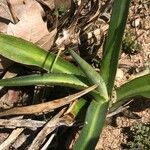
Source: leafsnapAgave parviflora is a species of succulent perennial flowering plant in the asparagus family, known by the common names Santa Cruz striped agave, smallflower century plant, and small-flower agave. It is native to Arizona in the United States and Sonora in Mexico.The specific epithet parviflora means "small-flowered".This agave produces a small rosette up to 25 cm (10 in) tall by 20 cm (8 in) wide. The succulent leaves are up to 20 cm (8 in) long and are a waxy dark green with white markings. The leaf margins have peeling fibers. The plant produces an inflorescence 1–2 m (3–7 ft)tall with cream or pale yellow flowers in summer. The flowers are pollinated by bees such as bumblebees.This species is the smallest agave in Arizona and is sought by collectors. For this reason the species has declined in its native habitat. There are only about two dozen natural populations in Arizona. Other threats to the species include road construction and mining. However, because the population appears to be stable and it grows in several protected areas, it is not considered by the IUCN to be threatened.The plant is valued in cultivation and has gained the Royal Horticultural Society's Award of Garden Merit.Subspecies of the plant include ssp. parviflora and ssp. densiflora.
Care Guide
💧 Water Once a week
The small flower century plant, native to arid regions, is highly drought-tolerant and needs very little moisture. It requires watering only once every three weeks. Being an evergreen, it maintains its foliage throughout the year and needs even less frequent watering during cooler months when evaporation decreases.
☀️ Light Full sun
Originating in arid areas, the Small flower century plant does best in full sun, as its native habitat has strong sunlight and little shade. It can also tolerate partial sun, giving it some flexibility in growth.
🌡️ Temperature 15–37.8°C
The small-flowered century plant does best in warm conditions and needs higher temperatures during the growing season to stimulate growth and metabolic activity. It prefers abundant sunlight, proper moisture levels, and good air circulation. However, it is vulnerable to damage from very low temperatures and from overwatering. Maintaining a balance is crucial; excessively high heat and overly dry conditions should also be avoided.
💨 Humidity dry (<40%)
This plant prefers dry conditions, so don't mist it. However, watering it less often can also thrive in higher humidity.
🪴 Soil 6-7
🌱 Fertilizer
For the small-flower century plant, light applications of fertilizer one to two times a year during the growing season are adequate. Avoid fertilizing in winter and in summer when it is dormant. Use less fertilizer on repotted plants and wait a couple of months after repotting before you start feeding. Fertilizing helps maintain healthy growth and promotes blooming.
🪴 Pot & Repot Every 12 months
✂️ Pruning
As new leaves emerge on the small flower century plant, the older leaves will begin to yellow and dry out. To maintain the plant's appearance, regularly remove these old leaves. Additionally, to protect the healthy foliage from infection, trim any leaves that show signs of pest infestation or disease.
🌿 Propagating
🐛 Diseases & pets
☠️ Toxicity
The Smallflower Century Plant is considered toxic to both plants and human beings. The toxic principle in it is the calcium oxylate raphides which causes extreme irritation to the skin, as well as gastrointestinal issues such as bloating, vomiting and diarrhea. Keep this plant out of reach of children and household pets and contact a veterinarian if anyone ingests the plant.
Characteristics
- Plant Type
- Succulent
- Life Cycle
- Perennial
- Genus
- Agave
- Family
- Asparagaceae
- Hardiness Zone
- 8-11
- Mature Height
- 20 cm
- Mature Spread
- 20 cm
- Leaf Color
- White, Green
- Leaf Type
- Evergreen
- Flower Color
- Yellow
- Flower Size
- 1.02 cm to 2.03 cm
- Bloom Time
- Early summer, Mid summer
- Planting Time
- Spring, Summer
- Harvest Time
- Late summer, Early fall, Mid fall
- Native Area
- North America, Central America, South America