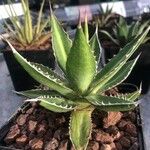
Agave univittata
McKelvey's century plant · Thorncrest century plant · Center-stripe agave · Thorn-crested century plant
Description
Source: leafsnapAgave univittata, the thorn-crested century plant or thorn-crested agave, is a plant species native to coastal areas of southern Texas and northeastern Mexico, at elevations less than 100 m (300 feet). It has been widely named Agave lophantha by botanists including Howard Scott Gentry, but the name A. univittata is older and therefore more in accord with nomenclatural rules of botany.Agave univittata has thick, fleshy leaves that are stiff and undulate (wavy) along the margins. It has sharp and prominent spines on the edges and tips of the leaves. Flowering stalk is up to 5 m (16 feet) tall, bearing greenish-white to yellow-ish green flowers.It is cultivated as an ornamental plant, and in the UK the cultivar 'Quadricolor' has won the Royal Horticultural Society's Award of Garden Merit.Because the species is widespread and the overall population is stable, it is not considered by the IUCN to be threatened.
Care Guide
💧 Water Every 14 days
McKelvey's century plant is well-suited for arid environments due to its high drought tolerance. It thrives in conditions of low rainfall and intense heat. Generally, it needs to be watered every three weeks, but during the growing season, its water requirements increase because of heightened metabolic activity.
☀️ Light Full sun
Native to dry areas, Mckelvey's century plant does best in full sun, its native habitat marked by intense sunlight and little shade. It will also tolerate partial sun, giving it some flexibility in how it grows.
🌡️ Temperature 15–37.8°C
Mckelvey's century plant does best in warm conditions and needs relatively high temperatures during the growing season to support growth and metabolic activity. It prefers plenty of sunlight, suitable moisture levels, and good air circulation. However, it can be damaged by very low temperatures and by overwatering. It is therefore important to maintain a balance and avoid both excessively high heat and overly dry conditions.
💨 Humidity dry (<40%)
This plant prefers dry conditions, so don't mist it. However, watering it less often can also thrive in higher humidity.
🪴 Soil 0-0
🌱 Fertilizer Every 60 days
For Mckelvey's century plant, small amounts of fertilizer applied one to two times a year during the growing season are adequate. Avoid fertilizing in winter or summer when the plant is dormant. Cut back on fertilizer for repotted plants and wait a couple of months after repotting before you start fertilizing. Fertilizing promotes healthy growth and encourages blooms.
🪴 Pot & Repot Every 3 years
✂️ Pruning
Mckelvey's century plant has rosette-shaped leaves and benefits greatly from early spring pruning. Removing dead leaves during this time improves air circulation and boosts the plant's overall health. When pruning, carefully trim the outer leaves, and after the plant has bloomed, remove the spent flower stalks. This encourages new growth and helps prevent disease and pest issues.
🌿 Propagating
🐛 Diseases & pets
☠️ Toxicity
Characteristics
- Plant Type
- Herb, Shrub
- Life Cycle
- Perennial
- Genus
- Agave
- Family
- Asparagaceae
- Hardiness Zone
- 8-11
- Mature Height
- 30 cm to 91 cm
- Mature Spread
- 1.52 m
- Leaf Color
- Yellow, Green, Pink, Variegated, Cream
- Leaf Type
- Evergreen
- Flower Color
- Yellow
- Flower Size
- 2.03 cm to 3.05 cm
- Bloom Time
- Early summer, Mid summer
- Planting Time
- Spring, Summer
- Harvest Time
- Late summer, Early fall, Mid fall
- Native Area
- Mexico