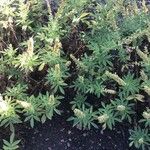
Agrimonia procera
Scented agrimony · Fragrant agrimony · Agrimony · Fragant Agrimony
Description
Source: leafsnapAgrimonia procera is a species of flowering plant belonging to the family Rosaceae.It is native to Europe and Southern Africa.
Care Guide
💧 Water
Fragrant agrimony thrives in environments with moderate moisture, requiring consistent but not excessive watering. Watering it weekly helps replicate its natural rainfall patterns. As an outdoor plant in temperate regions, matching its watering schedule with local rainfall can enhance its growth and resilience.
☀️ Light Partial sun
Fragant agrimony naturally grows in places such as forest understories or rocky areas, where it exists under natural shade. It prefers partial sun but can tolerate full sun or full shade, illustrating its versatile and hardy character.
🌡️ Temperature 5–35°C
Fragant agrimony can tolerate a wide range of temperatures, yet its distribution may still be restricted by particular combinations of moisture and heat. It does best in warm summer climates with sufficient rainfall or watering. Long periods of cloudy, rainy weather or sustained high temperatures can raise the risk of Fragant agrimony dying. In winter, protecting it from the cold can increase its chances of survival.
💨 Humidity
🪴 Soil 6-7
🌱 Fertilizer
The best time to fertilize a Fragant agrimony is in early spring, when it is coming out of dormancy and beginning active growth. Fertilization supplies essential nutrients for healthy development. Although Fragant agrimony has relatively low fertilizer requirements, an annual application can improve its survival and encourage better, longer-lasting flowers.
🪴 Pot & Repot
✂️ Pruning
Fragrant agrimony is known for its aromatic flowers and tall stems. To maintain its health and appearance, pruning should be done from early to late spring. Start by removing dead stems and thinning out overcrowded branches to improve air circulation. Light shaping can also help maintain its structure. Pruning encourages healthier growth, enhances blooms, and reduces the risk of pests. Always use sharp tools to prevent infection.
🌿 Propagating
🐛 Diseases & pets
☠️ Toxicity
Characteristics
- Plant Type
- Herb
- Life Cycle
- Perennial
- Genus
- Agrimonia
- Family
- Rosaceae
- Hardiness Zone
- 4-9
- Mature Height
- 0.4 m to 1.52 m
- Mature Spread
- 40 cm
- Leaf Color
- Green, Dark Green
- Leaf Type
- Deciduous
- Flower Color
- Yellow
- Flower Size
- 0.76 cm to 1.02 cm
- Bloom Time
- Summer
- Planting Time
- Spring, Summer
- Harvest Time
- Late summer, Early fall, Mid fall
- Native Area
- Sweden, Austria, Czech Republic, Slovakia, South Africa, Montenegro, Bulgaria, Poland, Greece, Slovenia, Belarus, Ukraine, Serbia, Russia, Norway, Hungary, Germany, Italy, Spain, Switzerland, Denmark, Netherlands, Finland, France, Ireland, United Kingdom, Romania, Belgium, Moldova, Portugal