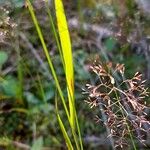
Agrostis gigantea
Redtop · Redtop bent · Bonnet grass · Fiorin · Black bent
Description
Source: leafsnapAgrostis gigantea, known by its common names black bent and redtop, is a perennial grass of the Agrostis genus. It is native to Europe, but in the cooler areas of North America was widely used as a pasture grass until the 1940s. Although it has largely been replaced by soybeans and more palatable grasses, it still gets some use in poor soils. It was one of the grasses planted in areas disturbed by the Trans-Alaska Pipeline. It generally does well in response to fires, due to survival of rhizomes and seeds.It can be found in open woodland, rough grassland, hedgerows, roadsides and waste ground, and as a weed on arable land. This species is similar to Agrostis stolonifera, with the key difference being that the latter has stolons. In fact the two are sometimes treated as a single species, and it is not always clear precisely what an author means by Agrostis alba or Agrostis stolonifera.Many internet sources describe Agrostis capillaris as being the tallest of the bent species. However C E Hubbard describes its height as ranging from 10 to 70 cm high, whereas Agrostis gigantea is 40–120 centimetres (16–47 in). Marjorie Blamey, Richard and Alastair Fitter also describe black bent as being taller.
Care Guide
💧 Water
Redtop is native to temperate regions and does best with moderate moisture, though it can withstand short periods of dryness. To keep it healthy and vigorous, especially during its active growing season, weekly watering is crucial. When grown outdoors, redtop benefits from natural rainfall, which helps support its growth.
What should I do if I give my Redtop plant too much water or too little water?
Proper watering is essential for the health of this attractive ornamental grass. Different watering issues can arise depending on whether the grass is planted in the ground or in a container. In the ground, these issues can typically be resolved. However, in a container, overwatering or underwatering can quickly lead to the death of the Redtop grass. When the Redtop grass does not receive the correct amount of water, its growth can be affected. Overwatering causes yellow leaves with brown tips to appear, while underwatering results in drooping leaves, weak seed head production, and browning of the leaves. If you suspect that your Redtop grass has been improperly watered, the first step is to determine whether it is receiving too much or too little water. If it's receiving too much water, you should stop watering it immediately. Keep in mind that it may take some time for heavy soils to dry out, so be patient. Once you notice new growth, test the soil for moisture and then decide whether it needs more water or not. On the other hand, if the Redtop grass is receiving too little water, simply give it a deep drink and observe if it starts to perk up. Remember that when it comes to watering, it is better to provide a long, deep watering instead of frequent shallow waterings. This encourages the growth of deep roots in the grass, making it more resistant to drought and less susceptible to watering-related problems.
How often do I need to water my Redtop?
The watering needs of Redtop grass vary depending on its planting location. Generally, it is recommended to water this grass once a week. However, in hot climates, watering twice a week during the summer may be necessary. In moderate climates, watering once every seven days or more may be sufficient. It is important to note that grass in containers typically requires more frequent watering compared to grass planted in the ground. Additionally, the location of the grass also matters, as shaded grasses need to be watered less frequently than those in direct sunlight. To determine when to water Redtop, check the soil moisture level. Pressing your finger a couple of inches into the soil will indicate if it is dry. For potted grass, you can use a portable scale to weigh it and determine if it feels light due to lack of water. Also, observe the appearance of the grass blades, as they may appear folded along the center and thinner than usual when the roots lack sufficient water. Despite its drought tolerance, regular and deep watering will result in a beautiful color for Redtop grass. Although Redtop is naturally found in open scrubland with extreme heat, bright sun, and intermittent rain, it still requires care and attention even with its drought-resistant qualities. Consistent watering is recommended for optimal growth. During the establishment phase, Redtop will require more frequent watering until its roots are deeply established. In pots, the soil tends to dry out quickly, especially when exposed to hot, direct sun. Testing the soil every 3 to 4 days and watering when it feels dry is important. Redtop planted in the ground generally needs less watering, but this depends on the soil type. Heavy clay soil holds moisture for a longer period, so it may appear dry at the surface while still retaining enough moisture below the ground. On the other hand, sandy soils that drain quickly will require more frequent watering.
What do I need to watch out for when watering my Redtop plant in different seasons, climates, or growth stages?
To determine if you are watering enough, keep an eye on how quickly your grasses are growing. For example, Redtop grass can double in size within a year during the hottest months. If it's hot outside but your grass isn't growing well, you may need to adjust your watering schedule. In winter, you might be fine with watering only once a month, but still check the soil for moisture. During the warmest months when the grass is actively growing, it will require more water than usual. However, during winter and cooler months, the need for water will be significantly reduced. The key thing to remember with Redtop is that the soil should always be allowed to completely dry out before watering again.
☀️ Light Full sun
Redtop favors spots where sunlight falls on the plant without obstruction all day. In its natural habitat it performs best with plentiful sun exposure. Insufficient or excessive light can disturb its growth cycle and overall health.
What are the sunlight requirements for Redtop (Agrostis gigantea)?
Redtop, or Agrostis gigantea, flourishes in full sun, requiring above 6 hours of sunlight daily to thrive optimally. It's crucial to observe your garden's sunlight patterns to find spots that offer a good balance of light and shade, ensuring the plant's well-being. In its natural setting, Redtop performs best with abundant sun exposure. It's essential to provide unobstructed sunlight throughout the day for the plant's successful growth cycle and health maintenance. Lack or excess of light might hinder its development.
How can artificial lighting support Redtop's growth indoors?
For indoor Redtop plants, artificial lighting is a beneficial solution when natural sunlight is inadequate, especially during the winter or in areas receiving limited sunlight. Optimal growth is supported by ensuring sufficient light exposure using artificial sources. LED lights, known for their adjustability to emit specific wavelengths, are recommended. The artificial light intensity should align with the plant's natural sunlight needs: 30-50W per square foot for full sun plants, 20-30W for partial sun, and 10-20W for full shade. The light source should be placed 12-36 inches above the plant and turned on for 8-12 hours a day to mimic natural daylight conditions.
What symptoms indicate insufficient light for Redtop?
Symptoms of insufficient light in Redtop include smaller new leaves, leggy or sparse growth indicating stretched plants with longer spaces between leaves or stems, and a quicker drop of older leaves. Additionally, the plant may exhibit slower or halted growth, develop lighter-colored or pale new leaves lacking chlorophyll, or display signs of chlorosis where leaves lose their greenness and turn yellow. Sunscald, leaf curling, wilting, and leaf scorching can also occur from improper light conditions, showing damage or stress from excessive sunlight or inadequate sunlight.
What solutions are recommended for Redtop struggling with light conditions?
To support Redtop in adverse light conditions, gradually relocate the plant to areas with at least 6 hours of direct sunlight daily. Indoors, consider moving it to a south-facing window or using artificial lights like desk lamps or professional grow lights for a minimum of 8 hours per day. Outdoors, plants should be moved to sunnier spots gradually to prevent sunburn. It's crucial to minimize obstructions such as branches that block sunlight, potentially through pruning or relocating smaller plants to sunnier locations with good drainage, particularly during their dormant periods. While parts of the plant affected by poor light may not recover, new growth should be healthy with improved light exposure.
🌡️ Temperature 5–35°C
Redtop can tolerate a wide range of temperatures, but its distribution may still be restricted by various combinations of water and heat conditions. It grows best in warm summer climates with sufficient rainfall or irrigation. Extended periods of cloudy, rainy weather or prolonged high temperatures increase the likelihood of Redtop dying. In winter, adequate protection from cold can boost the plant's survival rate.
💨 Humidity
🪴 Soil 5-7
🌱 Fertilizer
Redtop needs extra nutrients to encourage healthy new growth. In spring, placing compost around the base of the plant will supply the necessary nutrition. Fertilizing supports vigorous growth and helps the plant resist diseases and pests.
Why should I add fertilizer to my Redtop plant?
Fertilizing Redtop is crucial for several reasons. Firstly, your plant requires these additional nutrients to encourage healthy new growth. Moreover, the extra nutrients provided also play a vital role in maintaining the health of the existing growth, while simultaneously equipping your plant to combat potential diseases and pests.
When should I fertilize my Redtop grass?
To ensure the survival of Redtop in your garden, it's important to know the right time to fertilize it. Redtop is not a heavy feeder and doesn't need extra nutrients when it's dying back. Instead of using diluted fertilizer at the beginning of the growing season, it's best to apply mulch or compost around the base of the plant.
When should I not add fertilizer to my Redtop?
If you're not using packaged fertilizers, there's no need to be concerned about when to stop feeding Redtop. Simply apply a layer of compost or mulch during the spring, and that will be sufficient to keep Redtop happy all year round. It's not necessary to mulch or compost during the winter, when the plant is dormant.
What kind of fertilizer is best for my Redtop?
Instead of rushing to the garden center to buy fertilizer, you can skip it altogether for Redtop. In the spring, simply lay down a layer of compost to provide the necessary nutrients. Additionally, if you mulch your garden annually, the bark will also help keep your plant nourished and content.
How can I add fertilizer to my Redtop grass?
The steps for using Redtop, whether with mulch or compost, are the same. Start by putting down a layer of the material, ensuring that it covers the base of the plant. If you decide to use both mulch and compost, remember to decrease the amount of compost you add. Applying a layer of mulch can provide two benefits: it helps the soil retain moisture and provides nourishment for your plant.
🪴 Pot & Repot
✂️ Pruning
Redtop is a perennial grass that benefits from early spring pruning. To encourage new growth, use clean shears to remove up to one-third of the dead or damaged stems. Avoid heavy pruning during the peak growth period to prevent stress and to maintain the plant's health and appearance.
🌿 Propagating
🐛 Diseases & pets
☠️ Toxicity
Characteristics
- Plant Type
- Grass
- Life Cycle
- Perennial
- Genus
- Agrostis
- Family
- Poaceae
- Hardiness Zone
- 4-9
- Mature Height
- 0.3 m to 1.22 m
- Mature Spread
- 30 cm
- Leaf Color
- Green
- Leaf Type
- Deciduous
- Flower Color
- White, Yellow, Green, Red, Brown
- Flower Size
- 3.05 cm to 10.16 cm
- Bloom Time
- Early summer, Mid summer
- Planting Time
- Spring, Summer
- Harvest Time
- Mid summer, Late summer
- Native Area
- India, Turkey, Sweden, Slovakia, Montenegro, Pakistan, Croatia, Slovenia, Morocco, Belarus, Uzbekistan, Russia, Iraq, Germany, Estonia, Romania, Latvia, Belgium, Netherlands, Nepal, France, Bulgaria, Armenia, Poland, Greece, Ukraine, Serbia, China, Lithuania, Norway, Afghanistan, Italy, Kazakhstan, Spain, Switzerland, Denmark, Japan, Mongolia, Finland, Iran, Albania, Ireland, United Kingdom, Hungary, Algeria, Azerbaijan, Thailand