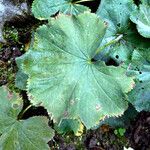
Alchemilla mollis
Garden lady's mantle · Lady's-mantle · Soft Lady's Mantle · Løvefod (DK)
Description
Source: leafsnapAlchemilla mollis, commonly known as Lady's Mantle, is a herbaceous perennial belonging to the Rosaceae family. Native to Europe and Asia, it has become a popular garden plant due to its attractive foliage and delicate flowers. The plant typically grows up to 45 cm in height, with a spread of about 60 cm. Its soft, velvety green leaves have scalloped edges that beautifully collect dewdrops after rain or watering. The small, yellow-green flowers of Alchemilla mollis appear from late spring through summer, blooming on tall stems above the foliage. These flowers are particularly appealing to bees and other pollinators. Lady's Mantle thrives in moist soil but is capable of tolerating some drought once established. It performs best in partial shade, although it can also handle full sun provided it receives adequate moisture. The leaves of Alchemilla mollis have been used for medicinal purposes for centuries, owing to their high tannin content, which has anti-inflammatory properties. They have also been used traditionally as an herbal remedy for menstrual disorders. Overall, Alchemilla mollis is an attractive garden plant that adds texture and interest with its soft foliage, while also offering medicinal benefits.
💡 Water beads are considered the most attractive feature of the lady's mantle, especially when it is grown as ground cover. These beads form due to the leaves' dewetting abilities, which cause the water to condense into droplets.
🌳 Lady's mantle features scalloped, toothed, and hairy leaves, adding texture to garden edges and borders. This easy-to-grow plant is fully hardy and adaptable to a variety of conditions, making it a popular choice for gravel gardens or challenging spots in the landscape.
Care Guide
💧 Water Every 3 days
Lady's mantle flourishes in the cooler areas of Europe and Asia, where it prefers partial shade and consistently moist, well-drained soil. For best growth, it needs to be watered weekly. The leaves of the plant have a unique ability to catch dew, creating a sparkling effect that adds charm to garden borders.
☀️ Light Full sun
Lady's mantle prefers exposure to the sky's main light source for best growth, but it can also adjust to reduced light or being in shade. Still, extreme sunlight or shade can be harmful. The habitat it comes from indicates a flexible range of light preferences.
What are the sunlight requirements for Lady's Mantle?
Lady's Mantle requires full sun, which entails more than 6 hours of sunlight daily, but it can also thrive in partial sun or full shade with about 3-6 hours of sunlight. It's vital to observe the movement of sunlight through your garden to identify areas that offer an ideal balance between light and shade, ensuring the plant's wellbeing. The plant's adaptability to various lighting conditions is a testament to its flexibility, although extreme conditions should be avoided to prevent harm.
How do artificial lights support the growth of indoor plants?
Indoor plants, including Lady's Mantle, if grown indoors, benefit significantly from artificial lighting, especially when natural sunlight is insufficient. Such conditions are common during winter or in spaces that receive limited sunlight. Artificial lights facilitate crucial support, ensuring faster and healthier plant growth. LED lights are recommended due to their ability to simulate specific wavelengths needed for photosynthesis. The intensity of artificial light for full sun plants should be 30-50W/sq ft, for partial sun plants 20-30W/sq ft, and for full shade plants 10-20W/sq ft. It's also important to position the light source 12-36 inches above the plants and provide 8-12 hours of light per day to mimic natural sunlight conditions.
What symptoms indicate insufficient or excessive sunlight in Lady's Mantle?
Symptoms of insufficient sunlight in Lady's Mantle include smaller new leaves, leggy or sparse growth, faster leaf drop, slower or no new growth, and lighter-colored or pale new leaves. Chlorosis, sunscald, leaf curling, wilting, and leaf scorching are indicators of excessive sunlight exposure. These symptoms serve as alerts that the plant is not receiving the optimal light conditions, either leading to reduced chlorophyll and nutrient assimilation or, conversely, to damage and dehydration due to overexposure.
How can I address sunlight-related issues with indoor and outdoor Lady's Mantle?
To optimize Lady's Mantle's growth in response to sunlight issues, indoor plants can be moved gradually to sunnier locations, ensuring they receive at least 6 hours of direct sunlight daily, preferably through a south-facing window. If moving the plant is not feasible, artificial lighting such as desk lamps or professional grow lights can be used for at least 8 hours daily. For outdoor plants, gradually transitioning them to better-lit spots can help them adapt without risking sunburn. If sunlight is obstructed, considering pruning or transplanting to more exposed locations might be necessary. Note that parts of the plant that suffered due to previous light conditions might not recover, but new growth will be healthy with improved light exposure.
🌡️ Temperature 0–32.2°C
Lady's mantle is well suited to climates where temperatures range from 32 to 90 °F (0 to 32 ℃). Its native habitat also indicates a preference for temperate conditions. It can tolerate frost yet also thrives in the warmth of summer. To ensure ideal growth, keep the temperature stable. In extreme cold or heat, extra care may be required.
What are the ideal temperature conditions for growing Lady's Mantle?
Lady's Mantle (Alchemilla mollis) thrives in temperatures ranging from 32 to 90 °F (0 to 32 °C), which indicates its strong adaptation to temperate climates. This plant possesses significant cold resistance, allowing it to endure frosty conditions without special frost protection measures in most cases. However, in extreme temperatures, especially during winter months when temperatures may plummet below -35°C, additional care, such as covering the plant with soil or straw, is advised. Before the onset of winter, it's recommended to water the plant abundantly to keep the soil moist, helping prevent drought and ensuring the plant has enough water through winter and early spring.
How does Lady's Mantle respond to low and high temperatures, and what are the solutions?
Lady's Mantle is notably resilient to low temperatures, preferring to remain above 0°C. In winters where temperatures are expected to stay above -30°C, the plant manages well, but at temperatures falling below -35°C, it may experience reduced or no sprouting in the spring. To manage this, it is recommended to remove any parts that fail to sprout as spring arrives. Conversely, in high temperatures, particularly above 32°C and especially if it exceeds 35°C, Lady's Mantle's leaves may lighten, curl, become sunburned, or in severe cases, the plant may wilt and dry out. Countermeasures include trimming sunburned and dried parts, relocating the plant to a shaded area, or using a shade cloth to shield it from midday and afternoon sun, along with watering the plant in the morning and evening to maintain soil moisture.
💨 Humidity
🪴 Soil 5-6
🌱 Fertilizer
The best time to fertilize Lady's mantle is in early spring, as it comes out of dormancy and starts active growth. Fertilizing supplies essential nutrients for healthy development. Although Lady's mantle has fairly low fertilization requirements, feeding it annually can improve its survival and encourage healthier, longer-lasting flowers.
🪴 Pot & Repot Every 12 months
✂️ Pruning
Lady's mantle features fan-shaped leaves and grows in a clumping form. For best results, prune it in early to mid-spring by removing old leaves and spent blooms. This encourages fresh growth and prolongs the flowering period. Regular pruning not only supports vigorous growth but also helps prevent disease. Ideally, pruning should be done during the plant's active growth phase.
🌿 Propagating
🐛 Diseases & pets
☠️ Toxicity
Although a lady’s mantle is not known to be toxic to humans or pets, it’s best to keep a close eye on curious children and pets that have access to the plant.
Characteristics
- Plant Type
- Herb
- Life Cycle
- Perennial
- Genus
- Alchemilla
- Family
- Rosaceae
- Hardiness Zone
- 3-8
- Mature Height
- 30 cm to 46 cm
- Mature Spread
- 30 cm to 61 cm
- Leaf Color
- Green
- Leaf Type
- Deciduous
- Flower Color
- Yellow
- Flower Size
- 0.25 cm
- Bloom Time
- Late spring, Early summer, Mid summer
- Planting Time
- Spring
- Harvest Time
- Mid summer
- Native Area
- Turkey, Greece, Bulgaria, Armenia, Iran, Romania