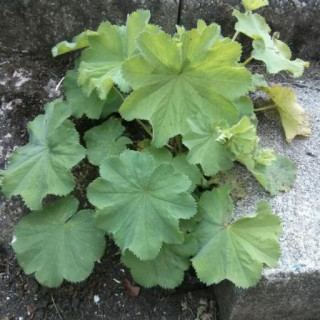
Alchemilla vulgaris
Leónfót · Common alchemilla · Lady's mantle · Intermediate lady's mantle
Description
Source: leafsnapAlchemilla vulgaris, common lady's mantle, is an herbaceous perennial plant in Europe and Greenland. These perennial wildflowers, members of the rose family, are sometimes grown in gardens - mainly for their leaves, which collect sparkling water droplets. Lady's Mantle is commonly seen in unimproved or lightly fertilized grassland, on roadside verges and banks, in chalk downland and on mountain slopes.
🎭 Affection, attractiveness, youthfulness, protection, innocence, fertility, enhancing romance
Care Guide
💧 Water
Lady's-mantle thrives in moist environments and is sensitive to drought. It needs consistent moisture, with weekly watering enough to keep its lush foliage healthy. Typically grown outdoors, it flourishes in soil that remains evenly damp, especially during its active growing season when water demand is highest.
☀️ Light Full sun
Lady's mantle does well in locations that receive a substantial amount of daily sunlight, yet it also tolerates areas with dappled or reduced light. Coming from habitats that typically have abundant light, this plant benefits from sunlight, particularly for photosynthesis. However, too much sun can cause plant stress, while too little can hinder its growth.
🌡️ Temperature 5–32.2°C
The natural temperature-related growing environment for lady's mantle is temperate regions, with temperatures ranging from 5 to 32 ℃ (41 to 89.6 ℉). It favors cooler conditions and does well in partial shade. In hot summer months, it's best to give some shade and increase watering to prevent the soil from drying out.
💨 Humidity
🪴 Soil 5-6
🌱 Fertilizer
A single fertilizer application in spring is usually enough for Lady's mantle, though multiple feedings can maximize growth. Feed once every month to a month and a half. Fertilizing improves the leaves' appearance and function, helping maintain even color and a healthy texture. It also encourages root development and nutrient uptake for long-term plant health.
🪴 Pot & Repot 2-3 years
When repotting Lady's mantle, select a pot 1-2 inches (2.5–5.1 cm) larger with ample drainage. Use a well-draining potting mix. Repot in spring or fall, making sure the root ball is slightly lower than the rim of the flower pot. Water thoroughly after repotting and place in a warm spot with indirect sunlight.
✂️ Pruning
Lady's mantle, known for its scalloped leaves and clusters of greenish-yellow flowers, benefits from pruning between early and late spring. By trimming spent stems and removing damaged foliage, you can enhance growth, manage its size, encourage robust flowering, and improve its overall health, resulting in a vibrant garden display.
🌿 Propagating
🐛 Diseases & pets
☠️ Toxicity
Characteristics
- Plant Type
- Herb
- Life Cycle
- Perennial
- Genus
- Alchemilla
- Family
- Rosaceae
- Hardiness Zone
- 4-7
- Mature Height
- 40 cm to 61 cm
- Mature Spread
- 30 cm
- Leaf Color
- Green, Yellow
- Leaf Type
- Deciduous
- Flower Color
- Yellow, Green
- Flower Size
- 0.51 cm
- Bloom Time
- Late spring, Early summer, Mid summer
- Planting Time
- Spring
- Harvest Time
- Mid summer
- Native Area
- Austria, Sweden, Slovakia, Montenegro, Croatia, Slovenia, Russia, Germany, Estonia, Romania, Latvia, Belgium, Netherlands, France, Czech Republic, Bulgaria, Poland, Greece, Ukraine, Lithuania, Norway, Italy, Spain, Switzerland, Denmark, Albania, Ireland, United Kingdom, Hungary