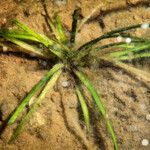
Alisma gramineum
Alisma Graminoide · Geyer Waterplantain · Grass-leaved Water Plantain · Grasslike Waterplantain · Narrow-leaf Water-plantain
Description
Source: leafsnapAlisma gramineum is a small aquatic plant in the water-plantain family. It has several common names including narrowleaf water-plantain, ribbonleaf water-plantain or ribbon-leaved water-plantain, and grass-leaved water-plantain. It grows in mud or submerged in shallow fresh or brackish water in marshy areas.
Care Guide
💧 Water
Native to wetlands, narrowleaf water-plantain thrives in high humidity and adapts well to consistently moist, saturated conditions. Watering it once a week helps maintain its preferred moisture levels. As an aquatic perennial, this plant flourishes outdoors, forming colonies that naturally filter water along ponds and streams.
☀️ Light Full sun
Narrowleaf water-plantain prospers in strong light, which greatly supports its healthy growth. The light conditions of its native habitat similarly match these requirements. However, excessive exposure can diminish its vigor; meanwhile, insufficient light does not essentially hinder its growth.
What are the sunlight requirements for Narrowleaf water-plantain?
Narrowleaf water-plantain, or Alisma gramineum, thrives best in conditions with prominent illumination, requiring above 6 hours of sunlight daily to ensure healthy growth. It's important to observe the movement of sunlight through your garden to choose spots that offer a perfect balance of light and shade, promoting the well-being of your plants. In its natural habitat, Narrowleaf water-plantain is accustomed to similar light conditions.
How does inadequate or excessive sunlight affect Narrowleaf water-plantain?
While Narrowleaf water-plantain can tolerate various lighting conditions, overexposure to sunlight may impact its robustness, leading to symptoms such as chlorosis, sunscald, leaf curling, wilting, and leaf scorching. On the other hand, inadequate light doesn’t heavily affect its growth but can result in symptoms like small leaves, leggy or sparse growth, faster leaf drop, slower or no new growth, and lighter-colored new leaves. It's critical to ensure the plant receives the right amount of sunlight for optimal health.
What artificial lighting requirements do indoor Narrowleaf water-plantains have?
Indoor Narrowleaf water-plantain plants require adequate lighting, especially when natural sunlight is insufficient. Artificial lights, such as LED lights, are effective in providing the necessary wavelengths for optimal growth. Full sun plants need 30-50W/sq ft, partial sun plants need 20-30W/sq ft, and full shade plants need 10-20W/sq ft of artificial light. Place the light source 12-36 inches above the plant, and mimic the length of natural daylight hours, typically needing 8-12 hours of light per day.
What care interventions can help Narrowleaf water-plantain adjust to lighting conditions?
To ensure Narrowleaf water-plantain's optimal growth under varying light conditions, gradual adjustments are key. For indoor plants, gradually move them to sunnier locations, use south-facing windows for maximum sunlight, or provide supplementary artificial light for at least 8 hours daily. Outdoors, it's essential to transition plants slowly to sunnier spots to avoid sunburn. Additionally, reducing obstructions like pruning trees can help, and for smaller plants, consider transplanting during the dormant period to a location with ample sunlight and good drainage. It's important to note that parts of the plant affected by insufficient sunlight may not recover, but new growth should be healthy with improved light exposure.
🌡️ Temperature 5–32.2°C
Narrowleaf water-plantain is native to habitats where temperatures range from 41 to 89.6 °F (5 to 32 ℃). It favors mild climates, and if conditions stray from this range, slowly adjust temperatures to meet its preference, particularly during extreme seasons.
What is the native environment of Narrowleaf water-plantain?
Narrowleaf water-plantain, with its botanical name Alisma gramineum, thrives in environments where temperatures range from 41 to 89.6 °F (5 to 32 °C). It is best suited to mild climates and can adapt to gradual temperature changes, especially during extreme seasons. This plant has good resistance to cold, typically not requiring special frost protection measures in winter, though attention should be given when temperatures are expected to drop below -25°C.
How do you protect Narrowleaf water-plantain in winter?
To protect Narrowleaf water-plantain during the winter, especially when temperatures might drop below -25°C, it's advisable to cover the plant with protective materials like soil or straw. It's also recommended to water the plant abundantly before the first freeze of autumn to ensure the soil remains moist and enters a frozen state. This is crucial for preventing drought and ensuring the plant has adequate water throughout winter and into early spring.
What are the important symptoms and solutions for Narrowleaf water-plantain in low temperatures?
In low temperatures, Narrowleaf water-plantain shows remarkable cold tolerance and performs best when temperatures stay above 5°C. However, if temperatures drop below -25°C, there might not be noticeable changes during the winter, but it could lead to reduced or no sprouting in spring. The solution for this issue includes removing any parts of the plant that fail to sprout in the spring.
How does high temperature affect Narrowleaf water-plantain and what are the solutions?
During summer, it's crucial for Narrowleaf water-plantain to be kept in conditions cooler than 32°C. Exceeding 35°C can cause the plant's leaves to lighten in color, become prone to curling, suffer from sunburn, and in severe cases, the entire plant might wilt and dry up. To combat this, trim away sunburned and dried parts of the plant, move it to a shaded area during midday and afternoon sun, or utilize a shade cloth. Ensuring that the plant is watered in the mornings and evenings to keep the soil moist is also vital for its health in high temperatures.
💨 Humidity
🪴 Soil
🌱 Fertilizer
🪴 Pot & Repot
✂️ Pruning
The narrowleaf water-plantain, recognized for its grass-like leaves and aquatic habitat, should be pruned from early to late spring to stay healthy. Remove any dead leaves to encourage growth, prevent decay, and improve water circulation. This also helps reduce the risk of disease, ensuring a vibrant aquatic garden feature.
🌿 Propagating
🐛 Diseases & pets
☠️ Toxicity
Characteristics
- Plant Type
- Herb
- Life Cycle
- Perennial
- Genus
- Alisma
- Family
- Alismataceae
- Hardiness Zone
- 5-8
- Mature Height
- 3 cm to 52 cm
- Mature Spread
- 10 cm
- Leaf Color
- Light Green
- Leaf Type
- Deciduous
- Flower Color
- White
- Flower Size
- 0.51 cm to 0.76 cm
- Bloom Time
- Summer
- Planting Time
- Spring, Summer
- Harvest Time
- Late summer, Early fall, Mid fall
- Native Area
- Libya, Egypt, Turkey, Sweden, Austria, Slovakia, Montenegro, Pakistan, Slovenia, Morocco, Croatia, Belarus, Uzbekistan, Russia, Germany, Estonia, Romania, Latvia, Belgium, Netherlands, France, Tajikistan, Tunisia, Czech Republic, Bulgaria, Armenia, Poland, Greece, Ukraine, Serbia, Lebanon, Lithuania, China, Afghanistan, Syria, Italy, Kazakhstan, Switzerland, Denmark, Mongolia, Israel, Iran, Azerbaijan, United Kingdom, Hungary, Turkmenistan