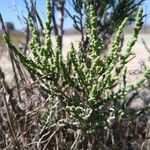
Allenrolfea occidentalis
Iodine-bush · Pickle weed
Description
Source: leafsnapAllenrolfea occidentalis, commonly known as the iodine bush or western allenrolfea, is a small shrub in the family Amaranthaceae. Native to the western United States and northern Mexico, it thrives in arid regions such as deserts, salt flats, and saline soils. This plant has a unique adaptation to its harsh environment: it accumulates iodine in its tissues, giving it a salty taste. This trait helps the plant survive in saline soils where other plants cannot grow. Allenrolfea occidentalis features small, succulent-like green leaves that grow on thin stems, which can reach up to 1 meter in height. Its flowers are small and inconspicuous, lacking petals and sepals. For centuries, Native Americans have used the plant for medicinal purposes due to its high iodine content, which aids thyroid function. Additionally, it is popular in xeriscaping for its drought tolerance. In summary, Allenrolfea occidentalis is a fascinating shrub with unique adaptations that enable it to thrive in harsh environments, while also offering medicinal benefits for humans.
Care Guide
💧 Water Every 7 days
The iodinebush is well-suited to arid environments, boasting high drought tolerance and requiring very little water. It is best watered every 2-3 weeks, which helps conserve water. This feature makes the iodinebush an excellent choice for xeriscaping and ensures its resilience in outdoor settings. While it benefits from occasional rain, it does not depend on regular watering.
☀️ Light Full sun
Iodinebush needs plenty of sunlight to grow optimally. Since its natural habitat is exposed to the sun, it performs best in similar conditions. Constant exposure to sunlight is important during its growth phases. Too little light can inhibit its growth, while too much can cause wilting.
What are the sunlight requirements for Iodinebush?
Iodinebush, or Allenrolfea occidentalis, thrives in conditions that mirror its natural sun-exposed environments, requiring above 6 hours of sunlight daily for optimal growth. It's crucial to observe the movement of sunlight through your garden to find spots that offer the perfect balance of light and shade, ensuring the plant's health and happiness. Lack of sunlight may stunt the plant's growth, while excess exposure can lead to wilting. In circumstances where natural light is insufficient, especially during winter or for indoor plants, artificial lighting can be a vital substitute, helping maintain healthy growth.
How can artificial lighting support Iodinebush growth indoors?
When natural sunlight is insufficient, particularly in less sunny spaces or during winter, artificial lighting becomes crucial for the growth of Iodinebush indoors. LED lights are recommended due to their ability to be customized to provide specific wavelengths needed by plants. For full sun plants, including Iodinebush, it's advised to use 30-50W per square foot of artificial light. The light source should be placed 12-36 inches above the plant to mimic natural sunlight's effects, ensuring the plant gets 8-12 hours of light per day.
What are the symptoms of inadequate sunlight for Iodinebush?
Iodinebush may show several symptoms when it doesn't receive enough sunlight, including smaller new leaves, leggy or sparse growth, faster leaf drop, slower or halted growth, and paler new leaves. Excessive sunlight can also cause problems such as chlorosis (leaves turning yellow), sunscald (damage from intense sun), leaf curling (to reduce surface area exposed to sunlight), wilting (due to increased water loss), and leaf scorching (brown, dry edges on leaves). These symptoms highlight the plant's sensitivity to its light environment, whether indoors or outdoors.
What are the solutions for sunlight-related issues in Iodinebush?
To remedy sunlight-related issues in Iodinebush, a gradual adjustment to the desired sunlight exposure is key. For indoor plants, moving them closer to a south-facing window or incorporating artificial light can help increase sunlight exposure. Outdoors, it's important to gradually acclimate plants to sunnier spots to prevent sunburn. Additionally, reducing any obstructions like overhanging branches can provide better light access. If necessary, transplanting smaller plants to areas with more direct sunlight and good drainage can improve their health. Note that parts of the plant damaged by insufficient light may not recover, but new growth will be healthy with proper light adjustments.
🌡️ Temperature 10–37.8°C
Iodinebush is native to habitats with moderate temperatures of 50 to 100.4 °F (10 to 38 °C). It does best within that range, and conditions may need to be adjusted in extreme seasons. Be sure to keep Iodinebush in a warmer location during colder months.
What is the ideal temperature range for Iodinebush?
Iodinebush, known botanically as Allenrolfea occidentalis, ideally grows in environments with moderate temperatures, specifically between 50 to 100.4 °F (10 to 38 °C). It is crucial to maintain this temperature range for optimal growth. During colder months, it's recommended to place the iodinebush in a warmer area to protect it from extreme cold. Although the plant has strong cold resistance and usually does not require special frost protection measures, if temperatures are expected to plummet below -25°C, protecting the plant by wrapping the trunk and branches with materials like non-woven fabric or cloth becomes essential. Additionally, before the onset of the first freeze in autumn, abundantly watering the plant to ensure the soil remains moist and enters winter in a frozen state can help prevent drought and water scarcity during the colder seasons and early spring.
How does low temperature affect Iodinebush and what are the solutions?
Iodinebush thrives best when temperatures are kept above 10°C and has a notable cold tolerance, meaning it should ideally be kept above -15°C during winter. However, if temperatures fall below -25°C, there may not be noticeable changes during the winter, but come spring, the branches can become brittle, dry, and fail to produce new shoots. In such cases, the preferred solution is to prune away any dead branches in spring that haven't developed new leaves, helping the plant to recover and maintain its health.
How does high temperature affect Iodinebush and what are the solutions?
During the summer months, it is important to ensure that the Iodinebush does not experience temperatures above 38°C. Exposure to temperatures exceeding 43°C can lead to the leaves becoming lighter in color, tips drying and becoming withered, and an increased susceptibility to sunburn. To mitigate these effects, sunburned and dried parts of the plant should be trimmed away. The plant should be moved to a location that is shaded from the midday and afternoon sun, or a shade cloth can be used to create the necessary shade. Additionally, watering the plant in the morning and evening will help keep the soil moist and further protect the plant from the adverse effects of high temperatures.
💨 Humidity
🪴 Soil 6-8
🌱 Fertilizer
Fertilize your Iodinebush in early spring to encourage healthy growth. Regular feeding improves the plant’s overall condition, producing vigorous growth, greater tolerance of challenging conditions, and increased resistance to pests and diseases. Keep to a consistent fertilization schedule for your Iodinebush to preserve vibrant, deeply colored foliage and a lush appearance.
🪴 Pot & Repot
✂️ Pruning
Iodinebush is a salt-tolerant shrub that thrives in saline environments. To maintain its health and appearance, it should be pruned annually between early and late winter. During pruning, remove any dead branches and thin out crowded areas to improve air circulation. While regular pruning is beneficial, be careful not to over-prune, as this can stress the plant. Following these practices, which are backed by reliable sources, will help keep your iodinebush healthy and attractive.
🌿 Propagating
🐛 Diseases & pets
☠️ Toxicity
Characteristics
- Plant Type
- Shrub
- Life Cycle
- Perennial
- Genus
- Allenrolfea
- Family
- Amaranthaceae
- Hardiness Zone
- 6-11
- Mature Height
- 0.3 m to 2.13 m
- Mature Spread
- 0.91 m to 2.13 m
- Leaf Color
- Green
- Leaf Type
- Evergreen
- Flower Color
- Yellow, Green
- Flower Size
- 2.54 cm
- Bloom Time
- Summer
- Planting Time
- Spring, Summer, Autumn
- Harvest Time
- Late summer, Early fall, Mid fall
- Native Area
- Mexico