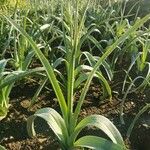
Allium polyanthum
Many-flowered onion
Description
Source: leafsnapAllium polyanthum, commonly known as many-flowered garlic, is a perennial herbaceous plant in the Allium genus. Native to China, it has been widely cultivated throughout other parts of Asia and Europe. The plant grows to a height of up to 30 cm and produces clusters of small, pink or white flowers that bloom in late winter or early spring. The leaves of Allium polyanthum are narrow and linear, reaching up to 20 cm in length. They are dark green with a waxy texture. While the bulbs are small, they produce numerous offsets that can be used for propagation. All parts of the plant emit a strong garlic-like odor due to the presence of sulfur compounds. This makes it a valuable culinary addition, as it can serve as a substitute for garlic or onion. In traditional Chinese medicine, Allium polyanthum has been used for its medicinal properties, such as treating colds, coughs, and digestive disorders. Overall, Allium polyanthum is an attractive ornamental plant with culinary and medicinal uses, making it an excellent addition to any garden or herb collection.
🎭 Forbearance, good luck, affluence, togetherness, fortitude
Care Guide
💧 Water Every 7 days
☀️ Light Full sun
Wild leek develops vigorously when exposed to sunlight for most of the day. It can still thrive in locations with somewhat reduced light. In its native habitats it is often found in open fields that have abundant sun. Conditions with either too little or too much light are detrimental and can weaken its growth and vitality.
🌡️ Temperature 15–35°C
Wild leek is adapted to native growth environments in regions with average annual temperatures of 68 to 95 °F (20 to 35 ℃). For healthy growth, the ambient temperature around this plant must remain within that range.
💨 Humidity
🪴 Soil 6-7
🌱 Fertilizer
To maximize the yield and flavor of Wild leek, provide ample nitrogen throughout the growth cycle, including the pre-planting phase and up to harvest. Plants that are well-watered and properly fertilized develop abundant, healthy leaves and exhibit less bitterness. Before planting, amend the soil with organic matter such as compost or manure, ideally 2 to 8 weeks in advance.
🪴 Pot & Repot
Repot Wild leek in early spring. Choose a pot that is wider than it is deep and provides good drainage. Use a loamy, well-draining potting mix enriched with compost. Carefully remove old soil from the bulb and plant it so the depth matches the bulb’s height. Water thoroughly after repotting and place the pot in a sunny spot. Avoid overwatering to prevent the bulb from rotting.
✂️ Pruning
🌿 Propagating
🐛 Diseases & pets
☠️ Toxicity
Characteristics
- Plant Type
- Herb
- Life Cycle
- Perennial, Annual
- Genus
- Allium
- Family
- Amaryllidaceae
- Hardiness Zone
- 7-10
- Mature Height
- 1.83 m
- Mature Spread
- 30 cm
- Leaf Color
- Green
- Leaf Type
- Deciduous
- Flower Color
- Lavender, White
- Flower Size
- 4.06 cm to 11.43 cm
- Bloom Time
- Late spring, Early summer
- Planting Time
- Spring, Winter, Summer, Autumn
- Harvest Time
- Mid summer
- Native Area
- Libya, Egypt, Turkey, Tunisia, Cyprus, Bulgaria, Greece, Morocco, Uzbekistan, Iraq, Portugal, Italy, Spain, Israel, Iran, Ethiopia, Albania, Algeria, Romania, Turkmenistan, France