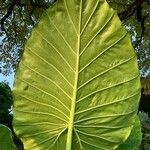
Alocasia macrorrhizos
بابا آدم · Giant taro · Elephant ear · Ape · Cunjevoi
Description
Source: leafsnapAlocasia macrorrhizos is a species of flowering plant in the arum family (Araceae) that it is native to rainforests of Maritime Southeast Asia, New Guinea, and Queensland and has long been cultivated in South Asia, the Philippines, many Pacific islands, and elsewhere in the tropics. Common names include giant taro, ʻape, giant alocasia, biga, and pia. In Australia it is known as the cunjevoi (a term which also refers to a marine animal).
💡 Legend has it that in the ancient Aegean Sea region of Europe, there was a beautiful princess with a fondness for the elephant's ear plant. She fell in love with a young man. When he learned that a variety of this plant, resembling ice, grew in the frigid Arctic, he set out on a quest to find it for her. Despite facing numerous hardships, he was unable to obtain the plant. However, the princess believed that as long as they were together, she would be happy.
🌳 The giant taro is not only eye-catching but also highly practical. People in many cultures eat its large, starchy underground stems as a carbohydrate source. Its bright spathes produce nectar that attracts insects for pollination, which helps the plant spread and supports local biodiversity. In Papua New Guinea, artisans use the stem fibers to make distinctive textiles. Additionally, giant taro has potential in green energy, with studies suggesting it could be used for biofuel production.
🎭 Purity, joy, holiness, a bond with one's ancestors, a blessing from the gods
Care Guide
💧 Water Every week
Giant taro, native to tropical rainforests, thrives in high humidity and prefers consistently moist but not waterlogged soil. To align with its natural growth cycle, it should be watered once a week. Typically cultivated outdoors, giant taro benefits greatly from rainfall patterns that resemble those of its native environment, ensuring optimal growth.
How should I water my Giant taro plant?
- If you have a Giant taro plant in a small pot indoors, you can bring it to the kitchen sink to water it. Simply turn on the faucet and add water to the container until you see it start to drain out of the holes in the pot. Make sure not to water your plant in cold temperatures as it can harm the roots. If your tap water has a high amount of fluorine, chlorine, or salts, it may be better to use rainwater or lake water. - Alternatively, you can also water your Giant taro plant overhead or directly into the soil using a watering can, hose, or any other watering tool you prefer.
What should I do if I give my Giant taro plant too much or too little water?
If you think you haven't been giving your Giant taro enough water, the first step is to give it a good watering. Make sure to water it deeply until excess water drains out of the container or until the soil is completely moist if it's grown outside. On the other hand, if you find that your Giant taro is getting too much water, start by reducing how often you water it. You should also pay attention to the soil and container that your plant is in. If the water is not draining properly because of the soil or container, your plant will likely be overwatered again. To fix this, transfer your plant to soil that drains better or use a container with larger drainage holes or a more porous material. Additionally, consider the location of your plant. If it's in a cramped or poorly ventilated area like a corner, it's recommended to move it near a window or door to enhance air circulation. Placing your plants in a well-ventilated location can help decrease the risk of overwatering to some extent.
How frequently should I water my Giant taro plant?
The Giant taro does not need constant soil moisture. Instead, it is best to let the soil dry out between waterings. If you are growing Giant taros in containers, you can determine when to water by checking the dryness of the soil. For example, if the top half of the soil in your container is dry, it's time to water. You can do this by inserting your fingers or sticks into the soil, or by using a soil moisture meter. If you are growing the Giant taro outdoors, you can plan to water it about once every other week, unless it has rained recently.
How much water does my big taro plant need?
To rehydrate the dry soil around your Giant taro's roots, wait for the top half of the soil to dry out first. Then, add enough water to make the soil moist again. The amount of water needed depends on factors such as the size of the container and the plant itself. For a small Giant taro in a small to medium-sized container, one to two cups of water should suffice. Larger plants will require more water. To ensure proper watering, you can check the moisture level by inserting your finger or a trowel into the soil. Another method is to water until you see excess water draining from the container's bottom holes.
How can I know if I'm giving my Giant taro plant enough water?
Both overwatering and underwatering can negatively affect the health of your Giant taro plant. However, these two issues present themselves in slightly different ways. If your plant isn't receiving enough water, you may notice yellow leaves and the margins of the leaves becoming brown and brittle. On the other hand, if your plant is being overwatered, you may observe both yellow and brown marks on the leaves simultaneously. Overwatering can also lead to diseases such as root rot, which may be visible on your plant. Fortunately, if you are familiar with the signs of overwatering and underwatering, you have a good chance of resolving both issues.
☀️ Light Partial sun
Giant taro prefers a location with a substantial amount of light but is also tolerant of dimmer areas. If it doesn't receive adequate light, growth can become stunted and the leaves may lose color. Excessive light can cause leaf scorch and damage. Coming from forest habitats, the plant is adapted to the lower light conditions commonly found beneath the canopy.
What are the sunlight requirements for Giant Taro?
Giant Taro thrives in partial sun, needing about 3-6 hours of sunlight per day, but it can also grow in full shade with less than 3 hours of sunlight. It's important to observe how sunlight moves through your garden to find spots that offer the right balance of light and shade for the plants. Despite its flexibility regarding sunlight, without the proper light conditions, Giant Taro's growth may be hindered, and its leaf color could fade, while excessive light might cause leaf scorching.
How does artificial lighting benefit indoor Giant Taro plants?
Indoor Giant Taro plants require adequate lighting to grow optimally. When natural sunlight is insufficient, especially during winter or in less sunny spaces, artificial lights serve as a crucial solution. LED lights are recommended for their ability to provide specific wavelengths needed for plant growth. Full sun plants need 30-50W/sq ft, partial sun plants require 20-30W/sq ft, and full shade plants need 10-20W/sq ft of artificial light. The artificial light source should be 12-36 inches above the plant to mimic natural sunlight, and it should be on for 8-12 hours per day depending on the plant's needs.
What are the symptoms of improper lighting for Giant Taro?
Symptoms of inadequate light for Giant Taro include lighter-colored new leaves, indicating a lack of chlorophyll and essential nutrients; smaller new leaves compared to previous ones; slower or halted growth; early leaf drop to conserve resources; chlorosis, which turns the leaves yellow due to chlorophyll breakdown from excessive sunlight; sunscald from intense sunlight exposure; leaf curling as a defense mechanism to minimize water loss; wilting due to excessive water loss from overexposure to sunlight; and leaf scorching, characterized by brown, dry edges on leaves due to too much sunlight.
How can I address lighting issues for my Giant Taro?
To optimize growth for Giant Taro, gradually move it to sunnier spots each week until it gets 3-6 hours of direct sunlight daily for outdoor plants. For indoor or large plants, consider using artificial light, keeping a lamp on for at least 8 hours daily, or invest in professional grow lights. Reduce obstructions by pruning trees or branches blocking sunlight, and for smaller plants, consider transplanting during the dormant period to a location with ample sunlight and good drainage. Note that parts of the plant affected by insufficient sunlight may not recover, but new growth will be healthy after light exposure is increased.
🌡️ Temperature 20–37.8°C
The giant taro grows naturally in warm, humid climates with temperatures from 20 to 38 ℃ (68 to 100.4 ℉). It prefers temperatures above 15 ℃ (59℉) and needs protection from frost. During winter, it should be kept in a warm, bright spot away from drafts to prevent leaf damage.
What are the essential growing conditions for Giant Taro?
The Giant Taro (Alocasia macrorrhizos) thrives in warm and humid climates, with optimal temperatures ranging between 20 to 38°C (68 to 100.4°F). It is a heat-loving plant that requires protection from frost and prefers staying above 15°C (59°F). During winter, it's important to keep the plant in a warm and bright spot, away from cold drafts, to avoid leaf damage. It is advised to bring outdoor-grown Giant Taro indoors during autumn, placing it near a bright window but at a distance from heaters to ensure the plant's growth is not affected by cold temperatures.
How does low temperature affect Giant Taro and what are the solutions?
Giant Taro prefers warm temperatures and does not fare well in cold conditions. It is crucial to keep it above specific temperature thresholds during winter. Exposure to low temperatures can lead to a lightening of the leaves' color. In case of frost damage, the leaves may turn brown or black, and the plant might show symptoms such as wilting and drooping. To mitigate these issues, frost-damaged parts should be trimmed off, and the plant should be moved indoors to a warm environment, ideally near a south-facing window for ample sunlight. It's also important to keep the plant away from heaters or air conditioning vents to avoid air dryness.
What should be done if Giant Taro is exposed to high temperatures?
During the summer, it's vital to ensure that the Giant Taro's surrounding temperature does not exceed certain limits to prevent the plant from becoming susceptible to sunburn, with the leaves' color becoming lighter. If the plant suffers from sunburn or dryness, affected parts should be trimmed away. To protect the plant, it should be moved to a shaded location, especially from the midday and afternoon sun. Watering the plant in the mornings and evenings will help keep the soil moist and aid in maintaining optimal growth conditions.
💨 Humidity
🪴 Soil 5-6
🌱 Fertilizer
During its active growth stage, typically in the spring, summer, and early autumn, the Giant taro necessitates the highest amount of fertilizer. It's vital to fertilize to replenish vital nutrients that might be absent from the ground, encouraging the healthy development of roots and stems. Besides, it enhances the foliage appeal, which is a significant characteristic of this particular plant.
Why should I put fertilizer on my Giant taro?
All plants, including the Giant taro, depend on soil nutrients for their growth. However, there is no guarantee that the soil where your plants grow will have all the necessary nutrients. To address this, fertilization and soil amendments are important to ensure that your garden plants have both the basic nutrients they require and the specific nutrients they need. In the case of the Giant taro, fertilizer is necessary to support the healthy development of its roots and stems throughout the growing season. Additionally, fertilization will enhance the appearance of the plant's leaves, which are a significant ornamental feature of the Giant taro.
When should I fertilize my Giant taro plant?
A Giant taro requires the most fertilizer when it is actively growing, which usually happens during spring, summer, and early fall. In winter, you should feed it once every two to four weeks. This feeding rate should continue until the arrival of the fall months. When fall arrives, gradually reduce the amount of fertilizer you give until you stop feeding it completely in preparation for winter, when the Giant taro will have less active growth.
When shouldn't I put fertilizer on my Giant taro plant?
For most of the year, including spring, summer, and most of fall, it is important to consistently feed your Giant taro. However, if you notice that your Giant taro has been over-fertilized or incorrectly fertilized, resulting in fertilizer burn or other issues, you should address these problems before resuming regular feeding. The only exception to fertilizing is during winter. If you have an indoor Giant taro in a cold winter region, it will go into a dormant phase. Feeding the plant during this dormant phase is unnecessary and can cause fertilizer burn.
What kind of fertilizer does my Giant taro plant require?
When fertilizing a Giant taro, it is important to use a specific blend of nutrients in relatively low amounts. An ideal fertilizer should have an N-P-K ratio of 3-1-2, but a general-purpose fertilizer with even nutrient distribution can also be effective. Regardless of the fertilizer type, the volume of each nutrient should be kept at 10 or lower. Granular or liquid-based fertilizers can both be used, but if opting for a liquid fertilizer, it is recommended to dilute the strength by half. While granular fertilizer is generally fine, using liquid fertilizer is usually more practical, especially if watering the Giant taro at the same time.
How can I give my Giant taro plant the nutrients it needs to grow well?
When using fertilizer for your Giant taro, it's important to follow the application instructions that come with it. To avoid harming the plant's roots, it is recommended to fertilize just before or while watering the soil. If using a slow-release granular fertilizer, sprinkle it on the soil and immediately water. In the case of a liquid-based fertilizer, dilute it with water, apply it to the soil, and then provide additional water. It is particularly crucial to dilute the fertilizer by at least half during spring and fall, when the plant's growth is increasing and decreasing, respectively.
🪴 Pot & Repot Once a year
Repot Giant taro in spring or summer once it's warm enough, choosing a pot slightly larger with good drainage. Water deeply after repotting, and place the plant in bright, indirect light. Consider using a moss pole for support as the plant grows.
✂️ Pruning
To prune giant taro effectively, start by removing any dead or damaged leaves in early spring using clean, sharp tools. This helps promote healthier growth and keeps the plant at a manageable size. Regular pruning improves airflow and reduces the risk of pests. However, be careful not to over-prune, as giant taro relies on its leaves for photosynthesis.
🌿 Propagating
🐛 Diseases & pets
☠️ Toxicity
Characteristics
- Plant Type
- Herb
- Life Cycle
- Perennial
- Genus
- Alocasia
- Family
- Araceae
- Hardiness Zone
- 9-12
- Mature Height
- 0.91 m to 4.88 m
- Mature Spread
- 1.83 m to 2.44 m
- Leaf Color
- Green
- Leaf Type
- Evergreen
- Flower Color
- White
- Flower Size
- 10.16 cm to 30.48 cm
- Bloom Time
- Mid summer
- Planting Time
- Spring, Summer, Autumn
- Harvest Time
- Late summer, Early fall
- Native Area
- Solomon Islands, Malaysia, Indonesia, Papua New Guinea, Philippines