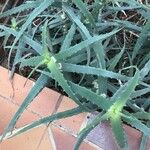
Aloe bakeri
Baker aloe
Description
Source: leafsnapAloe bakeri is a species of flowering plant in the family Asphodelaceae, native to Madagascar, where it grows on rocky hills at low elevations. Growing to 10–20 cm (4–8 in) tall by 40 cm (16 in) wide, it is an evergreen perennial forming multiple rosettes of spidery succulent green or reddish-green toothed leaves, heavily mottled with white. The leaves are typically 10 cm (4 in) long and bear straight or slightly curved white teeth that are 1 mm long and about 1-2 mm apart. In summer it produces red or orange, green-tipped tubular flowers. These flowers are attractive to birds, bees, and wasps, and are typically 2 cm (0.75 in) long, borne on racemes 30 cm (12 in) tall.The Latin specific epithet bakeri honours one of two British horticulturalists, in this case John Gilbert Baker of Kew (1834-1920).With a minimum temperature of 10 °C (50 °F), this plant requires winter heat, and in temperate regions is cultivated under glass. It has gained the Royal Horticultural Society's Award of Garden Merit. However, it may be susceptible to scale and mealybugs. In the US, this plant is best grown outside only in hardiness zone 11.
Care Guide
💧 Water
Baker aloe is a hardy plant that thrives in dry conditions by storing water in its succulent leaves, which means it requires very little watering. To keep it healthy, water it just once every three weeks and use well-draining soil to avoid root rot. This plant prefers environments with controlled humidity and is perfect as a low-maintenance indoor plant.
☀️ Light Full sun
Native to dry areas, Baker aloe flourishes in full sun, its native habitat marked by intense sunlight and little shade. It can also tolerate partial sun, giving it some flexibility in how it grows.
🌡️ Temperature 20–37.8°C
Baker aloe originates from areas where temperatures usually range between 68 and 100 °F (20 to 38 ℃). It favors those conditions, and cultivating it outside that temperature span can hinder its growth. Modifying its environment as the seasons change can help keep it at its preferred temperature.
💨 Humidity dry (<40%)
This plant prefers dry conditions, so don't mist it. However, watering it less often can also thrive in higher humidity.
🪴 Soil 6-7
🌱 Fertilizer
For Baker aloe, light applications of fertilizer once or twice a year during the growing season are adequate. Do not fertilize in winter or in summer when the plant is dormant. Cut back on fertilizer for repotted plants and wait a couple of months after repotting before applying it. Fertilizing helps maintain healthy growth and encourages blooms.
🪴 Pot & Repot Every 2 years
When repotting a Baker aloe, choose a pot only slightly larger than the current one that provides good drainage. Use a gritty, well-draining succulent or cactus mix. Gently remove the plant from its old pot, brush off excess soil, and plant it at the same depth. Wait a few days before watering so any root damage can heal. Repot in spring or fall and place the plant in a brightly lit spot.
✂️ Pruning
To care for Baker's aloe, minimal pruning is needed. Focus on removing spent flower stalks and any dead leaves. Trim any orange or brown leaves to encourage the healthy parts of the plant. For smaller plants, use a knife, and for larger ones, use pruning shears to maintain the plant's health.
🌿 Propagating
🐛 Diseases & pets
☠️ Toxicity
Characteristics
- Plant Type
- Succulent
- Life Cycle
- Perennial
- Genus
- Aloe
- Family
- Asphodelaceae
- Hardiness Zone
- 9-11
- Mature Height
- 10 cm to 15 cm
- Mature Spread
- 15 cm to 20 cm
- Leaf Color
- White, Green
- Leaf Type
- Evergreen
- Flower Color
- Red
- Flower Size
- 1.02 cm to 1.52 cm
- Bloom Time
- All year round
- Planting Time
- Spring, Autumn
- Harvest Time
- All year round
- Native Area
- Madagascar