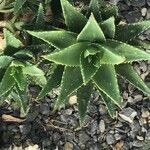
Aloe distans
Short-leaved aloe · Jewelled aloe
Description
Source: leafsnapAloe distans is a succulent plant from the Asphodelaceae family, native to the arid regions of southern Africa, particularly Namibia and South Africa. It features a rosette of fleshy, lance-shaped leaves that are green-grey in color, growing up to 30 cm long. The leaves are adorned with small white teeth along their edges and speckled with white spots. During the summer months, Aloe distans produces tall spikes of tubular flowers in striking shades of orange-red or yellow. These blooms attract pollinators such as bees, butterflies, and birds. Thanks to its attractive foliage and vibrant flowers, Aloe distans is commonly cultivated as an ornamental houseplant. It thrives in well-draining soil and requires moderate watering during its growing season, yet can withstand short periods of drought. Traditionally, Aloe distans has been used in medicine to treat skin conditions like burns and wounds, leveraging its anti-inflammatory properties. Overall, Aloe distans is an appealing succulent that enhances both indoor and outdoor spaces. Additionally, it offers potential medicinal benefits when used appropriately under medical supervision.
Care Guide
💧 Water Every 14 days
Like other succulents, jewel aloes cannot withstand stagnant water. It's important not to overwater them since this will cause root rot. Once established, the plant is drought-tolerant, but light watering is beneficial throughout the growing season—just make sure the soil has time to thoroughly dry between waterings. Watering should be done sparingly when the plant is dormant; once every couple of months is usually sufficient.
☀️ Light Full sun
Originating from dry regions, the Jewelled aloe thrives in full sun, its native habitat defined by intense sunlight and very little shade. It can also tolerate partial sun, providing some adaptability in its growth.
🌡️ Temperature 20–37.8°C
Jewelled aloe does best in warm settings and needs higher temperatures during its growing season to encourage growth and metabolic processes. It benefits from plenty of sunlight, proper moisture levels, and good air circulation. However, it is vulnerable to harm from very low temperatures and from too much watering. It’s important to maintain a balance and to avoid both excessively high heat and overly dry conditions.
💨 Humidity
🪴 Soil 6-7
🌱 Fertilizer
Jewelled aloe should receive light fertilizer applications once or twice a year during the growing season. Do not fertilize in winter or summer when the plant is dormant. Use less fertilizer for plants that have been repotted and wait a few months after repotting before applying fertilizer. Fertilizing promotes healthy growth and helps stimulate blooms.
🪴 Pot & Repot Every 2 years
When repotting Jewelled aloe, pick a pot slightly larger than the current one that provides good drainage. Use a gritty, well-draining mix made for succulents or cacti. Gently lift the plant from its old pot, brush off extra soil, and plant it at the same depth. Wait a few days before watering so any root injury can heal. Repot in spring or fall and place the plant in a brightly lit spot.
✂️ Pruning
You'll have to wait until spring to prune it. Cut the blade from its base, near to the ground, with a sharp knife (not a saw). It is suggested that those closest to the ground level, which are the oldest, be taken. The plant would weaken if the newest ones were removed. Any leaf that is dry or damaged on your plant should be removed. You can pluck little leaves and put them in individual pots if you have them.
🌿 Propagating
🐛 Diseases & pets
☠️ Toxicity
Characteristics
- Plant Type
- Succulent, Shrub
- Life Cycle
- Perennial
- Genus
- Aloe
- Family
- Asphodelaceae
- Hardiness Zone
- 9-11
- Mature Height
- 15 cm
- Mature Spread
- 91 cm
- Leaf Color
- Sky Blue, Pale Green
- Leaf Type
- Evergreen
- Flower Color
- Red, Orange
- Flower Size
- 2.03 cm to 3.05 cm
- Bloom Time
- Winter
- Planting Time
- Spring, Autumn
- Harvest Time
- Late winter, Early spring, Mid spring
- Native Area
- South Africa