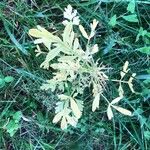
Ammi majus
وایه، گل سفید · زند العروس · خلة · خلة شيطانية · Bishop's-weed
Description
Source: leafsnapAmmi majus, commonly known as Bishop's weed or Queen Anne's lace, is an annual herbaceous plant that belongs to the Apiaceae family. Native to the Mediterranean region, it has now become naturalized in many parts of the world. The plant can grow up to 1 meter tall and features finely divided leaves arranged alternately on its stem. The flowers of Ammi majus are small, white, and grouped in umbels at the ends of its branches. The blooming period extends from June to September, after which the plant produces small fruits, each containing two seeds. Historically, Ammi majus has been used for its anti-inflammatory properties in traditional medicine. It also serves as a natural insecticide and as a food source for certain butterfly species. In gardening, Ammi majus is prized as an ornamental plant due to its delicate white flowers, which add beauty and elegance when planted in borders or combined with other plants in cottage gardens. While it prefers full sun exposure, it can also tolerate partial shade as long as the soil is well-drained. Overall, Ammi majus is a versatile annual herbaceous plant with numerous medicinal and aesthetic uses, making it a popular choice among gardeners worldwide.
🌳 Besides its well-known functions in gardens and traditional medicine cabinets, large bullwort contains an unexpected feature in its stems and flowers: substances that can be used for dyeing textiles. In some regions, local artisans have made use of this lesser-known characteristic to impart fabrics with soft hues, showing an inventive use of large bullwort that links botany and craftsmanship.
🎭 Comfort, refuge
Care Guide
💧 Water Every 3 days
Large bullwort thrives in dry, low-humidity environments similar to its Mediterranean origins, and it is known for its drought tolerance. While it needs to be watered weekly, it grows best outdoors, where the cooler temperatures during the growing season can reduce its watering requirements even further.
How should I water my big bullwort plant?
To water Large bullwort, there are various options you can choose from. You can use a garden hose with a spray nozzle, a watering can, or any other common watering tool you have. The good news is that Large bullwort is not too picky about the type of water they receive. They can thrive on rainwater, tap water, or even filtered water. However, it is best to avoid watering this plant from overhead as it can harm the leaves and flowers and may even cause disease. If possible, it's recommended to set up a drip irrigation system for watering Large bullwort. This method ensures that water is evenly distributed and directly applied to the soil. If you have a container-grown Large bullwort, the same principle applies, but you can use a cup, watering can, or tap to water the plant directly at the soil level.
What should I do if I give my big bullwort plant too much or too little water?
To remedy underwatering for Large bullwort, simply increase watering. However, overwatering is a more serious issue that can lead to disease and death. To prevent this, choose a location with ample sunlight and good drainage. If overwatering occurs in a potted bullwort, consider repotting with well-draining soil and a pot with efficient drainage.
How often should I give water to my Big bullwort plant?
Large bullwort requires regular watering throughout the growing season. In spring, water once a week. As the season progresses and gets warmer, you may need to water two to three times a week. However, exceeding this rate can harm the plant. It's important to keep the soil moist but not wet, regardless of the watering frequency. If the Large bullwort is in a pot, you should increase the watering frequency because the soil in pots dries out faster than ground soil. Typically, water a potted Large bullwort a few times per week compared to once a week for an in-ground plant.
How much water does my big bullwort plant need?
There are a few ways to decide how much water to give your Large bullwort. Some gardeners prefer to feel the soil for moisture and water until the top six inches are moist. Another option is to use a set measurement, like two gallons per week, adjusting for temperature and soil dryness. It's important to be flexible and not automatically give two gallons if your plant needs less. For container gardening, check for dryness by sticking your finger in the soil or watering until you see water coming out of the drainage holes.
Am I giving enough water to my big bullwort?
Avoiding overwatering can be a challenge for Large bullwort plants. These plants have deep roots, so it is necessary to moisten the soil weekly. However, they are highly prone to root rot and browning if overwatered. Underwatering is less likely to occur, as Large bullworts can survive without frequent watering. However, if you wait too long to water the plant, it will start to wilt and develop dry leaves.
☀️ Light Full sun
Large bullwort does best when exposed to plentiful sunlight, though it can tolerate periods of reduced light. Its development can be impeded by either too much or too little light. Native to a sun-rich habitat, large bullwort stays healthiest under similar lighting conditions, especially during its growing stage.
What are the sunlight requirements for Large Bullwort?
Large Bullwort, scientifically known as Ammi majus, thrives under conditions that mimic its natural habitat, which is abundant in sunlight. It requires 'Full sun', meaning it needs above 6 hours of sunlight a day to flourish optimally. However, it can also survive in 'Partial sun', with about 3-6 hours of sunlight daily. Ensuring the right balance of light and shade is crucial for the plant's health and happiness, so observing how sunlight moves through your garden to choose the best spots is recommended.
What essentials should be considered for the wellbeing of Large Bullwort?
Understanding the fundamental needs of Large Bullwort is key to its growth. This plant is best suited to abundant sunlight but can tolerate varying levels of light exposure, both excessive and inadequate, which might impact its growth. Originating from regions with plentiful sunlight, it's advisable to simulate similar conditions, especially during its growth phase. For indoor plants, utilizing artificial lighting can significantly aid in optimal growth, especially when natural sunlight is scarce. LED lights are recommended, as they can be tailored to provide specific light wavelengths needed by the plant. The intensity and duration of artificial lighting should mimic natural conditions, with full sun plants requiring 30-50W/sq ft, partial sun plants 20-30W/sq ft, and shade plants 10-20W/sq ft of light.
What are the symptoms of incorrect sunlight exposure for Large Bullwort?
Large Bullwort shows various symptoms when it doesn't receive adequate sunlight, such as new leaves growing smaller, the plant appearing leggy or sparse, increased leaf dropping, slowed or ceased growth, and leaves becoming lighter in color or yellow (chlorosis). Excessive sunlight exposure can lead to sunscald, where leaves or stems are visibly damaged, leaf curling as a protective response, wilting from excessive transpiration, and leaf scorching characterized by brown, dry, and crispy leaf edges. These symptoms indicate the need for adjusting the plant's light exposure to ensure its health.
How can I best manage Large Bullwort's sunlight exposure indoors and outdoors?
To manage Light Bullwort's sunlight exposure effectively, a gradual approach is recommended. Indoors, plants should be progressively moved to sunnier spots until they receive at least 6 hours of direct sunlight daily, utilizing south-facing windows and keeping curtains open for maximum exposure. Artificial lighting, such as desk or ceiling lamps or specialized grow lights, can be used for plants that are large or difficult to move, ensuring they receive at least 8 hours of light daily. Outdoors, plants should also be gradually moved to more sunlit areas, avoiding drastic changes to prevent sunburn. Note that parts of the plant already affected by insufficient light may not recover, but new growth should be healthy once light conditions improve. Additionally, reducing obstructions like pruning trees and transplanting smaller plants during their dormant period can enhance sunlight access.
🌡️ Temperature 0–37.8°C
Large bullwort is a plant that prospers in a temperate climate, with an ideal temperature range of 68 to 100.4 °F (20 to 38 ℃). It originates from cooler regions but can adapt to warmer climates when necessary. Adjustments in care may be necessary during seasonal changes to maintain optimal growth.
What is Large Bullwort and where does it thrive?
Large Bullwort, scientifically known as Ammi majus, is a plant that prefers a temperate climate, ideally between 68 to 100.4 °F (20 to 38 °C). Originally from cooler regions, it has the ability to adapt to warmer climates when necessary. For optimal growth, adjustments in care might be required with the changing seasons. This plant exhibits strong cold resistance, generally obviating the need for special frost protection measures in winter. However, in cases where winter temperatures are expected to fall below the plant's cold tolerance limit, protective measures such as covering it with soil or straw, and watering abundantly before the first freeze in autumn, are recommended to maintain soil moisture and prevent drought and water scarcity during the colder months.
How should you care for Large Bullwort in low temperatures?
Large Bullwort displays significant cold tolerance and prefers temperatures to remain above its minimum growth threshold. During winter months, it's crucial to ensure that temperatures do not fall below this plant's tolerance limit to prevent adverse effects on its growth. Lower temperatures might not show immediate impact during winter but can lead to reduced or absent sprouting in spring. If parts of the plant fail to sprout with the arrival of spring, these should be removed as part of the plant's care regimen.
What are the care instructions for Large Bullwort in high temperatures?
In the summer, Large Bullwort's ideal temperature should be maintained below its maximum growth tolerance. Exposure to temperatures exceeding this limit can cause the leaves to lighten in color, curl, and become prone to sunburn. In extreme cases, the plant might wilt and dry out. Caring for Large Bullwort in hot conditions involves trimming away sunburned and dried parts of the plant. Moving the plant to shaded areas during the peak sun hours or using a shade cloth can protect it from direct sunlight. Additionally, watering the plant in the morning and evening can help in keeping the soil moist and aiding in the plant's recovery from high temperature stress.
💨 Humidity
🪴 Soil 6-7
🌱 Fertilizer
Large bullwort benefits from regular, diluted fertilizer applications to encourage healthy leaf development. You should fertilize Large bullwort about once a month during the summer. Nitrogen is essential for foliage, and providing nitrogen-rich sources helps Large bullwort thrive.
Why should I add fertilizer to my big bullwort plant?
Some plants can get all the nutrients they need without extra fertilizer. However, plants like large bullwort need nutrients for growth and internal processes. Among the main nutrients that plants use (nitrogen, phosphorus, and potassium), nitrogen is especially important for foliage growth. Large bullwort may struggle to get enough nitrogen from the soil, so many gardeners choose to supplement it with a nitrogen source.
When should I fertilize my big bullwort?
Large bullwort generally grows well, but it is beneficial to apply fertilizer about once a month while it is actively growing. During the spring and summer months, you should fertilize Large bullwort once a month. However, during fall and winter when the plant is less active and requires fewer nutrients, fertilization is not necessary. To determine when to start fertilizing, look for signs of new growth. Whether the plant is grown outside or indoors in a container, the fertilization schedule remains the same. If your Large bullwort is in a container, you may not need to fertilize for the first one to two months. Container plants often have enough nutrients in the potting soil, so you should start fertilizing after the plant has been in the same soil for a while.
When should I not put fertilizer on my Large bullwort?
To ensure the best results, refrain from fertilizing a Large bullwort that is not in good health. This includes instances where the plant has contracted a disease or has been affected by insect pests. Similarly, avoid fertilizing a dehydrated plant, as this will only exacerbate the problem. It is advisable to only fertilize plants that are deemed to be in a healthy state. When watering the plant, take care not to splash fertilizer onto its leaves or stem, as this can create burned spots. Furthermore, it is important to avoid direct contact between the plant and the fertilizer, unless you are using a specialized fertilizer designed for foliage application.
What kind of fertilizer does my big bullwort plant need?
Fertilizers, like all-purpose fertilizers with a 10-10-10 NPK number, contain high levels of nitrogen, potassium, phosphorus, and other essential nutrients such as iron, manganese, and zinc. These elements are necessary for promoting growth in Large bullwort. Nitrogen, in particular, is important for supporting the growth of leaves, which is a main feature desired in Large bullwort. Natural fertilizers like blood meal or worm castings can also be used. If your goal is not to encourage flowers or seeds, there is no need to provide excessive supplements for those aspects.
How do I make my Big bullwort plant healthy and strong?
To properly fertilize your Large bullwort, follow these steps: 1. Start with half-strength fertilizer to avoid over-fertilizing. This plant often gets over-fertilized accidentally due to its frequent fertilization needs. Remember, it's easier to add more fertilizer later than to try to save an over-fertilized plant. 2. Only apply fertilizer to moist soil, not to dry soil. Make sure the soil is already somewhat moist before fertilizing. This helps the fertilizer absorb better and prevents fertilizer burn. After applying dry fertilizers, water the soil. 3. There are different ways to apply fertilizer depending on the type. Some fertilizers should be mixed into the soil during planting, while others should be applied on top of the soil and then watered in. For most Large bullwort plants, using a water-soluble fertilizer is a simple choice. Just mix the fertilizer solution into your watering can following the recommended dosage for Large bullwort, and then water the plant as usual. 4. If you don't want to remember to fertilize every month, you can use slow-release granules or fertilizer spikes instead. These options provide a longer-lasting source of nutrients for the plant.
🪴 Pot & Repot
When repotting Large bullwort, choose a pot that is 1-2 inches (2.5–5.1 cm) larger in diameter and has good drainage. Use a well-draining potting mix, and consider adding perlite for extra drainage. Repot during spring or early summer, then water thoroughly, and place it in a shady spot at first.
✂️ Pruning
Large bullwort features delicate white umbels and fern-like leaves. Prune the plant from early to late spring to remove damaged stems and improve airflow. Light pruning encourages healthy growth and blooms. Tailor your pruning techniques based on the plant's vigor to achieve the best results.
🌿 Propagating
🐛 Diseases & pets
☠️ Toxicity
Characteristics
- Plant Type
- Herb
- Life Cycle
- Annual, Perennial
- Genus
- Ammi
- Family
- Apiaceae
- Hardiness Zone
- 2-11
- Mature Height
- 76 cm to 91 cm
- Mature Spread
- 34 cm to 46 cm
- Leaf Color
- Green
- Leaf Type
- Deciduous
- Flower Color
- White
- Flower Size
- 10.16 cm
- Bloom Time
- Late spring, Early summer, Mid summer
- Planting Time
- Spring
- Harvest Time
- Mid summer
- Native Area
- Saudi Arabia, Libya, Egypt, Turkey, Tunisia, Montenegro, Eritrea, Cyprus, Greece, Croatia, Slovenia, Morocco, Yemen, Ukraine, Lebanon, Iraq, Portugal, Syria, Italy, Spain, Oman, Iran, Ethiopia, Albania, Algeria, France