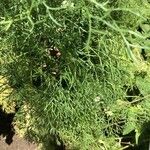
Ammi visnaga
Bisnaga · Lesser bishop's-weed · Toothpick ammi · Toothpickplant · Khella
Description
Source: leafsnapVisnaga daucoides is a species of flowering plant in the carrot family known by many common names, including toothpick-plant, toothpickweed, bisnaga, khella, or sometimes bishop's weed. It is native to Europe, Asia, and North Africa, but it can be found throughout the world as an introduced species. This is an erect annual plant growing from a taproot to a maximum height near 80 centimeters. The leaves are up to 20 centimeters long and generally oval to triangular in shape but dissected into many small linear to lance-shaped segments. The inflorescence is a compound umbel of white flowers similar to those of other Apiaceae species. The fruit is a compressed oval-shaped body less than 3 millimeters long. This species is a source of khellin, a diuretic extract. Like its close relative Ammi majus, Visnaga daucoides is commonly seen in gardens where it is grown from seed annually.Some authorities regard Visnaga daucoides as a synonym of Ammi visnaga; and it is still widely referenced under that name.
Care Guide
💧 Water
☀️ Light Full sun
Toothpickweed grows best when exposed to plentiful daytime light. However, it can tolerate light shade, reflecting its resilience and adaptability. Adequate sunlight is essential for its health and development. Insufficient light can stunt growth, while excessive exposure may cause wilting or burning.
🌡️ Temperature 0–37.8°C
Toothpickweed originates in temperate environments where temperatures are typically between 68 to 100 °F (20 to 38 °C). It generally prefers that temperature range, though it may need seasonal adjustments for proper growth.
💨 Humidity
🪴 Soil 6-7
🌱 Fertilizer
When the majority of Toothpickweed's blooms have fully opened, resume fertilizing. Around the peak bloom period, apply fertilizer every three to four weeks, weather permitting. Then, once Toothpickweed begins producing fewer new blooms, stop fertilizing; there is no need to feed the plant when it can no longer produce additional flowers.
🪴 Pot & Repot
✂️ Pruning
🌿 Propagating
🐛 Diseases & pets
☠️ Toxicity
Characteristics
- Plant Type
- Herb
- Life Cycle
- Annual, Biennial, Perennial
- Genus
- Ammi
- Family
- Apiaceae
- Hardiness Zone
- 2-11
- Mature Height
- 76 cm
- Mature Spread
- 61 cm
- Leaf Color
- Green
- Leaf Type
- Evergreen
- Flower Color
- White
- Flower Size
- 0.25 cm to 0.51 cm
- Bloom Time
- Early summer, Mid summer
- Planting Time
- Spring, Summer, Autumn
- Harvest Time
- Late summer, Early fall
- Native Area
- Saudi Arabia, Libya, Egypt, Turkey, Tunisia, Cyprus, Armenia, Greece, Croatia, Morocco, Yemen, Lebanon, Iraq, Portugal, Syria, Italy, Spain, Iran, Albania, Azerbaijan, Algeria, France