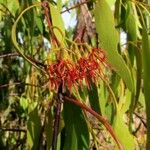
Amyema miquelii
Box misteltoe
Description
Source: leafsnapAmyema miquelii, also known as box mistletoe, is a species of flowering plant, an epiphytic hemiparasitic plant of the family Loranthaceae, found attached to several species of Australian eucalypt and occasionally on some species of Acacia. It is the most widespread of the Australian Mistletoes, occurring mainly to the west of the Great Dividing Range. It has shiny leaves and red flowers arranged in groups of 3. It is distinguished from the similar Amyema pendula through the individual stalks of the flowers. The seeds are dispersed by various birds, particularly by the mistletoebird (Dicaeum hirundinaceum) that eat the fruit and then either wipes the sticky remains from the beak or when defecating has to wipe it from its feathers onto, most often, a twig due to the extremely sticky nature of the seed. The seed immediately begins to germinate and soon penetrates the vascular system of the tree and creates a physiological connection with the xylem of the new host. From that point, the seedling begins to obtain water and mineral nutrients from the host.
Care Guide
💧 Water
☀️ Light Full sun
Box misteltoe is found in open habitats, like sunny meadows and forest edges, where there is plenty of light. It does best in Full Sun but can also tolerate Partial Sun, showing good adaptability to different light levels.
🌡️ Temperature 20–37.8°C
Box misteltoe is highly adaptable to a range of climate conditions, from blazing summers to frosty winters. Nevertheless, it has a preferred temperature range for healthy growth. If temperatures become too high, the plant can experience heat and humidity stress that may lead to its death. In areas where temperatures near the lower edge of its cold tolerance, providing insulation to protect the plant is necessary.
💨 Humidity
🪴 Soil 6-8
🌱 Fertilizer
Fertilize your Box misteltoe in early spring to encourage healthy growth. Regular feeding boosts overall health, promoting vigorous development, greater tolerance of harsh conditions, and enhanced resistance to pests and diseases. Adhere to a specific fertilization schedule to keep the foliage vivid, richly colored, and lush in appearance.
🪴 Pot & Repot
✂️ Pruning
🌿 Propagating
🐛 Diseases & pets
☠️ Toxicity
Characteristics
- Plant Type
- Vine
- Life Cycle
- Perennial
- Genus
- Amyema
- Family
- Loranthaceae
- Hardiness Zone
- 9-11
- Mature Height
- 30 cm to 91 cm
- Mature Spread
- 0.49 m to 1.52 m
- Leaf Color
- Olive Drab, Dark Olive Green
- Leaf Type
- Evergreen
- Flower Color
- Red, Orange
- Flower Size
- 1.02 cm to 2.03 cm
- Bloom Time
- Fall
- Harvest Time
- Winter