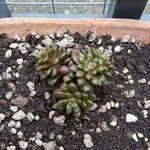
Anacampseros retusa
Description
Source: leafsnapAnacampseros retusa is a species of succulent plant native to the Northern Cape and Western Cape Provinces of South Africa, as well as to Namibia.
Care Guide
💧 Water
☀️ Light Partial sun
Anacampseros retusa comes from habitats with dappled light, such as the understory of forests or rocky sites that provide natural shade. It prefers partial sun but can also tolerate full sun.
🌡️ Temperature 20–37.8°C
Anacampseros retusa tolerates some heat, but it mainly thrives and grows during the cooler seasons, becoming dormant in summer. In hot summer temperatures, provide shade to prevent scorching from intense sunlight. Watering should be reduced or stopped during the hottest season to prevent root rot. Anacampseros retusa grows most vigorously in winter and spring. As long as the temperature doesn't drop too low, it will continue to grow steadily.
💨 Humidity dry (<40%)
This plant prefers dry conditions, so don't mist it. However, watering it less often can also thrive in higher humidity.
🪴 Soil 6-7
🌱 Fertilizer
Anacampseros retusa needs only light applications of fertilizer once or twice a year during the growing season. Do not fertilize in winter or summer when the plant is dormant. Use less fertilizer on repotted specimens and wait a few months after repotting before applying fertilizer. Fertilizing helps maintain healthy growth and promotes flowering.
🪴 Pot & Repot Every 2 years
When repotting Anacampseros retusa, choose a pot just a bit larger than the current one that has good drainage. Use a gritty, well-draining cactus or succulent mix. Gently lift the plant from its old pot, remove excess soil, and set it into the new pot at the same planting depth. Wait a few days before watering to allow any root injury to heal. Repot in spring or fall and place the plant in a brightly lit location.
✂️ Pruning
Anacampseros retusa is a slow-growing succulent known for its fleshy rosettes. To encourage new growth, prune it in early spring by removing any dead leaves. Be sure to use sterile tools to prevent infections. Pruning not only helps maintain a compact and sturdy structure but also improves airflow and light penetration. However, be careful not to remove too many leaves, as this can stress the plant.
🌿 Propagating
🐛 Diseases & pets
☠️ Toxicity
Characteristics
- Plant Type
- Succulent
- Life Cycle
- Perennial
- Genus
- Anacampseros
- Family
- Anacampserotaceae
- Hardiness Zone
- 9-11
- Mature Height
- 5 cm to 10 cm
- Mature Spread
- 10 cm to 15 cm
- Leaf Color
- Dark Green, Light Green
- Leaf Type
- Evergreen
- Flower Color
- Pink
- Flower Size
- 1.02 cm to 2.03 cm
- Bloom Time
- Summer, Early fall
- Planting Time
- Spring, Summer, Autumn
- Harvest Time
- Late summer, Fall
- Native Area
- South Africa, Namibia