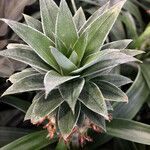
Ananas comosus
Pineapple · Ananas · Phaeneapole · అనాస · Manas
Description
Source: leafsnapThe pineapple (Ananas comosus) is a tropical plant with an edible fruit; it is the most economically significant plant in the family Bromeliaceae. The pineapple is indigenous to South America, where it has been cultivated for many centuries. The introduction of the pineapple to Europe in the 17th century made it a significant cultural icon of luxury. Since the 1820s, pineapple has been commercially grown in greenhouses and many tropical plantations. Pineapples grow as a small shrub; the individual flowers of the unpollinated plant fuse to form a multiple fruit. The plant is normally propagated from the offset produced at the top of the fruit, or from a side shoot, and typically matures within a year.
🌳 Pineapple is not just a tropical delicacy but also provides many uses beyond human consumption. For example, pineapple leaves are made into a fine, luxurious fabric called piña cloth, valued for its delicacy and commonly used in the Barong Tagalog, the national garment of the Philippines. The plant also provides animal feed: foliage and other byproducts from pineapple processing can be used in livestock diets to cut waste and support sustainability in agriculture.
🎭 Flawlessness, riches
Care Guide
💧 Water
Pineapples, native to tropical regions, thrive in warm and humid environments. They need regular watering, roughly once a week, to mimic their natural conditions, but be careful not to overwater as this can lead to waterlogging. Being an evergreen plant, pineapples benefit from proper watering during their active growth phase, which promotes healthy growth and lush foliage.
When Should I Water My Pineapple?
Proper and timely watering is crucial for the health and development of a pineapple, which includes optimal growth, vibrant fruit production, and disease resistance. The key to knowing when to water your pineapple is by checking the soil's moisture level. Insert your finger about 1 to 2 inches deep into the soil; if it feels dry, it's time to water. Additionally, signs such as wilting, yellowing, or browning leaves, and stunted growth also indicate the need for watering. During the fruit production stage, pineapple requires consistent watering, and adjustments should be made in response to temperature and humidity changes. Be mindful of the risks of both over-watering and under-watering to maintain the plant’s health.
How Should I Water My Pineapple?
To water your pineapple effectively, you should be aware of its preference for well-drained soil conditions, avoiding waterlogged situations that can lead to root rot. Utilize a small watering can with a long spout to direct water to the base of the plant, keeping the foliage dry to prevent disease. Using a moisture meter can help ascertain the ideal time for watering again, keeping the soil's moisture level optimal. Focus the water near the pineapple's base, avoiding the foliage, and consider using distilled, rain, or filtered water to avoid chlorine or fluoride harm. For those in dryer indoor environments, occasional misting may help, but ensure the foliage dries to avoid fungal issues. Alternatives like bottom-watering can also be effective for maintaining moisture without over-watering.
How Much Water Does Pineapple Really Need?
The optimal water quantity for a pineapple depends on various factors, including pot size, root depth, and the plant's overall size. A general guideline is to water with about 1-1.5 inches (2.5-3.8 cm) of water per week, allowing the soil to slightly dry out between waterings. Signs of proper hydration include healthy green leaves and ongoing growth. Conversely, signs of under-watering include dry, crispy, or yellowing leaves, while over-watering may cause leaves to turn yellow or pale green, indicating potential root rot. Ensuring thorough watering without stagnation is key, taking care to avoid wetting the leaves or plant center directly.
What Kind of Water is Best for Pineapple?
The best types of water for pineapple plants are distilled, rain, or filtered water. Rainwater is particularly recommended due to its softness and natural acidity, which aligns with the plant's needs. Tap water can be used if treated to remove chlorine or set out to allow chlorine to evaporate. Pineapple plants are sensitive to cold water, which can shock and damage them, so always use room temperature or slightly warmer water. The right type of water helps the plant absorb nutrients effectively and avoid illnesses related to poor water quality.
How Do Pineapple's Watering Needs Change with the Seasons?
Pineapple's watering needs vary with the seasons. In spring, consistent soil moisture is crucial to support its active growth phase. In summer, you may need to reduce watering frequency slightly as some varieties go into a natural dormancy. Autumn calls for a gradual reduction in watering as the plant readies for winter dormancy. During winter, water sparingly, as pineapple's moisture needs are minimal, allowing the topsoil to dry out between waterings. Seasonal adjustments are key to maintaining the plant's health and promoting growth.
☀️ Light Full sun
Pineapple needs substantial sunlight for the healthiest growth. Its native environment has abundant sunshine, though it can moderately tolerate places with less than full sun. Be careful, however: too little light can stunt growth, while too much can cause burns.
What are the sunlight requirements for growing pineapples?
Pineapples require significant amounts of sunlight for the healthiest growth, ideally thriving in full sun exposure of above 6 hours of sunlight per day. They can moderately adapt to partial sun or full shade conditions, receiving about 3-6 hours of sunlight. It's essential to observe the movement of sunlight in your garden to find the optimal balance of light and shade for your plants. However, a lack of light may stunt growth, while too much can cause burns, so monitoring and adjustments are crucial for pineapple cultivation.
How can artificial lighting support pineapple plant growth indoors?
Indoor pineapple plants benefit greatly from adequate lighting, especially when natural sunlight is insufficient. Artificial lights, particularly LED lights, are effective because they can provide the specific wavelengths needed by plants. For full sun plants, 30-50W/sq ft of artificial light is recommended, 20-30W/sq ft for partial sun plants, and 10-20W/sq ft for full shade plants. The light source should be placed 12-36 inches above the plant to mimic natural sunlight. Most plants require 8-12 hours of light per day, so it's important to mimic the natural daylight hours as closely as possible.
What are the symptoms of improper lighting for pineapple plants?
Pineapple plants exhibit several symptoms when they experience unsuitable light conditions. When there is not enough light, growth may slow down or stop, and new leaves may appear lighter in color or develop irregular patterns, indicating a lack of chlorophyll and nutrients. Too much sunlight can lead to chlorosis, where leaves lose their green color, and sunscald, resulting in pale, bleached areas on the plant tissue. Other symptoms include leaf curling, wilting, and leaf scorching, which are the plant's responses to extreme sunlight exposure and water loss.
How can I manage my pineapple plant's exposure to sunlight?
Managing your pineapple plant's sunlight exposure involves a few strategies to ensure optimal growth. Indoors, gradually moving the plant to sunnier locations to achieve at least 6 hours of direct sunlight daily is crucial. Utilize a south-facing window and consider artificial lighting if the plant is large. Outdoors, plants should be moved gradually to sunnier spots to prevent sunburn. If trees block sunlight, pruning can help. For smaller plants, transplanting during the dormant period to a location with better sunlight and drainage is beneficial. Remember, while parts of the plant that suffered from inadequate light may not recover, new growth should be healthy with improved light conditions.
🌡️ Temperature 20–37.8°C
The natural growing climate for pineapple is in tropical and subtropical areas, with temperatures between 20 and 38 ℃ (68 to 100.4 ℉). Although it prefers warm conditions, it can tolerate a range of temperatures. In colder periods, it is advisable to keep temperatures at least 16 ℃ (60.8 ℉) to avoid damage to the plant.
What are the ideal temperature conditions for growing pineapples?
Pineapples thrive in tropical and subtropical environments, preferring temperature ranges from 20 to 38°C (68 to 100.4°F). They can adapt to various temperatures but fare best in warm conditions. To avoid damage during colder seasons, it's advisable to maintain temperatures above 16°C (60.8°F). If you're cultivating pineapple indoors during winter, ensure the plant is moved to a location that receives ample sunlight, preferably near a south-facing window, while keeping it away from heaters or air conditioners to prevent the air from becoming excessively dry. Indoor temperatures should ideally be kept above 20°C, and watering should be reduced, allowing the soil surface to dry before watering again to avoid root rot. For outdoor plants needing to overwinter, place them in a sheltered, sunny spot, possibly using a temporary greenhouse or wrapping with protective materials, and reduce watering to keep the soil slightly moist.
How should pineapples be cared for during low temperatures?
Pineapples are sensitive to cold and thrive best when temperatures are above 20°C. During winter, ensure temperatures stay above 0°C to prevent damage. If the temperature drops below -5°C, the plant's leaves may initially show no symptoms, but they will begin to wither and droop after three to five days, potentially leading to the plant drying up entirely in severe cases. To protect pineapples from cold, trim any frostbitten areas, and promptly move the plants indoors to a warmer environment. Position them near a south-facing window for maximum sunlight and avoid placing them close to heaters or air conditioning vents to keep air humidity at optimal levels.
What measures should be taken when pineapples are exposed to high temperatures?
In high temperatures, particularly above 38°C during summer, the tips of pineapple leaves may dry and wither, growth can halt, and the plant becomes susceptible to root rot. Excessive sunlight can also lead to sunburn. To mitigate these issues, remove any withered parts of the plant and position it in a location where it can receive shade during the intense midday and afternoon sun. It's beneficial to water the plant in the early morning and evening, maintaining moisture levels both for the plant and the surrounding environment.
💨 Humidity normal (40-60%)
This plant will thrive in moderate humidity, which is probably the level in your home. However, misting it a few times a week can be very beneficial. Make sure the room has good ventilation.
🪴 Soil 4-6
🌱 Fertilizer
Use organic fertilizers (for example, fish emulsion or compost) instead of chemical ones for Pineapple. Give young plants extra nitrogen and phosphorus in spring. Work compost or fertilizer into the soil either before or after planting. For established plants, apply a balanced fertilizer or one targeted to specific deficiencies in spring. Nutrient shortages result in small leaves, short shoots, yellow or bronze foliage, sour fruits, early fruit drop, and fruit splitting.
Why is it necessary to give my Pineapple plant fertilizer?
If the soil in your area is rich, you may not need to fertilize. However, if the soil lacks nutrients, a Pineapple will struggle to grow leaves, flowers, and fruits. Testing the soil is the best way to identify which nutrients are abundant and which are lacking. Insufficient nutrients can result in small leaves, stunted branches, yellow or bronze foliage, and less tasty, more acidic fruits. Certain deficiencies can also cause premature fruit dropping or splitting.
When should I fertilize my Pineapple for the best results?
To support strong leaf and root development in young Pineapples, it is recommended to provide higher nitrogen and phosphorus fertilizer. The best time for fertilizing is during the spring of the first growing season. Before or right after planting, it is beneficial to add compost or another fertilizer to the soil. For mature Pineapple plants, supplement with a balanced fertilizer or specific soil deficiency addressing fertilizer every few years during the spring and summer as needed. It is important to avoid fertilizing Pineapples in the autumn or winter seasons.
When is it not a good idea to fertilize my Pineapple plant?
To ensure the health of your Pineapple plant, avoid fertilizing it after pruning or when it is facing disease, insect infestations, or any kind of stress. Keep in mind that fertilizer is only effective in treating nutrient deficiencies in the soil and cannot solve other problems that could harm your Pineapple. It is important to accurately diagnose the issue to prevent unnecessarily adding fertilizer when the real cause lies elsewhere. In addition, refrain from fertilizing Pineapple during winter or during excessively hot and dry periods in the summer.
What kind of fertilizer should I use for my Pineapple plant?
Most types of Pineapple thrive in tropical locations with plenty of decaying organic matter in their natural environment. While they can benefit from fertilizer to meet their macronutrient and micronutrient needs, when growing Pineapple for fruit, it's best to use a high-phosphorus organic fertilizer like mushroom compost, bone meal, or poultry manure. These will help support the development of delicious and well-formed fruits. When buying fertilizer, you'll notice a number (NPK) on the label that represents the ratio of nitrogen, phosphorus, and potassium. The most common nutrient deficiency in soil is low nitrogen, but getting a soil test done is the best way to determine which specific nutrients might be lacking in your soil and need extra supplementation.
How can I make my pineapple plant grow better?
Follow the instructions on the fertilizer you choose. It is better to use too little fertilizer than too much, so be cautious when adding fertilizers. This is particularly important with chemical fertilizers, which are generally more concentrated than organic fertilizers. Liquid fertilizers are usually mixed with water and used to water the Pineapple plant. Granular or dry fertilizers can be spread around the base of the plant, making sure to avoid direct contact with any part of the plant. It is common to use fertilizer once every 2-3 weeks during the growing season. For organic fertilizers, they can be mixed into the soil before planting or spread on top of the soil for newly planted or mature plants.
🪴 Pot & Repot 2-3 years
When repotting Pineapple, choose a pot 1–2 inches (2.5–5.1 cm) larger with ample drainage. Use a well-draining potting mix. Repot in spring or fall, making sure the root ball is slightly lower than the rim of the flower pot. Water thoroughly after repotting and place in a warm spot with indirect sunlight.
✂️ Pruning
The tropical pineapple plant benefits from careful pruning, especially in early summer. By removing dead leaves and suckers, you can promote growth and increase the fruit yield. Pruning also improves air circulation, which helps reduce the risk of diseases. Always remember to sterilize your tools to prevent infections during the pruning process.
🌿 Propagating
🐛 Diseases & pets
☠️ Toxicity
Ananas cosmos skin is not toxic although unripe flesh and leaves have a toxic effect, it contains enzyme bromelain, which is used as a meat tenderizer and is considered very low in toxicity.
Characteristics
- Plant Type
- Herb
- Life Cycle
- Perennial, Annual
- Genus
- Ananas
- Family
- Bromeliaceae
- Hardiness Zone
- 9-11
- Mature Height
- 0.91 m to 1.52 m
- Mature Spread
- 0.91 m to 1.22 m
- Leaf Color
- Green, Red
- Leaf Type
- Evergreen
- Flower Color
- Purple, Red, Yellow
- Flower Size
- 2.03 cm
- Bloom Time
- Early summer, Mid summer
- Planting Time
- Spring, Autumn
- Harvest Time
- Spring, Late summer, Fall, Winter
- Native Area
- Guyana, Colombia, Venezuela, Brazil