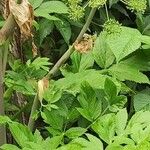
Angelica atropurpurea
American angelica · Alexanders · Great angelica · Masterwort · Purple angelica
Description
Source: leafsnapAngelica atropurpurea, known commonly as purplestem angelica, great angelica, American angelica, high angelica, and masterwort, is a species of flowering plant that can be found in moist and swampy woodlands, mostly by riverbanks, in eastern North America. It has been found in eastern Canada (Nunavut, Ontario, Quebec, Labrador, Newfoundland, all 3 Maritime Provinces) and the United States (from New England south as far as North Carolina, and west to Minnesota, Iowa, and Tennessee).The plant grows to 6 ft (180 cm) tall. The erect, branching stem is purple, smooth, hollow, and sturdy. The leaves are divided into segments. The total width of a lower leaf may be up to 2 ft (61 cm). The plant has white to greenish flowers in umbrella-like umbels. One umbel may have as many as 40 branches and be up to 8 in (20 cm) across. The stalks can be eaten like celery and the flavor is similar. Early American settlers boiled parts of the plant to make into candy and added it to cakes. In Europe, it was believed that the plant could cure alcoholism.The aromatic root of angelica has widespread use as a purification herb among the Native American cultures. In California, it is often burned during a shaman's prayers in a healing ceremony. It has traditionally been held in high esteem by native peoples in Arkansas, who have often carried it in their medicine bags and mixed it with tobacco for smoking. In the Mvskoke Creek tribes of Alabama, Oklahoma, and Northwest Florida, Angelica atropurpurea (known as notossv in the Creek language) has both medicinal and ceremonial uses. Medicinally, notossv is used by the Creeks to: cure back pain in adults; to calm panic attacks or people that are in hysterics; as a vermifuge in children; as well as treating stomach disorders. Mvskoke Creek Ceremonial uses include preventing heat stroke during the Ribbon Dance in the Green Corn Ceremony, aiding ceremonial singers, and to help those in legal trouble.
🌳 Because purplestem angelica can build up manganese in its tissues, it has been identified as a potential bioindicator for that metal in environmental monitoring. Studies have explored how well purplestem angelica reflects manganese concentrations—and possibly those of other heavy metals—in the adjacent soil, a characteristic that could be applied in bioindication and phytoremediation research.
🎭 Expelling spirits, Safeguarding, Restoration
Care Guide
💧 Water Every 7 days
Purplestem angelica thrives in moist conditions, needing weekly watering to stay properly hydrated. Although it prefers consistent moisture, it can withstand short periods of dryness. Covering it with a layer of mulch in outdoor environments helps retain moisture, mimicking the leaf litter found in its natural habitat.
How should I water my Purplestem angelica plant?
To properly care for the Purplestem angelica plant, use filtered water at room temperature. Tap water may contain harmful particles, so filtered water is better. It's important to use room temperature water or slightly warmer because the plant is accustomed to warm environments and cold water can be a shock to its system. Instead of overhead watering, you should water the plant by applying filtered room temperature water to the soil until it is fully soaked. This helps moisten the roots, allowing them to spread and collect the necessary nutrients. Avoiding overhead watering prevents foliage problems.
What should I do if I give too much or too little water to my Purplestem angelica plant?
Overwatering is a common issue with Purplestem angelica plants and can cause wilting, yellowing leaves, and diseases like root rot. Underwatering is less common but can result in brittle, brown leaves. It's important to recognize signs of overwatering early to prevent irreversible damage. Reduce watering if you notice early signs and consider using well-draining potting mix if the soil doesn't drain well. If your plant is not getting enough water, simply increase the watering frequency until the signs improve.
How frequently should I give water to my Purplestem angelica plant?
"If your Purplestem angelica plant is in a pot, the best way to know when it needs water is to check the soil. Stick your finger into the soil and if the top two to three inches feel dry, it's time to water it. If you have your Purplestem angelica planted outdoors in the ground, you can use the same method to test the soil. When you find that the first few inches of soil have dried out, it's a sign that you should water it. Typically, during spring and early fall, you'll need to water this plant about once a week using this method. If the weather becomes extremely hot, you may need to increase watering to two or more times per week. However, it's worth noting that mature, well-established Purplestem angelica plants have a remarkable ability to withstand drought."
How much water does my Purplestem angelica plant need?
When watering your Purplestem angelica, do not hold back on the amount of water you give. Make sure that the top two to three inches of soil are dry before watering. It's best to give the plant a deep and thorough watering, making sure to completely saturate the soil. The water should flow out through the drainage holes at the bottom of the pot. If you don't see excess water draining, it means you haven't watered enough. However, be careful not to let water accumulate in the soil, as this can harm the plant. Also, if the water doesn't drain properly, it could be a sign that the soil is not draining well, which is bad for the plant's health. If the plant is outside, receiving 1 inch of rain per week will be enough.
How should I water my Purplestem angelica as it grows?
The water needs of the Purplestem angelica vary depending on growth stages. In the first few years and after transplanting, more water is needed as the plant focuses on developing new roots to support future growth. These roots benefit from slightly higher moisture levels. As the plant matures, less water is required. Additionally, during the blooming period, the flower development requires a significant amount of moisture, necessitating more water for the Purplestem angelica at this time.
☀️ Light Partial sun
Purplestem angelica does best under a canopy that supplies moderate light, though it can adjust to spots with higher sun exposure. In its natural range it is generally found in semi-open sites sheltered from intense rays. Too little light can limit its growth, while excessive exposure can be harmful, especially in hot weather.
What are the sunlight requirements for Purplestem angelica?
Purplestem angelica thrives best under moderate light conditions but can acclimate to areas with more sun exposure, typical of its semi-open, native habitats. For healthy growth, it needs a balance of light and shade, with partial sun being about 3-6 hours of sunlight and full sun requiring above 6 hours. It's essential to observe how sunlight moves through your garden to find spots offering this balance, ensuring the plants' happiness. In conditions of excessive exposure, especially in hot climates, the plant may suffer detrimental effects.
How can artificial lighting be used for Purplestem angelica indoors?
Indoor Purplestem angelica plants require adequate lighting for optimal growth. When natural sunlight is insufficient, particularly in winter or less sunny spaces, artificial lights provide a crucial alternative. LED lights are a popular choice since they can be tailored to emit specific wavelengths necessary for the plant. The requirement for artificial lighting varies by plant type: full sun plants need 30-50W/sq ft, partial sun plants need 20-30W/sq ft, and full shade plants need 10-20W/sq ft. The light source should be placed 12-36 inches above the plant to mimic natural light and be kept on for 8-12 hours per day to simulate natural daylight conditions.
What are the symptoms of inadequate or excessive light in Purplestem angelica?
Symptoms of inadequate light include smaller new leaves, leggy or sparse growth, faster leaf drop, slower or halted growth, and paler new leaves. Chlorosis, or the loss of green leaf color turning to yellow, suggests too much sunlight, as do symptoms like sunscald which shows as pale or necrotic spots, leaf curling to minimize water loss, wilting due to excessive transpiration, and leaf scorching characterized by brown, dry edges on leaves. These symptoms indicate that the plant's light conditions need to be adjusted for better health.
What solutions are recommended for light-related issues in Purplestem angelica?
To optimize Purplestem angelica's growth in terms of lighting, indoors, you can gradually shift the plant to sunnier spots each week until it receives 3-6 hours of direct sunlight daily for adjustment or use desk, ceiling lamps, or grow lights for at least 8 hours daily if the plant is large or hard to move. Outdoors, gradually moving the plants to sunnier locations each week helps prevent sunburn. Reducing obstructions like pruning trees can increase sunlight exposure. For ground plants, consider transplanting during their dormant period to a brighter location with ample sunlight and good drainage. Note that parts of the plant damaged by insufficient sunlight might not recover, but new growth will be healthy with better light exposure.
🌡️ Temperature 5–32.2°C
Purplestem angelica grows best in temperatures between 41 and 90 ℉ (5 and 32 ℃). It is commonly found in cooler climates and can tolerate some frost and mild freezes. In summer it may need some shade and more frequent watering to stay cool.
What is the preferred temperature range for Purplestem angelica, and how does it handle different temperatures?
Purplestem angelica thrives in temperatures ranging from 41 to 90 °F (5 to 32 °C), preferring cooler climate conditions. It is highly cold-tolerant, able to withstand frost and mild freezes without requiring additional protection measures. In the winter, it's suggested to water the plant generously before the first freeze to keep the soil moist, helping to prevent drought and water scarcity during winter and early spring. During hot summer months, Purplestem angelica may require shade and increased watering to stay cool, as it struggles with high temperatures. Exceeding its comfort temperature range can halt its growth and increase susceptibility to rot.
How should I care for Purplestem angelica in extremely low or high temperatures?
In conditions of extreme cold, Purplestem angelica shows remarkable tolerance, though it is essential to keep the winter temperature above a certain minimum to ensure sprouting in spring. If temperatures fall below this threshold, there might be less or no sprouting, and the recommendation is to remove any parts that failed to sprout as spring arrives. For high temperatures, which Purplestem angelica is not tolerant of, you should move the plant to a shaded location or use a shade cloth to protect it from the midday and afternoon sun. Additionally, to address the risk of rot under hot conditions, trim away any sunburned or dried parts and ensure the soil remains moist by watering in the morning and evening.
💨 Humidity
🪴 Soil 6-7
🌱 Fertilizer
One fertilizer application in spring is generally enough for Purplestem angelica, though additional feedings can boost growth. Apply fertilizer about once every month to a month and a half. Fertilizing improves the leaves' appearance and function, helping keep color even and texture healthy. It also promotes root development and nutrient uptake, supporting long-term plant health.
Why is it necessary to fertilize my Purplestem angelica plant?
The Purplestem angelica relies on its leaves for its main structure, so it's important to fertilize them effectively. By fertilizing properly, you can ensure that the leaves of your Purplestem angelica have a vibrant color and healthy texture. Fertilization also has benefits below the soil's surface, as it helps the plant develop new roots and maintain existing ones. This means that fertilization not only keeps the plant healthy in the present but also improves its ability to absorb nutrients in the future.
When should I fertilize my Purplestem angelica?
If you grow your Purplestem angelica outdoors, it will start sprouting new growth in early spring. This is a signal to begin fertilizing for the year. Usually, applying fertilizer once in the spring is sufficient. But if you want your plant to grow even more, you can fertilize it multiple times throughout the spring and early summer. In this case, you can feed your Purplestem angelica every month to month and a half.
When is the best time to not use fertilizer on my Purplestem angelica plant?
During late fall and winter, your Purplestem angelica goes into a dormant phase with no new growth. Therefore, you should avoid fertilizing it during this time. During spring and summer, if you choose to fertilize, start decreasing the amount as summer approaches because the growth rate of your Purplestem angelica will slow down. In general, it's not recommended to fertilize your Purplestem angelica when the weather is unusually hot or the soil is extremely dry. Fertilizing in those conditions can stress the plant and cause it to die earlier.
What kind of fertilizer does my Purplestem angelica plant need?
Choosing the best fertilizer for a Purplestem angelica is not difficult. These plants thrive on a general-purpose garden fertilizer with equal amounts of nitrogen, phosphorus, and potassium, like a 10-10-10 ratio. Avoid fertilizers high in nitrogen if unsure. Granular slow-release fertilizers are ideal and easy to apply. Additionally, feeding with organic soil amendments like compost can be beneficial.
How can I give my Purplestem angelica plant the nutrients it needs?
To ensure proper growth of your Purplestem angelica, wait for its first leaves to emerge in early spring. Once you see this, apply a granular slow-release fertilizer with a balanced formula to the soil around the base of the plant. You can repeat this process later in the season if desired. When reapplying fertilizer, make sure to apply it to the soil at the base of the plant, not directly on the plant itself. You may need to move some leaves aside to access the soil above the roots. Additionally, it's a wise choice to water your Purplestem angelica before and after fertilizing.
🪴 Pot & Repot
✂️ Pruning
Purplestem angelica showcases tall purple stems adorned with large clusters of white flowers. To maintain healthy growth and control its size, regular pruning from early to late spring is essential. Focus on removing dead or damaged stems to enhance air circulation. Be sure to use clean tools to prevent disease, which will lead to healthier growth and a more attractive appearance.
🌿 Propagating
🐛 Diseases & pets
☠️ Toxicity
Characteristics
- Plant Type
- Herb
- Life Cycle
- Perennial
- Genus
- Angelica
- Family
- Apiaceae
- Hardiness Zone
- 4-7
- Mature Height
- 1.83 m
- Mature Spread
- 0.61 m to 1.83 m
- Leaf Color
- Green
- Leaf Type
- Deciduous
- Flower Color
- White, Green
- Flower Size
- 20.32 cm
- Bloom Time
- Late spring, Early summer, Mid summer
- Planting Time
- Spring
- Harvest Time
- Mid summer