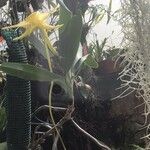
Angraecum sesquipedale
Darwin’s orchid
Description
Source: leafsnapAngraecum sesquipedale , also known as Darwin's orchid, Christmas orchid, Star of Bethlehem orchid, and king of the angraecums, is an epiphytic orchid in the genus Angraecum endemic to Madagascar. The orchid was first discovered by the French botanist Louis-Marie Aubert du Petit-Thouars in 1798, but was not described until 1822. It is noteworthy for its long spur and its association with the naturalist Charles Darwin, who surmised that the flower was pollinated by a then undiscovered moth with a proboscis whose length was unprecedented at the time. His prediction had gone unverified until 21 years after his death, when the moth was discovered and his conjecture vindicated. The story of its postulated pollinator has come to be seen as one of the celebrated predictions of the theory of evolution.
Care Guide
💧 Water
Native to Madagascar's humid climate, Darwin's orchid thrives in moist conditions and can tolerate moderate drought. To maintain the soil's moisture, it's important to water the plant weekly. As an epiphytic orchid well-suited for indoor cultivation, Darwin's orchid significantly benefits from higher ambient humidity, which is crucial for optimal growth and flowering.
☀️ Light Partial sun
Darwin's orchid prefers places with a moderate amount of sunlight, though it can tolerate periods of extreme conditions with little or no light. Ongoing exposure to intense rays can damage its health. In its native habitat it prospers beneath the soft filtering of the forest canopy rather than in harsh, open sun. If it lacks adequate light, growth can be stunted and flowers may not develop.
What are the sun requirements for Darwin's Orchid?
Darwin's Orchid, botanically known as Angraecum sesquipedale, favors partial sun, receiving about 3-6 hours of sunlight daily. It's crucial to observe how sunlight moves through your garden to find locations offering a perfect balance of light and shade. Although the orchid can endure periods of environmental extremes, constant exposure to intense rays might harm its health. In its natural habitat, it thrives under the gentle filter of a forest canopy rather than in harsh, open sunlight.
How essential is lighting for Darwin's Orchid, and what are some artificial lighting tips?
Lighting is a vital aspect of caring for Darwin's Orchid, especially in conditions where natural sunlight is insufficient, such as during winter or in less sunny spaces. Artificial lights, such as LED, can be crucial in promoting healthier growth by offering the necessary wavelengths of light. For optimal growth, it's recommended to provide 30-50W/sq ft of light for full sun plants, 20-30W/sq ft for partial sun plants, and 10-20W/sq ft for full shade plants. The artificial light source should be placed 12-36 inches above the plant and kept on for 8-12 hours per day to mimic natural daylight hours.
What are common symptoms of improper sunlight exposure in Darwin’s Orchid?
Darwin’s Orchid may exhibit several symptoms due to improper sunlight exposure. In conditions of low light, the plant may experience reduced growth rate, smaller new leaves, leggy or sparse growth, and faster leaf drop as it conserves energy. Leaves may also develop irregular color patterns or appear pale due to a lack of chlorophyll. On the other hand, excessive sunlight can lead to chlorosis, sunscald, leaf curling, wilting, and leaf scorching, indicating damage and stress from overexposure.
What are recommended solutions for managing sunlight exposure for Darwin’s Orchid?
To manage sunlight exposure for Darwin's Orchid effectively, gradual adaptation is key. For indoor plants, gradually relocating them to sunnier spots until they receive 3-6 hours of direct sunlight or using artificial lighting solutions such as desk, ceiling lamps, or professional grow lights for at least 8 hours daily can be beneficial. Outdoors, it's advised to move plants to progressively sunnier spots each week to avoid sunburn. Reducing obstructions, such as by pruning trees or relocating plants to sunny areas with good drainage, can also improve light exposure. Remember, while parts of the plant affected by insufficient light may not recover, new growth should be healthy with proper light management.
🌡️ Temperature 20–37.8°C
Darwin's orchid grows best in conditions where temperatures range from 68 to 100 °F (20 to 38 ℃). This soft-wooded plant favors a warm setting and needs attention during changing seasons to keep the temperature steady.
What is the ideal temperature range for Darwin's orchid?
Darwin's orchid, also known as Angraecum sesquipedale, thrives in warm environments, with an ideal temperature range between 68 to 100 °F (20 to 38 °C). This tropical plant requires careful attention during fluctuating seasons to maintain a stable temperature, ensuring its growth and health.
How should Darwin's orchid be cared for in winter?
During winter, it's crucial to protect Darwin's orchid from cold temperatures. If the temperature drops below 10°C, the orchid should be brought indoors to ensure its survival. Keeping indoor temperatures above 20°C and positioning the plant near a south-facing window for ample sunlight are beneficial strategies. To mimic the plant's natural humid environment, regularly misting the orchid or using a humidifier is recommended. For orchids remaining outdoors, ensure they're in a sheltered, sunny spot and consider using a temporary greenhouse or wrapping with materials like plastic film or fabric for extra warmth.
What are the symptoms of low temperature stress in Darwin's orchid, and how can it be treated?
Low temperature stress manifests in Darwin's orchid through water-soaked necrosis, wilting, and drooping leaves, especially when temperatures fall below 5°C, indicating the plant's intolerance to cold. To treat these symptoms, trim off the affected areas and move the plant to a warmer indoor location, preferably near a south-facing window to ensure sufficient sunlight. Additionally, avoid placing the orchid near heaters or air conditioning vents to avert excessive dryness.
How does high temperature affect Darwin's orchid, and what are the solutions?
High temperatures above 38°C halt the growth of Darwin's orchid and may lead to wilting leaves, increased susceptibility to root rot, and potential sunburn when exposed to direct sunlight. Solutions include trimming away sunburned or dried parts of the plant, relocating it to a shaded area away from direct midday and afternoon sun, and ensuring the orchid and its surrounding environment are kept moist with morning and evening watering.
💨 Humidity high (>60%)
This plant needs special care because it loves high humidity levels of 60-80% or more. The best way to achieve this is by placing a humidifier near the plant. Daily misting is also essential! Make sure the room has good ventilation.
🪴 Soil 6-7
🌱 Fertilizer Every 30 days
Proper fertilization is essential for Darwin's orchid's health and appearance. Fertilize the orchid during summer, applying fertilizer once a month throughout the season. Nutrients power growth and help maintain the plant's parts. Fertilization improves the orchid's flowering, ensuring its best blooms.
🪴 Pot & Repot Every 12 months
When repotting Darwin's orchid, pick a slightly larger pot with good drainage; a clear orchid pot is preferable. Use an orchid-specific, well-draining mix that includes bark or moss. Carefully clean the roots and trim any that are dead or rotting. Repot after it has finished flowering, typically in spring or fall, water thoroughly, and place it in bright, indirect light. Avoid disturbing the roots once the plant is repotted.
✂️ Pruning
Darwin's orchid showcases large, fragrant white flowers with long nectar spurs. Minimal pruning involves removing dead leaves and spent stems from early spring through late winter. Ensuring good airflow helps prevent disease and enhances flower production. Be sure to use sterilized tools to avoid infections.
🌿 Propagating
🐛 Diseases & pets
☠️ Toxicity
Characteristics
- Plant Type
- Herb
- Life Cycle
- Perennial
- Genus
- Angraecum
- Family
- Orchidaceae
- Hardiness Zone
- 11
- Mature Height
- 0.91 m to 1.22 m
- Mature Spread
- 91 cm
- Leaf Color
- Green
- Leaf Type
- Evergreen
- Flower Color
- White
- Flower Size
- 17.78 cm to 22.86 cm
- Bloom Time
- Mid winter, Late winter, Early spring
- Planting Time
- Spring, Summer, Autumn
- Harvest Time
- Mid spring, Late spring, Early summer
- Native Area
- Madagascar