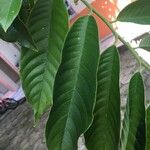
Annona mucosa
Wild sweetsop · Wild Sugar-Apple · Sugar apple · Biribá
Description
Source: leafsnapAnnona mucosa, commonly known as the custard apple or sweetsop, is a tropical fruit tree native to Central and South America. It belongs to the Annonaceae family and is closely related to other popular fruits like cherimoya and soursop. The custard apple tree can grow up to 10 meters tall and features a dense canopy of large, glossy leaves. The fruit is oval-shaped with a greenish-yellow skin that softens as it ripens. Inside, the flesh is creamy white with inedible black seeds. The custard apple has a sweet flavor reminiscent of vanilla pudding or caramelized sugar, making it a popular ingredient in desserts such as ice cream and smoothies. Additionally, it offers several health benefits due to its high fiber content and vitamins C and B6. This plant thrives in warm climates with plenty of sunlight but can tolerate some shade. It requires well-draining soil that retains moisture without becoming waterlogged. Overall, Annona mucosa is an attractive tropical fruit tree that produces deliciously sweet fruits while offering several health benefits to those who consume them regularly.
Care Guide
💧 Water Every 7 days
☀️ Light Full sun
Biriba comes from open habitats, such as sunny meadows and forest edges, which provide abundant light. It does best in Full Sun but can also tolerate Partial Sun, adapting well to various light conditions.
What are the sunlight requirements for Annona mucosa?
Annona mucosa, also known by its botanical name Annona mucosa, thrives in varying degrees of sunlight to ensure optimal growth and happiness. For 'full sun' conditions, it requires above 6 hours of sunlight daily, making it suitable for spots in your garden that are bathed in light for most of the day. For those areas that don't get as much constant sunlight, 'partial sun', which constitutes about 3-6 hours of sunlight, is also suitable for this plant. It's important to observe how sunlight moves through your garden over the course of the day to find the perfect balance of light and shade, ensuring that you choose locations that will make your Annona mucosa thrive.
🌡️ Temperature 20–37.8°C
Biriba comes from tropical areas, where the climate is generally warm and humid. Consequently, it is well suited to high heat and humidity. It does not tolerate sudden temperature changes and prefers a steady thermal environment, so avoiding indoor temperature fluctuations is important. It usually cannot endure cold and needs warmer conditions to grow. If the surrounding temperature drops too low, the plant may stop growing or even die.
💨 Humidity
🪴 Soil 4-6
🌱 Fertilizer
Prefer organic fertilizers (e.g., fish emulsion, compost) to chemical ones for Biriba. Supply higher levels of nitrogen and phosphorus to young plants in spring. Incorporate compost or fertilizer into the soil before or after planting. For mature plants, apply a balanced fertilizer or one targeted to specific deficiencies in spring. Nutrient deficiency produces small leaves, short branches, yellow or bronze foliage, acidic fruits, premature fruit drop, and fruit splitting.
🪴 Pot & Repot
✂️ Pruning
To promote the optimal health of Annona mucosa, begin pruning in early spring. Focus on removing dead branches and thinning out overcrowded areas to improve airflow. Regular pruning helps enhance growth and increase fruit production. Be sure to use sharp tools to make clean cuts, which reduces the risk of disease and helps maintain the plant's structure and vitality.
🌿 Propagating
🐛 Diseases & pets
☠️ Toxicity
Characteristics
- Plant Type
- Tree
- Life Cycle
- Perennial
- Genus
- Annona
- Family
- Annonaceae
- Hardiness Zone
- 10-12
- Mature Height
- 4.88 m to 10.06 m
- Mature Spread
- 3.96 m to 6.1 m
- Leaf Color
- Dark Green, Forest Green
- Leaf Type
- Deciduous
- Flower Size
- 2.03 cm to 3.05 cm
- Bloom Time
- Late spring, Early summer, Mid summer
- Planting Time
- Spring, Summer, Autumn
- Harvest Time
- Late summer, Fall
- Native Area
- Colombia, Belize, Honduras, Mexico, Guatemala, Bolivia, Venezuela, Peru, Guyana, Brazil, Nicaragua, Ecuador, Costa Rica, Panama