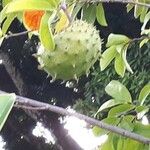
Annona muricata
Soursop · Sirsak · Guanabana · Prickly custard apple · Graviola
Description
Source: leafsnapAnnona muricata, commonly known as soursop or graviola, is a tropical fruit tree native to Central and South America. It is also found in the Caribbean and parts of Africa. The tree can reach up to 10 meters in height and produces large, heart-shaped fruits with a spiky green exterior, weighing up to 5 kilograms. The soursop fruit has a sweet yet tangy flavor, making it popular in juices, smoothies, ice creams, and other desserts. Additionally, it is believed to have medicinal properties due to its high content of antioxidants, such as vitamin C. The leaves of the Annona muricata plant are used in traditional medicine for their anti-inflammatory properties. They are thought to help reduce swelling and pain associated with conditions like arthritis. Despite its many health benefits, concerns have been raised about the potential toxicity of certain compounds found in Annona muricata seeds. However, more research is needed to draw definitive conclusions on this matter. Overall, Annona muricata is a fascinating tropical plant with numerous potential health benefits, which continue to be studied by researchers worldwide.
🌳 The roots and leaves of soursop have shown potential for bioremediation, being able to take up heavy metals from contaminated soil — a capability that could be used in environmental clean-up efforts. This trait could allow soursop to be included in phytoremediation programs aimed at restoring polluted landscapes.
Care Guide
💧 Water Every 7 days
Soursop thrives in tropical habitats and prefers moist soil, yet it is resilient during dry periods. To mimic its natural water cycle, it should be watered every 1 to 2 weeks. Typically grown outdoors, soursop exhibits robust growth, especially when aided by seasonal rains for irrigation.
How should I water my Soursop plant?
To water your Soursop plant, you can use any common watering tool like watering cans, hoses, or even cups. The important thing is to apply the water directly to the soil and make sure that all parts of the root system get evenly moistened. Using filtered water is recommended to avoid harmful particles from tap water. Also, try to use water that is around room temperature, as extreme temperatures can shock the Soursop. But don't worry too much, the Soursop generally handles different types of water well.
What should I do if I give my Soursop plant too much water or too little water?
Outdoor plants, especially newly planted ones or seedlings, can easily suffer from lack of watering. It is important to remember to consistently water these plants for a few months until they become established. Once the roots are established, Soursop trees can rely on rain for most of their moisture. When Soursop plants are in pots, overwatering becomes a more common issue. If you accidentally overwater your Soursop, it is important to address the situation promptly. Firstly, stop watering the plant immediately to minimize the negative effects of overwatering. Then, remove the Soursop from its pot to check the roots. If no root rot is found, you can place the plant back into the container. However, if root rot is present, trim any affected roots and consider using a fungicide to prevent further damage. Lastly, repot the Soursop in well-draining soil. On the other hand, underwatering Soursop is a simpler problem to fix. If you notice the plant's leaves drooping, drying out, or falling off, it is a sign of underwatering. Increase the frequency of watering to properly address this issue. Adjust your watering schedule as soon as you notice symptoms of underwatering to maintain the plant's health and vitality.
How frequently do I need to water my Soursop?
Most outdoor plants can thrive with natural rainfall. However, if your area doesn't get enough rain, you'll need to water your plants every 2 weeks in the spring and fall, and more frequently in the summer. During winter, when growth slows down, you can water your plants less often, or even not at all. Watering frequency is especially important for young or newly planted Soursop plants, as it helps them establish and become more adaptable to drought. For potted plants, you have two options to determine watering frequency. One is to follow a set schedule, watering once every week or every other week. However, this may not always be suitable for your specific growing conditions. Another option is to base watering on soil moisture. Wait until the top two to four inches of soil (about ⅓ to ½ depth of the pots) have completely dried out before watering again. This approach may require more frequent watering during the summer when the plant's water needs are highest.
How much water does my Soursop fruit tree need?
When watering your Soursop, you don't always need to give it a lot of water. If only a few inches of soil have dried since your last watering, you can provide about five to ten ounces of water each time. You can also judge how much water to give based on the moisture of the soil. Take note of how many inches of soil have dried out between waterings. To ensure that your Soursop gets enough moisture, water until all the layers of dry soil since the last watering are moistened. If more than half of the soil is dry, you may need to give it more water. In that case, keep watering until there is excess water draining from the pot's holes. If your Soursop is planted in an area that receives plenty of rain, it may not need additional watering. For young or newly established Soursop plants, ensure they receive 1-2 inches of rain per week. As they continue to grow, they can rely solely on rainwater unless there is a prolonged period without rainfall during hot weather. In this case, consider giving them a full watering to prevent stress.
How do I know if I am giving enough water to my Soursop?
The Soursop plant is more likely to be overwatered, which can be identified by yellowing leaves and leaf drop, as well as drooping and the potential for root rot. On the other hand, an underwatered Soursop will also wilt and have brown or brittle leaves. Regardless of whether you see signs of overwatering or underwatering, it's important to take action and restore the plant's health.
☀️ Light Full sun
Soursop does best in areas exposed to full sunlight but can also tolerate moderately lit conditions. Coming from regions with abundant sun, its vigorous growth depends greatly on sun exposure. Not enough light will inhibit its growth, whereas excessive sunlight can damage the leaves.
What are the sun requirements for Soursop?
Soursop requires full sun, defined as above 6 hours of sunlight daily, to thrive optimally, though it can also withstand partial sun or about 3-6 hours of sunlight. It's essential to observe how sunlight moves through your garden throughout the day to choose spots that offer an ideal balance of light and shade, ensuring the plants' well-being and vigorous growth.
What essentials should be considered for Soursop growth?
Soursop flourishes best in unmitigated sunlight but can also adapt to moderately illuminated conditions. Originating from regions abundant in sunlight, its growth heavily relies on adequate sun exposure. Too little sunlight can impede its development, whereas excessive sun exposure might harm the foliage. In scenarios where natural light is insufficient, especially during winter or in areas receiving less sunlight, artificial lighting such as LED lights, which can provide the specific light wavelengths required by the plants, becomes crucial. For optimal growth indoors, full sun plants necessitate 30-50W/sq ft of artificial light, partial sun plants require 20-30W/sq ft, and full shade plants need 10-20W/sq ft.
What symptoms indicate insufficient or excessive sunlight in Soursop?
Soursop may exhibit several symptoms under poor light conditions, including smaller new leaves, leggy or sparse growth, accelerated leaf drop, and stunted or ceased growth. These are subtle signs of light deficiency. Conversely, excessive sunlight can lead to chlorosis, where leaves lose their green color, sunscald, leaf curling as a defense mechanism against intense sunlight, wilting due to increased transpiration, and leaf scorching, identified by brown, dry, and crispy leaf edges or patches. These symptoms highlight the need for balanced light exposure.
How to address light-related issues in Soursop for optimal growth?
For indoor Soursop plants experiencing insufficient sunlight, gradually moving them to a brighter location where they can receive at least 6 hours of direct sunlight daily is recommended. Use a south-facing window for maximum exposure. If relocation is not possible, supplement with artificial lighting, keeping a lamp on for at least 8 hours daily or using professional plant grow lights. Outdoors, acclimatize your plants to sunlight gradually to prevent sunburn. Reducing obstructions such as pruning branches can improve sunlight access. If necessary, transplant smaller plants during their dormant period, usually in late winter or early spring, to a sunnier spot with good drainage. It's important to note that while parts of the plant already affected by insufficient light may not recover, new growth should be healthy once light conditions improve.
🌡️ Temperature 20–37.8°C
Soursop is native to regions where temperatures consistently range from 68 to 100.4 °F (20 to 38 ℃). The plant performs best within this specific temperature band. Seasonal temperature adjustments may be necessary to suit the plant's preferences.
What is the native temperature range for Soursop?
Soursop, also known scientifically as Annona muricata, is native to areas where the temperature consistently ranges between 68 to 100.4 °F (20 to 38 °C). This plant thrives best under this specific thermal range, indicating its preference for relatively warm temperatures. Seasonal adjustments may be necessary to ensure the plant's environment remains within this range, especially during winter cultivation, where maintaining temperatures above 20°C is beneficial for the plant's growth. It's essential to keep the minimum temperature above the freezing point to prevent the plant from sustaining freezing damage. When outdoor temperatures approach -5°C (25°F) during winter, it is advisable to bring the Soursop indoors or provide protection by setting up a temporary greenhouse or using protective materials such as plastic film or fabric.
How does low temperature affect Soursop and what are the solutions?
Soursop has a moderate tolerance to low temperatures, performing best when the ambient temperature remains between 20°C and 38°C. During the winter season, it is crucial to keep the temperature above 5°C. Exposing the plant to temperatures below 1°C can cause the leaves to darken and in severe cases, lead to water-soaked necrosis, wilting, and drooping, with the leaves gradually turning brown. To mitigate these issues, any frost-damaged parts should be trimmed away and the plant should be immediately moved to a warmer indoor environment or placed in a makeshift greenhouse for cold protection. If kept indoors, it's recommended to position the plant near a south-facing window to ensure it receives ample sunlight, supplementing with artificial lighting if necessary.
How does high temperature affect Soursop and what are the solutions?
During the summer months, it's important to ensure that the temperature surrounding a Soursop plant does not exceed 38°C. Exposure to temperatures above 43°C can inhibit the plant's growth, cause the leaves to lighten in color, and increase susceptibility to sunburn. To address these issues, any sunburned or dried-up parts of the plant should be trimmed away. Moving the plant to a shaded location, especially to avoid the harsh afternoon sun, can be beneficial. Additionally, watering the plant in the morning and evening will help keep the soil adequately moist, further mitigating the impacts of high temperatures on the plant.
💨 Humidity normal (40-60%)
This plant will thrive in moderate humidity, which is probably the level in your home. However, misting it a few times a week can be very beneficial. Make sure the room has good ventilation.
🪴 Soil 5-6
🌱 Fertilizer
Prefer organic fertilizers (for example, fish emulsion or compost) over chemical ones for soursop. Give young plants higher nitrogen and phosphorus in spring. Work compost or fertilizer into the soil before or after planting. For mature plants, add a balanced fertilizer in spring or one formulated for a specific nutrient deficiency. Nutrient shortages lead to small leaves, short branches, yellow or bronze foliage, acidic-tasting fruit, early fruit drop, and fruit splitting.
Why should I put fertilizer on my Soursop plant?
If the soil is rich in your area, fertilizing might not be necessary. On the other hand, if the soil lacks nutrients, a Soursop may struggle to grow leaves, flowers, and fruit. To identify nutrient deficiencies, a soil test is the most effective method. Not having enough nutrients can result in small leaves, short branches, yellow or bronze leaves, and less flavorful fruits due to increased acidity. Certain nutrient deficiencies can even lead to premature fruit dropping or splitting.
When should I fertilize my Soursop tree?
To best support the growth of young Soursop plants, it is recommended to provide them with higher nitrogen and phosphorus fertilizer. This will promote strong development of both the leaves and roots, ensuring future growth. It is advisable to apply this fertilizer during the spring of the plant's first growing season. Additionally, it is beneficial to mix compost or another type of fertilizer into the soil before or right after planting. For mature Soursop plants, it is necessary to supplement with fertilizer every few years, adjusting as needed during the spring and summer months. It is important to choose a balanced fertilizer or one that specifically targets any deficiencies in the soil particular to your area. It is not recommended to fertilize Soursop plants during the autumn or winter seasons.
When is the best time to not use fertilizer on my Soursop plant?
To ensure the health of your Soursop plant, it is important to avoid fertilizing it after pruning, when it is affected by disease or insects, or when it is under any form of stress. Fertilizer is only effective in treating nutrient deficiencies in the soil, and cannot address other problems that may arise with the Soursop. It is important to accurately diagnose the issue to prevent mistakenly applying fertilizer when another factor is causing the problem. Additionally, refraining from fertilizing during winter or during excessively hot and dry periods in the summer is advisable.
What kind of fertilizer does my Soursop tree need?
Soursop is typically found in tropical areas with lots of decaying organic matter. To help them grow, fertilizers can be used to provide the necessary nutrients. When growing Soursop for fruit, a high-phosphorus organic fertilizer like mushroom compost, bone meal, and poultry manure is recommended for optimal fruit development. When buying fertilizer, look for the NPK ratio on the label, which represents the nitrogen, phosphorus, and potassium content. Nitrogen deficiency is common in soil, but a soil test can help identify any other nutrient deficiencies that may require supplementation.
How can I give nutrients to my Soursop plant?
1. It's important to follow the instructions on the fertilizer you use. 2. It's better to use too little fertilizer than using too much, so use a conservative amount when adding fertilizers. 3. Chemical fertilizers are highly concentrated compared to organic ones, so exercise extra caution when using them. 4. For liquid fertilizers, dilute them with water and use the mixture to water the Soursop plant. 5. For granular or dry fertilizers, spread them around the plant's base, ensuring no direct contact with any part of the plant. 6. It is recommended to use fertilizers once every 2-3 weeks during the growing season. 7. Organic fertilizers can be mixed into the soil before planting or spread as a layer on top of the soil for newly-planted or mature plants.
🪴 Pot & Repot 2-3 years
Soursop plants need to be repotted every 2-3 years, preferably in late winter. Use a large, deep pot to give the root system plenty of space. After repotting, water the plant sparingly until you see new growth. This approach helps ensure a smooth transition and promotes healthy growth.
✂️ Pruning
Soursop plants yield large green fruits and have broad leaves. To keep the plant healthy, prune it from early to late spring. This involves removing dead branches to improve air circulation and maintain the plant's shape. Pruning at this time encourages healthy fruit growth, prevents diseases, and enhances the overall health of the plant.
🌿 Propagating
🐛 Diseases & pets
☠️ Toxicity
Characteristics
- Plant Type
- Tree
- Life Cycle
- Perennial
- Genus
- Annona
- Family
- Annonaceae
- Hardiness Zone
- 10-12
- Mature Height
- 9.14 m
- Mature Spread
- 3.05 m
- Leaf Color
- Green, Blue
- Leaf Type
- Evergreen, Deciduous
- Flower Color
- Yellow, Green
- Flower Size
- 3.81 cm
- Bloom Time
- Late spring, Summer, Early fall
- Planting Time
- Spring, Autumn
- Harvest Time
- Early spring, Mid spring, Mid summer, Late summer, Fall, Winter
- Native Area
- Colombia, Belize, Cuba, Mexico, Venezuela, Guyana, Costa Rica, Panama, Jamaica