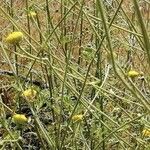
Anthemis tinctoria
Golden chamomile · Dyer's Chamomile · Golden Marguerite · Ox-eye Chamomile · Yellow Camomile
Description
Source: leafsnapCota tinctoria, the golden marguerite, yellow chamomile, or oxeye chamomile, is a species of perennial flowering plant in the sunflower family. Other common names include dyer's chamomile, Boston daisy, and Paris daisy. In horticulture this plant is still widely referred to by its synonym Anthemis tinctoria.It is a short-lived plant often treated as biennial, native to Europe, the Mediterranean and Western Asia and naturalized in scattered locations in North America. It has aromatic, bright green, feathery foliage. The serrate leaves are bi-pinnatifid (= finely divided) and downy beneath. It grows to a height of 60 cm (24 in).It has yellow daisy-like terminal flower heads on long thin angular stems, blooming in profusion during the summer.It has no culinary or commercial uses and only limited medicinal uses. However, it produces excellent yellow, buff and golden-orange dyes, used in the past for fabrics.Cota tinctoria is grown in gardens for its bright attractive flowers and fine lacy foliage; there is a white-flowering form. Under the synonym Anthemis tinctoria, the cultivar ‘E.C. Buxton’ has gained the Royal Horticultural Society’s Award of Garden Merit. The popular seed-raised cultivar 'Kelwayi' has 5 cm wide, yellow flowers on 65 cm plants.
Care Guide
💧 Water 1 to 2 times a week
Cota tinctoria is fairly drought tolerant but produces the best blooms and foliage with regular watering. Once the ground dries slightly, then it is time to water your plant. Allowing the soil to dry between waterings will not only maintain appropriate soil moisture but also prevent overwatering.
☀️ Light Full sun
Golden chamomile is a sun-loving herbaceous perennial native to open habitats and is commonly found in meadows and grasslands. It prefers full sun but can also tolerate partial sun.
🌡️ Temperature 5–35°C
Golden chamomile can tolerate a wide range of temperatures, but its distribution may still be limited by different combinations of moisture and heat. It does best in warm summer climates with sufficient rainfall or irrigation. Extended periods of cloudy, rainy weather or prolonged high temperatures can raise the risk of Golden chamomile dying. In winter, adequate protection from cold can increase the plant’s survival rate.
💨 Humidity
🪴 Soil 6-8
🌱 Fertilizer
The best time to fertilize a Golden chamomile is in early spring, when it is coming out of dormancy and starting active growth. Fertilizing supplies essential nutrients for healthy development. Although Golden chamomile needs relatively little fertilizer, applying it once a year can improve its survival and encourage better, longer-lasting blooms.
🪴 Pot & Repot
✂️ Pruning
Deadhead your cota tinctoria by removing spent or faded blooms. Deadheading will encourage vibrant and profuse blooming into the early fall. During late fall or early winter, you can cut back any dead growth to stimulate fresh, new growth in the spring.
🌿 Propagating
🐛 Diseases & pets
☠️ Toxicity
Characteristics
- Plant Type
- Herb
- Life Cycle
- Perennial
- Genus
- Anthemis
- Family
- Asteraceae
- Hardiness Zone
- 4-9
- Mature Height
- 30 cm to 61 cm
- Mature Spread
- 30 cm to 46 cm
- Leaf Color
- Green, Dark Green
- Leaf Type
- Evergreen
- Flower Color
- White, Yellow
- Flower Size
- 2.03 cm to 4.06 cm
- Bloom Time
- Summer
- Planting Time
- Spring, Summer, Autumn
- Harvest Time
- Late summer, Early fall, Mid fall
- Native Area
- Turkey, Sweden, Austria, Slovakia, Montenegro, Slovenia, Croatia, Belarus, Uzbekistan, Russia, Iraq, Germany, Indonesia, Estonia, Romania, Latvia, Belgium, Moldova, Netherlands, France, Czech Republic, Bulgaria, Armenia, Poland, Greece, Ukraine, Lebanon, Serbia, Lithuania, Norway, Syria, Kyrgyzstan, Kazakhstan, Italy, Switzerland, Denmark, Iran, Azerbaijan, Hungary