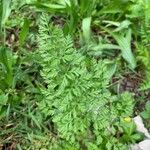
Anthriscus caucalis
Bur Chervil · Burr chervil · Bur Parsley · Burr parsley · Beaked parsley
Description
Source: leafsnapAnthriscus caucalis, commonly known as bur chervil or wild chervil, is a biennial or perennial plant belonging to the Apiaceae family. It is native to Europe and Asia but has been introduced and naturalized in North America. The plant can grow up to 1 meter tall and has a taproot that can extend up to 1 meter deep. The leaves of Anthriscus caucalis are alternate, pinnately divided, and feature toothed leaflets. The flowers are small, white or pinkish-white, with five petals arranged in umbels. The fruit is a small, oval-shaped achene with ridges. Bur chervil prefers moist soils but can also thrive in dry environments such as roadsides, fields, meadows, and disturbed areas like waste places. It blooms from May until August. The plant has traditionally been used for medicinal purposes, such as treating digestive issues like bloating and gas, due to its carminative properties. However, caution is advised when using it because it contains furanocoumarins, which may cause skin irritation when exposed to sunlight. Anthriscus caucalis also serves as food for some animals, such as rabbits, but should be avoided by livestock because it contains toxic compounds that may lead to photosensitization when ingested in large quantities. Overall, Anthriscus caucalis is an intriguing plant with unique characteristics that make it both useful and potentially harmful, depending on how it is utilized by humans or animals.
Care Guide
💧 Water Every 7 days
Bur Chervil comes from temperate regions and grows best in moderately moist soil. To keep it healthy, it needs to be watered once a week. It prefers consistent moisture without becoming waterlogged. Its growth is also affected by the seasonal rainfall patterns in its native climate.
How should I water my Bur Chervil plant?
To water Bur Chervil, you have various options such as using a garden hose with a spray nozzle, a watering can, or any other common watering tool. This plant is not particularly fussy about the type of water it receives. It can thrive on rainwater, tap water, or filtered water. It's generally best to avoid watering this plant from above as it can harm the leaves and flowers and potentially cause diseases. Using a drip irrigation system can be the most effective way to water Bur Chervil, as it delivers water evenly and directly to the soil. When watering a container-grown Bur Chervil, you can use a cup, watering can, or tap water to water the soil directly.
What should I do if I give my Bur Chervil too much or too little water?
To avoid underwatering your Bur Chervil, make sure to water it regularly when you notice it lacks moisture. However, overwatering can be a more serious problem. It can lead to diseases and even death for your plant. To prevent this, choose a growing location with plenty of sunlight and good drainage. If you have overwatered your Bur Chervil in a pot, you may need to repot it. Use a pot with good drainage and loose soil to ensure proper water flow.
How frequently should I water my Bur Chervil?
Bur Chervil requires regular watering throughout the growing season. In the spring, you should water it once a week. As the season progresses and it gets warmer, you may need to increase watering to two or three times a week. However, watering too much can harm the plant, so be careful. Regardless of watering frequency, make sure the soil remains moist but not wet. When it comes to Bur Chervil in a pot, you'll need to water it more frequently compared to when it's planted in the ground. Potted soil tends to heat up and dry out faster, so plan to water a container-grown Bur Chervil a few times per week, instead of just once a week for an in-ground plant.
How much water does my Bur Chervil plant need?
Determining how much water to give your Bur Chervil can be done in a few different ways. Some gardeners prefer to feel the soil to judge its moisture level and water until the top six inches are moist. Others use a set measurement, such as two gallons per week, considering factors like heat and soil dryness. However, this method may lead to overwatering. When growing Bur Chervil in a container, it's best to moisten all layers of dry soil by sticking your finger in or observing slight excess water from the drainage holes.
How can I know if I'm watering my Bur Chervil plants enough?
Avoiding overwatering your Bur Chervil can be a bit tricky. On one hand, you need to moisten the soil weekly because these plants have deep roots. However, Bur Chervil is highly prone to root rot, which can cause browning. While underwatering is less of a concern because these plants can survive without much watering, if you go too long without watering, your Bur Chervil will wilt and have dry leaves.
☀️ Light Full sun
Bur Chervil grows best in full sun and can also tolerate partially sunny spots. Coming from habitats with substantial sun exposure, bur Chervil needs plenty of sunlight to develop well. Too little light can produce weak, spindly growth, while too much light may cause the leaves to become discolored.
What are the sunlight requirements for Bur Chervil?
Bur Chervil thrives under full exposure to the sun, necessitating above 6 hours of sunlight daily for optimal growth. It can also endure partially sunny conditions, which means about 3-6 hours of sunlight. This adaptability makes it suitable for various garden spots, emphasizing the importance of choosing locations that provide a perfect balance of light and shade, as sunlight patterns can significantly affect plant health.
How does artificial lighting support Bur Chervil's growth indoors?
When natural sunlight is insufficient for Bur Chervil, especially during winter or in less sunny spaces, artificial lighting can be a vital solution. It promotes faster, healthier growth by supplementing the light needed for photosynthesis. LED lights are recommended due to their ability to provide specific wavelengths needed by plants. Full sun plants require 30-50W/sq ft, partial sun plants 20-30W/sq ft, and full shade plants 10-20W/sq ft of artificial light. The light source should be placed 12-36 inches above the plant, mimicking natural sunlight conditions, and provided for 8-12 hours per day to ensure adequate growth.
What are the symptoms of inadequate light exposure in Bur Chervil?
Bur Chervil shows several symptoms when light exposure is inadequate, including small and lighter-colored new leaves, leggy or sparse growth, faster leaf drop, slower or no new growth, chlorosis, sunscald, leaf curling, wilting, and leaf scorching. These symptoms can range from subtle, such as smaller leaves and increased spacing between stems, indicating light deficiency, to more severe, such as chlorosis and sunscald, resulting from excessive sunlight. Identifying these signs early is crucial for adjusting care and preventing further damage.
How can you mitigate light-related issues for Bur Chervil both indoors and outdoors?
Mitigating light-related issues for Bur Chervil involves careful placement and gradual adaptation to light conditions. Indoors, gradually moving plants to sunnier spots or employing artificial lighting can help achieve the recommended 6 hours of direct sunlight. Outdoor plants should be moved slowly to prevent shock and sunburn. Reducing obstructions like pruning trees can increase sunlight exposure. Transplanting during dormant periods helps small plants adapt to brighter locations with better sunlight and drainage, ensuring their growth and health.
🌡️ Temperature 15–32.2°C
Bur Chervil prefers temperatures between 20 and 35 ℃ (68 and 95 °F). In its native habitat it is adapted to temperate conditions. To achieve optimal growth, adjust the temperature in accordance with seasonal variations, particularly in extreme conditions.
What is the optimal temperature range for Bur Chervil?
Bur Chervil thrives in a temperature range of 20 to 35°C (68 to 95°F). Originating from temperate conditions, it's important to regulate the temperature according to seasonal changes to ensure the plant's optimal growth. Although it has strong cold resistance and usually doesn't require special frost protection measures, during excessively cold winters with temperatures dropping below -10°C, it is advised to protect the plant by covering it with materials like soil or straw. Additionally, watering the plant abundantly before the first freeze in autumn helps maintain soil moisture, preventing drought and water scarcity during winter and early spring.
How does low temperature affect Bur Chervil and how can it be managed?
Bur Chervil is cold-tolerant and shows best growth when the temperature is maintained above 20°C. However, it should not be exposed to temperatures below 0°C during winter. Exposure to temperatures below -10°C might not show immediate adverse effects during winter, but it could lead to decreased sprouting or complete lack of sprouting by springtime. To manage this, in spring, it is recommended to remove any parts of the plant that have failed to sprout, assisting in its recovery from the cold.
What impact does high temperature have on Bur Chervil and how should it be addressed?
During the summer months, it is crucial to keep Bur Chervil's temperature below 35°C. Temperatures exceeding 38°C can cause its leaves to lighten in color, become prone to curling, susceptible to sunburn, and in severe cases, lead to the wilting and drying of the entire plant. To address high-temperature stress, trim away any sunburned and dried-up parts of the plant. Moving the plant to a shaded area during the midday and afternoon sun or using a shade cloth can provide necessary protection. Ensuring the plant is watered in the morning and evening will also help keep the soil at an optimal moisture level.
💨 Humidity
🪴 Soil 6-7
🌱 Fertilizer
Bur Chervil does well with regular, dilute applications of fertilizer to encourage healthy leaf development. Fertilize Bur Chervil about once a month during the summer. Nitrogen is important for foliage, and adding nitrogen-rich sources helps Bur Chervil thrive.
🪴 Pot & Repot
✂️ Pruning
🌿 Propagating
🐛 Diseases & pets
☠️ Toxicity
Characteristics
- Plant Type
- Herb
- Life Cycle
- Annual
- Genus
- Anthriscus
- Family
- Apiaceae
- Hardiness Zone
- 8
- Mature Height
- 46 cm to 91 cm
- Mature Spread
- 20 cm to 40 cm
- Leaf Color
- Light Green, Forest Green
- Leaf Type
- Deciduous
- Flower Color
- White
- Flower Size
- 2.03 cm to 4.06 cm
- Bloom Time
- Late spring, Early summer
- Planting Time
- Spring, Summer, Autumn
- Harvest Time
- Early summer, Mid summer
- Native Area
- Turkey, Austria, Sweden, Slovakia, Croatia, Morocco, Slovenia, Belarus, Russia, Germany, Romania, Belgium, Netherlands, France, Portugal, Cyprus, Bulgaria, Poland, Greece, Ukraine, Lebanon, Serbia, Syria, Italy, Spain, Switzerland, Denmark, Albania, Ireland, United Kingdom, Hungary, Algeria, Azerbaijan