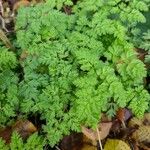
Anthriscus cerefolium
Cow parsley · Chervil · Garden chervil · Cerfille · Common Chervil
Description
Source: leafsnapChervil (; Anthriscus cerefolium), sometimes called French parsley or garden chervil (to distinguish it from similar plants also called chervil), is a delicate annual herb related to parsley. It was formerly called myrhis due to its volatile oil with an aroma similar to the resinous substance myrrh. It is commonly used to season mild-flavoured dishes and is a constituent of the French herb mixture fines herbes.
Care Guide
💧 Water
Garden chervil grows best in moist environments and benefits from consistent hydration. Watering it weekly is ideal. While it can tolerate some drought, it truly thrives with steady moisture. To prevent waterlogging and support its delicate roots, well-draining soil is crucial. This also enhances its suitability for use in culinary applications.
How should I water my Garden chervil?
The Garden chervil has specific preferences for both the amount and method of watering. Improper watering techniques can harm your tomatoes. To water Garden chervil effectively, apply the water directly to the soil in a slow and gentle manner. Avoid pouring all the water at once or overhead watering. While watering slowly, make sure to water deeply to ensure the entire soil where your Garden chervil grows is sufficiently moist.
What can I do if I give too much or too little water to my Garden chervil?
If you have overwatered your Garden chervil and are worried about disease, take immediate action. The best solution is to remove the plant from its current location, let the roots dry a bit, and then replant it in soil with good drainage. If you're growing in pots, consider moving the plant to a pot with better drainage. On the other hand, if you have underwatered your plant, simply increase the frequency of watering.
How frequently should I water my Garden chervil plant?
Garden chervil needs a lot of water during the growing season. To meet this need, water it frequently in the spring and summer. In the beginning, water it once or twice a week. As the season goes on, increase watering. In summer, you may need to water it twice a day or more, depending on the weather. Once the major growth phases are over, water it once a week until the end of the growing season.
How much water does my Garden chervil require?
Garden chervil is highly popular among professional and amateur gardeners who have successfully grown them. This popularity has allowed us to gather valuable knowledge on how to care for these plants, particularly in terms of watering. On average, a Garden chervil plant should receive about 1 - 1.5 inches of water per week. It is important to evenly distribute this volume during your weekly watering routine. As temperatures rise, you may need to increase the amount of water supplied, but generally, two inches per week is a good baseline.
How can I know if I am giving enough water to my Garden chervil?
Both underwatering and overwatering can cause problems for your Garden chervil, and they can result in similar symptoms. For instance, both overwatering and underwatering can cause foliage discoloration and wilting. When your Garden chervil is not getting enough water, its leaves will start curling and drooping. The leaves will also become less vigorous. Since this plant requires a high amount of water, underwatering can lead to stunted growth and poor overall development, affecting both the flowers and the entire plant. On the other hand, overwatering can promote disease, including rot, and can cause unpleasant smells from the soil. The symptoms of underwatering appear more quickly than those of overwatering. Additionally, you can identify overwatering by observing the soil conditions. If you find a lot of standing water or waterlogged soils, it is likely that overwatering is occurring.
☀️ Light Partial sun
Garden chervil does well with a fairly large amount of sunlight and can tolerate strong sun. Coming from environments with varied light levels, it performs well through multiple stages of development. Excessive exposure can lead to wilting, while too little light may slow its growth.
What are the sunlight requirements for Garden chervil?
Garden chervil requires partial to full sun exposure to thrive, with partial sun needing about 3-6 hours of sunlight per day and full sun requiring more than 6 hours. It's crucial to observe the movement of sunlight in your garden to find the ideal balance of light and shade that will make your plants happy.
How does Garden chervil respond to different lighting conditions?
Garden chervil performs well under significant sunlight but can also endure intense sun conditions. It originates from environments with mixed lighting, allowing it to flourish during various growth stages. However, too much exposure can cause wilting, and insufficient light may slow down its growth. For indoor plants, artificial lighting such as LED lights can be used to supplement natural sunlight, especially in less sunny spaces or during winter. This artificial lighting should be adjusted based on the type of plants, with full sun plants requiring 30-50W/sq ft, partial sun plants needing 20-30W/sq ft, and full shade plants needing 10-20W/sq ft.
What are the key symptoms of improper lighting in Garden chervil?
Garden chervil can show several symptoms if it's not getting the right amount of light, including smaller new leaves, leggy or sparse growth, faster leaf drop, slower or no new growth, lighter-colored new leaves, chlorosis, sunscald, leaf curling, wilting, and leaf scorching. These symptoms reflect the plant's struggle with either too much or too little light, highlighting the need for a balanced lighting environment.
What are the solutions for correcting light exposure issues in Garden chervil?
To correct light exposure issues in Garden chervil, you can gradually shift them to sunnier spots to adapt to changing light conditions, with outdoor plants needing a gradual move to avoid sunburn. For indoor plants, consider using artificial light sources like desk lamps or professional grow lights for at least 8 hours daily. If your plants are in the ground and experiencing obstruction, pruning nearby trees or transplanting during the dormant season to a sunnier location with good drainage can help. Note that parts of the plant damaged by insufficient sunlight may not recover, but new growth should be healthy with proper sunlight exposure.
🌡️ Temperature 10–35°C
Garden chervil is native to temperate regions and favors conditions with temperatures from 68°F to 95°F (20 to 35 °C). Seasonal care may involve protecting it during cooler periods to maintain comfortable conditions for growth.
What is the native habitat and ideal temperature range for Garden chervil?
Garden chervil, botanically known as Anthriscus cerefolium, is native to temperate regions and thrives in environments where the temperature ranges from 68°F to 95°F (20°C to 35°C). It prefers relatively warm temperatures and requires seasonal adjustments such as protection during cooler weather to ensure cozy conditions for growth. Maintaining temperatures above 20°C during winter cultivation benefits the plant, while the minimum temperature should always be kept above the freezing point to prevent damage.
What should be done when the temperature approaches -5°C (25°F) during winter?
When the outdoor temperature approaches -5°C (25°F) during winter, it is advisable to bring Garden chervil indoors or provide protection by setting up a temporary greenhouse. Using materials such as plastic film or fabric to wrap the plant can also offer the necessary protection against the cold, helping to prevent freezing damage.
How does Garden chervil react to low temperatures and what are the solutions?
Garden chervil has moderate tolerance to low temperatures, flourishing best between 20°C and 35°C. It should be kept above 0°C during winter to avoid damage. Exposure to temperatures below -25°C can lead to darkening leaves, potential water-soaked necrosis, wilting, drooping, and gradual browning of leaves. The solution includes trimming away frost-damaged parts and moving the plant to a warm environment indoors, preferably near a south-facing window for ample sunlight. If necessary, supplemental lighting may be used to ensure adequate light for the plant.
What care should be taken for Garden chervil during high temperatures?
During summer, it is crucial to keep Garden chervil below 35°C to prevent growth slowdown and sunburn. Temperatures exceeding 38°C can cause the plant to become more susceptible to damage, evident through lighter leaf color and slowed growth. To mitigate this, trim away sunburned and dried-up parts of the plant, transfer it to a shaded location, especially from the afternoon sun, and ensure the soil is kept moist by watering in the morning and evening.
💨 Humidity normal (40-60%)
This plant will thrive in moderate humidity, which is probably the level in your home. However, misting it a few times a week can be very beneficial. Make sure the room has good ventilation.
🪴 Soil 6-7
🌱 Fertilizer
To maximize the yield and flavor of Garden chervil, provide sufficient nitrogen throughout the entire growth cycle, including the pre-planting phase and at harvest. Plants that are well-watered and fertilized develop plentiful, healthy leaves and are less prone to bitterness. Before planting, enrich the soil with organic matter such as compost or manure, preferably 2 to 8 weeks beforehand.
Why should I use fertilizer for my Garden chervil?
Garden chervil, which is grown for its edible leaves, has specific nutritional requirements. Nitrogen is the most important nutrient for foliage growth, and Garden chervil often struggles to obtain enough nitrogen from the soil. To ensure a bountiful harvest, many gardeners choose to supplement Garden chervil with additional nitrogen through heavy feeding.
When should I fertilize my Garden chervil?
To benefit your Garden chervil, there are a few key moments during the growing season when you should apply fertilizer. Firstly, when you are preparing the ground for planting, make sure to amend the soil with nutrient-rich organic material, like compost or manure, at least 2 to 8 weeks before planting. Next, when it's time to actually plant the seeds, amend the soil again using the same method. Once the seedlings have emerged and grown to around 2 inches tall, it's time for the next round of fertilizer. From there, you should continue regularly feeding your Garden chervil with either rich organic matter or a commercial fertilizer until harvest. A good rule of thumb is to fertilize every two to three weeks. Additionally, it's beneficial to add a layer of compost or manure around the plant to supply a continual stream of nutrients.
When is the best time to not put fertilizer on my Garden chervil?
When using nitrogen-rich fertilizers, be cautious about applying them near other vegetable plants that need to focus on fruiting rather than foliage. Otherwise, you might have a vegetable plant with lots of leaves but few vegetables. To prevent harming your Garden chervil, avoid letting any fertilizer touch or splash onto its leaves. Instead, apply it a few inches away from the plant's base. If your Garden chervil is suffering from disease, pests, drought, or other issues, hold off on fertilizing until those problems are resolved. While fertilizer can benefit healthy plants, it can cause damage if used on an unhealthy one.
What kind of fertilizer does my Garden chervil need?
Deciding on the best fertilizer for Garden chervil isn't a straightforward process. It depends on factors such as the specific plant type, environmental conditions, and soil composition. However, because Garden chervil needs a lot of nitrogen, using high-nitrogen fertilizers is generally a good idea. At the start of the growing season, soil can be amended with manure or compost, and for the rest of the season, dry or liquid fertilizers can be used. During the seedling stage, light feeding is recommended, gradually increasing as the plant matures. Organic fertilizers are often preferred for their superior taste, but chemical fertilizers can also be effective. Popular organic options with high nitrogen include fish emulsion, soil meal, compost tea, alfalfa meal, blood meal, and chicken manure. When using chemical fertilizers, check the NPK number, which indicates the relative proportions of nitrogen, phosphorus, and potassium. To prioritize nitrogen, choose a fertilizer with a high first number, such as 13-2-5 or even one that exclusively contains nitrogen, like 16-0-0.
How can I add fertilizer to my Garden chervil?
When fertilizing your Garden chervil, there are different methods depending on the type of fertilizer. For amending the soil, you should dig at least 6 inches (preferably deeper) and mix the amendment material at a ratio of 2 parts soil to 1 part amendment. Spread granular or powder fertilizers around the base of the plant according to the recommended amount. It's a good idea to mix this material into the top layer of soil to prevent it from being washed or blown away. Apply the fertilizer about 2 to 3 inches away from the plant to prevent fertilizer burn. Always water thoroughly after adding dry fertilizer to the soil. If you water your Garden chervil from a container, you can dissolve water soluble chemical fertilizers and use that diluted mix to water the plants. This method is not suitable for irrigation or other watering methods.
🪴 Pot & Repot Every 12 months
✂️ Pruning
Garden chervil, with its feathery and aromatic leaves, thrives when properly pruned from early to late spring. To promote healthier growth, trim away dead leaves, pinch the stems to prevent them from becoming leggy, and improve air circulation to reduce the risk of disease. These steps will help ensure a robust and productive plant.
🌿 Propagating
🐛 Diseases & pets
☠️ Toxicity
Chervil is not considered a toxic plant. It is safe to consume by both humans and animals. Chervil is a popular herb to use during cooking to add flavor to a dish.
Characteristics
- Plant Type
- Herb
- Life Cycle
- Annual, Biennial, Perennial
- Genus
- Anthriscus
- Family
- Apiaceae
- Hardiness Zone
- 6-9
- Mature Height
- 61 cm
- Mature Spread
- 30 cm
- Leaf Color
- Green
- Leaf Type
- Semi-evergreen
- Flower Color
- White
- Flower Size
- 2.54 cm
- Bloom Time
- Mid spring, Late spring, Early summer
- Planting Time
- Spring
- Harvest Time
- Early summer, Mid summer
- Native Area
- Libya, Tajikistan, Turkey, Austria, Tunisia, Czech Republic, Slovakia, Montenegro, Cyprus, Bulgaria, Armenia, Greece, Croatia, Morocco, Ukraine, Serbia, Russia, Hungary, Iraq, Germany, Kyrgyzstan, Iran, Albania, Azerbaijan, Algeria, Romania, Moldova, Turkmenistan