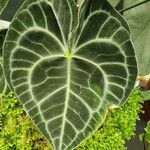
Anthurium clarinervium
Velvet cardboard anthurium · Kuping Gajah
Description
Source: leafsnapAnthurium clarinervium, commonly known as the velvet cardboard anthurium, is a tropical plant native to Mexico and Central America. It belongs to the Araceae family and is renowned for its unique foliage. The plant features large, heart-shaped leaves that are velvety to the touch and adorned with prominent white veins, giving it a distinctive appearance. This plant thrives in bright, indirect light and requires well-draining soil that remains consistently moist but not waterlogged. It can be cultivated both indoors and outdoors in warm climates. Anthurium clarinervium produces small flowers on long stems, surrounded by colorful bracts in shades of red, pink, or white. While the flowers are not particularly showy, they do add an element of interest to the plant's striking foliage. This plant has gained popularity among houseplant enthusiasts due to its unique appearance and ease of care. With proper care, it can grow up to 2-3 feet tall indoors or up to 6 feet tall outdoors in tropical climates. In summary, Anthurium clarinervium is an attractive tropical houseplant with striking foliage that adds interest and texture to both indoor and outdoor spaces when properly cared for.
Care Guide
💧 Water Every 7 days
The velvet cardboard anthurium is a tropical plant native to the rainforests and thrives in environments with high humidity. For optimal health, it should be watered every 1-2 weeks and is usually grown indoors. Being an evergreen, it effectively retains moisture and requires consistently moist soil.
☀️ Light Partial sun
Velvet cardboard anthurium is native to habitats like forest understories and rocky areas, where it grows in natural shade. It prefers partial sun but can adapt to full sun or full shade, showing its versatile and hardy nature.
🌡️ Temperature 20–37.8°C
Velvet cardboard anthurium is a plant naturally adapted to moderate environments and prefers temperatures between 68 and 100 °F (20 and 38 ℃). Seasonal changes may call for slight adjustments to maintain its optimal growth.
💨 Humidity high (>60%)
This plant needs special care because it loves high humidity levels of 60-80% or more. The best way to achieve this is by placing a humidifier near the plant. Daily misting is also essential! Make sure the room has good ventilation.
🪴 Soil 5-6
🌱 Fertilizer
Correct feeding is essential for the Velvet cardboard anthurium's health and appearance. Feed the Velvet cardboard anthurium in summer, repeating the feeding monthly throughout the season. The nutrients support growth and the maintenance of the plant's parts. Fertilizing improves the Velvet cardboard anthurium's flower display, helping it achieve its best blooms.
🪴 Pot & Repot Once a year
Repot the velvet cardboard anthurium in spring or summer once it's warm enough, choosing a slightly larger pot with good drainage. After repotting, water thoroughly and place the plant where it receives bright, indirect light. You can add a moss pole to support it as it grows.
✂️ Pruning
For optimal growth and health, it's important to prune your Velvet Cardboard Anthurium strategically, ideally in early spring. This process involves removing dead leaves and leggy stems, which not only encourages healthy growth but also improves airflow around the plant. Regular pruning helps prevent disease and keeps the plant looking attractive. Be sure to use sterilized tools and take the plant's growth cycle into account for the best results.
🌿 Propagating
🐛 Diseases & pets
☠️ Toxicity
The White-Veined Clarinervium is poisonous if eaten. They are both poisonous to people and animals. Ingestion of Anthurium clarinervium results in esophageal and throat ulcers.
Characteristics
- Plant Type
- Herb
- Life Cycle
- Perennial
- Genus
- Anthurium
- Family
- Araceae
- Hardiness Zone
- 9-11
- Mature Height
- 1 cm to 25 cm
- Mature Spread
- 49 cm
- Leaf Color
- Green, White
- Leaf Type
- Evergreen
- Flower Color
- White, Green
- Flower Size
- 5.08 cm to 10.16 cm
- Bloom Time
- All year round
- Planting Time
- Spring, Summer, Autumn
- Harvest Time
- Late spring, Summer, Fall, Winter, Early spring, Mid spring
- Native Area
- Mexico