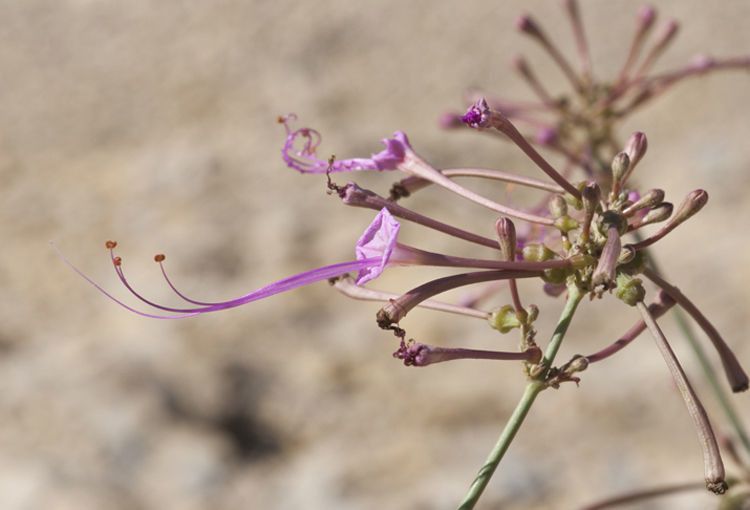
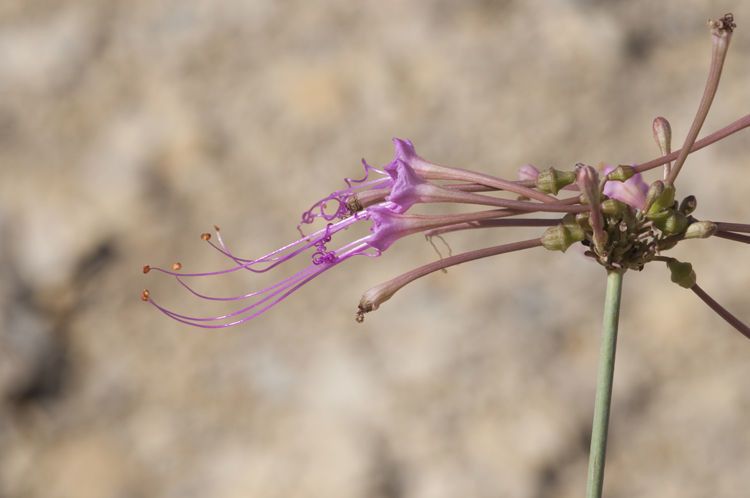
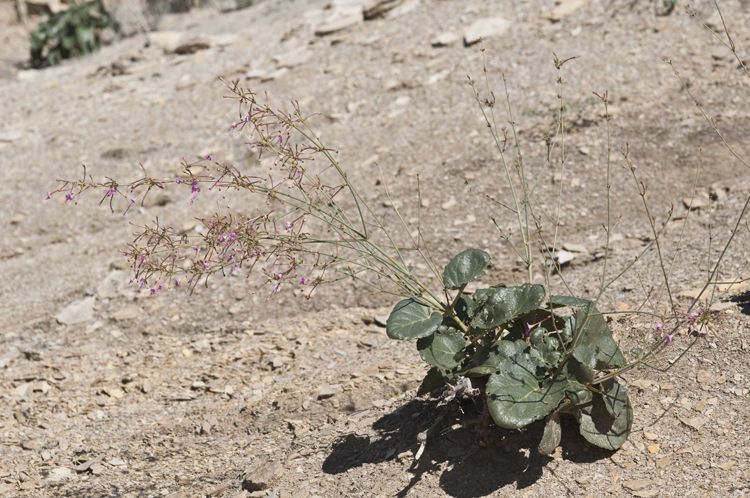
Anulocaulis leiosolenus, commonly known as the smoothstem false tamarisk, is a perennial plant species belonging to the Nyctaginaceae family. It thrives in the arid regions of North America, particularly in Arizona, New Mexico, and Texas.
This plant is easily recognizable by its thin, green or reddish-brown stems that can grow up to 1 meter tall. Its small, scale-like leaves are grayish-green, a coloration that helps conserve water.
From late spring to early fall, Anulocaulis leiosolenus produces small pink or white flowers. These flowers, which have five petals, are arranged in clusters at the tips of the stems.
Adapted to survive harsh desert conditions, this plant has deep roots that access water from underground sources. Additionally, its specialized leaves reduce water loss through transpiration.
Anulocaulis leiosolenus plays a crucial role in the desert ecosystem by serving as a food source for animals such as rabbits, rodents, birds, and insects. Furthermore, Native American tribes have used it medicinally to treat ailments such as fever and stomach issues.
Overall, Anulocaulis leiosolenus is a fascinating plant species with unique adaptations for survival in arid environments, providing significant ecological benefits to local wildlife populations.
Southwestern ringstem has good disease resistance and is generally not prone to illnesses. However, it can be vulnerable to pests and diseases present in its surroundings. These infections are usually not severe. Regarding care, this plant requires moderate maintenance. It needs regular pruning to maintain a neat appearance and healthy growth. Fertilizing can also help encourage flowering. Southwestern ringstem is suitable for anyone with outdoor space, such as a garden or patio, and does not demand extensive care experience. It may require more attention when grown indoors.
How to keep Anulocaulis Leiosolenus.
Fertilizer
Typically, a one-time fertilizer application in the spring is enough for Southwestern ringstem, yet more frequent feeding can lead to optimal growth. Apply feed roughly every one to one and a half months. The fertilization process improves the look and functionality of leaves, encouraging steady color and a healthy feel. Further, it boosts the development of roots and the assimilation of nutrients, contributing to the overall well-being of the plant in the long run.
Botanical profile.
- Plant Type
- Herb
- Life Cycle
- Perennial
- Genus
- Anulocaulis
- Family
- Nyctaginaceae
- Mature Height
- 0.91 m to 1.83 m
- Leaf Type
- Evergreen
- Native Area
- Mexico
Other names.