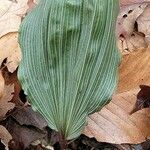
Aplectrum hyemale
Adam-and-Eve · Adam and Eve · Puttyroot
Description
Source: leafsnapAplectrum hyemale is a species of orchid native to the eastern United States and Canada, from Oklahoma east to the Carolinas and north to Minnesota, Ontario, Quebec and Massachusetts. It is particularly common in the Appalachian Mountains, the Great Lakes Region, and the Ohio and Upper Mississippi Valleys. Isolated populations are also reported from Arizona.Aplectrum hyemale is the sole species of the genus Aplectrum. The generic name comes from Greek and signifies "spurless". The species is commonly referred to as Adam and Eve or putty root; the latter refers to the mucilaginous fluid which can be removed from the tubers when they are crushed.Aplectrum hyemale spreads underground through the growth of its tubers, forming large colonies. The leaves appear in late November and persist until March. They are uniquely pin-striped, with parallel alternating silvery-white and green stripes. In late May or early June the flower stalk emerges carrying several flowers, each only a few millimeters across. It is sometimes confused with Tipularia discolor, another orchid species that occurs in eastern North America.There exists a color variation, Aplectrum hyemale var. pallidum which differs in flower color.
Care Guide
💧 Water Every 7-14 days
The putty root orchid thrives in moist, well-drained soil and requires consistent humidity. It is adaptable to changes in seasonal moisture. To care for this plant, water it once a week and mist it regularly, particularly if it's indoors. This helps to replicate its naturally humid environment during the growing season.
☀️ Light Partial sun
The putty root orchid does best with moderate sunlight but can also tolerate lower light levels similar to its native woodland habitat. Too much light can cause leaf scorch, while too little can hinder growth. These light requirements remain the same at every stage of its development.
What are the sunlight requirements for Putty Root Orchid?
The Putty Root Orchid requires about 3-6 hours of sunlight (partial sun) and can also grow in conditions where it receives less than 3 hours of sunlight daily (full shade). It's crucial to watch how sunlight moves through your garden to find the perfect balance for your plants. For indoor conditions, especially during winter or less sunny spaces, artificial lighting can be essential. LED lights are recommended, and the amount of artificial light needed varies depending on the type of plant: 30-50W/sq ft for full sun plants, 20-30W/sq ft for partial sun plants, and 10-20W/sq ft for full shade plants. The light source should be placed 12-36 inches above the plant, mimicking natural daylight for 8-12 hours per day.
What are the symptoms of insufficient light for Putty Root Orchid?
When Putty Root Orchid receives insufficient light, several symptoms may appear, including smaller new leaves, leggy or sparse growth, faster leaf drop, slowed or halted new growth, lighter-colored new leaves, chlorosis (leaves turning yellow due to lack of chlorophyll), sunscald (damaged leaves/stems from intense sun), leaf curling (to reduce sunlight exposure), wilting (due to transpiration loss), and leaf scorching (brown, dry patches on leaves). These symptoms indicate that the plant needs more light, either by moving it to a sunnier spot gradually or using artificial lighting.
How can I address light issues for Putty Root Orchid both indoors and outdoors?
To optimize Putty Root Orchid's growth in light-deficient situations, gradually increase its exposure to sunlight by shifting it to sunnier spots each week until it receives the recommended 3-6 hours of sunlight. For large or immovable indoor plants, consider supplemental artificial lighting, keeping lamps on for at least 8 hours daily or investing in professional plant grow lights. Outdoors, avoid sudden changes to prevent sunburn by gradually moving plants to sunnier locations each week. If parts of the plant have been affected by insufficient sunlight, new healthy growth should appear once you increase light exposure. Additionally, for plants in the ground, reducing obstructions like overhanging tree branches can help, as can transplanting smaller plants during their dormant period to sunnier locations with good drainage.
🌡️ Temperature 5–32.2°C
Putty root orchid is indigenous to habitats where temperatures range from 41 to 89.6 °F (5 to 32 ℃). It naturally favors moderate temperate conditions. To reproduce these, vary temperatures seasonally, with cooler winter periods recommended.
What is the native temperature range for Putty root orchid?
Putty root orchid is native to environments where the temperature ranges from 41 to 89.6 °F (5 to 32 °C). It naturally prefers average temperate conditions. To replicate its native habitat, it is suggested to adjust temperatures seasonally, allowing for cooler periods during winter. This orchid has a strong cold resistance, meaning special frost protection measures are usually not necessary. However, if winter temperatures are expected to drop below -30°C, providing cold protection with materials like soil or straw could be beneficial. Additionally, watering the plant abundantly before the first freeze in autumn is recommended to keep the soil moist and prevent drought and water scarcity during winter and early spring.
How to care for Putty root orchid in low temperatures?
Putty root orchid thrives best in temperatures above 5°C and should be kept above -25°C during winter. In the case of temperatures falling below -30°C, you might not notice any immediate changes during the winter. However, there could be a decrease in sprouting or even no sprouting at all during springtime. The solution for any parts of the orchid that fail to sprout in spring is to simply remove them.
How to care for Putty root orchid in high temperatures?
During the summer, it's crucial to ensure that the temperature around a Putty root orchid stays below 32°C. If temperatures exceed 35°C, the leaves may become lighter in color, prone to curling and susceptible to sunburn, and in severe cases, the entire plant may wilt and become dry. To protect and care for the orchid under such conditions, trim away any sunburned and dried-up parts. Moving the plant to a location that provides shade during the midday and afternoon sun, or using a shade cloth, can be helpful. Also, watering the plant in the morning and evening will help keep the soil moist and support the plant's health.
💨 Humidity
🪴 Soil 6-7
🌱 Fertilizer
The best time to fertilize a Putty root orchid is in early spring, when it is coming out of dormancy and beginning active growth. Fertilization supplies essential nutrients for healthy development. Although the Putty root orchid has relatively low fertilizer needs, applying fertilizer once a year can improve its survival and encourage better, longer-lasting blooms.
🪴 Pot & Repot
✂️ Pruning
The putty root orchid is known for its distinctive winter foliage and unique root structure. To maintain its health, prune the orchid in early to late spring by removing spent flowers and damaged leaves, and avoid cutting in the autumn. Proper pruning encourages flowering and healthy growth. For more detailed care instructions, consult horticultural manuals.
🌿 Propagating
🐛 Diseases & pets
☠️ Toxicity
This plant is not known to be toxic to humans or pets. If unintentionally consumed, consult a physician.
Characteristics
- Plant Type
- Herb
- Life Cycle
- Perennial
- Genus
- Aplectrum
- Family
- Orchidaceae
- Hardiness Zone
- 4-8
- Mature Height
- 30 cm to 61 cm
- Mature Spread
- 20 cm to 30 cm
- Leaf Color
- Green, Blue, White, Bronze
- Leaf Type
- Deciduous
- Flower Color
- Green, Brown
- Flower Size
- 2.54 cm
- Bloom Time
- Mid spring, Late spring
- Planting Time
- Spring, Summer
- Harvest Time
- Summer
- Native Area
- Eastern United States and Canada