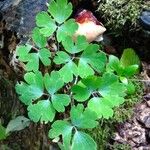
Aquilegia vulgaris
Columbine · Granny's-bonnet · European columbine · European crowfoot · Capon's-feather
Description
Source: leafsnapAquilegia vulgaris is a species of columbine native to Europe with common names that include: European columbine, common columbine, granny's nightcap, and granny's bonnet. It is a flowering herbaceous perennial plant growing to 1.2 m tall, with branched, thinly hairy stems. The leaves are biternate; each leaf has three groups of three leaflets. The flowers, in various shades of purple, blue, pink and white, are pendent or horizontal with strongly hooked spurs, and appear in early summer.The Latin specific epithet vulgaris means "common".
🌳 Columbine releases a distinctive compound that not only attracts hoverflies, which are known aphid predators, but also exemplifies nature’s clever biological pest control. This ecological interaction suggests alternatives for agricultural pest management that could replace harmful chemicals. However, for now, applying it in commercial farming remains an unexploited theoretical possibility.
🎭 Unfaithful love, a man who cheats, wisdom, knowledge, piety
Care Guide
💧 Water Every week
The common columbine, native to temperate regions, thrives in consistently moist soil and has a moderate tolerance for drought. For best results, water the plant weekly, particularly during periods of active growth, to promote lush foliage and vibrant flowers. It's important to avoid both overwatering and extended dry spells to ensure the plant's hydration needs are met.
When should I water my common columbine?
Water your common columbine when the top 1 to 2 inches of soil is dry to the touch. Wilted or discolored leaves and the formation of flower buds are indicators that it's time to water. Extreme temperatures and high sunlight exposure increase its water needs. Avoid over-watering to prevent risks like root rot, and avoid under-watering to prevent wilting or stunted growth. It's crucial to recognize these signs for effective water management, ensuring the plant's health and longevity.
How should I water my common columbine?
For common columbine, prefer well-drained soil and avoid water saturation to prevent root rot and fungal diseases. Use a watering can with a long, thin spout to direct water at the plant base, or consider bottom watering. A moisture meter can help prevent water-logging or underwatering by checking moisture levels at the root depth. Watering should focus on the plant base, avoiding the foliage to prevent fungal growth. Water thoroughly until it begins to drain from the bottom, ideally in the early morning or late evening to minimize evaporation.
How much water does common columbine really need?
Common Columbine (Aquilegia vulgaris) requires moderate amounts of water. The optimal quantity depends on factors like pot size, root depth, and environmental conditions. Typically, a mature plant in a medium-sized pot might need about 0.5 to 1 liter per watering session. Signs of proper hydration include upright leaves, deep green color, and vibrant flowers. Overwatering or underwatering can cause yellowing or wilting of leaves, respectively. Using mulch can help retain soil moisture and maintain consistent soil conditions.
What kind of water is best for common columbine?
Rainwater is the best option for common columbine due to its natural qualities and balanced pH. Distilled, tap, or filtered water are also suitable, although you should be cautious of chlorine and fluoride levels which can be harmful to the plant. Moderate temperature water, around 68-72°F (20-22°C), is preferred. To mitigate chlorine effects from tap water, let it sit for 24 hours before use or employ a water conditioner. Avoid extremes in water temperature to prevent plant shock.
How do common columbine's watering needs change with the seasons?
In spring, water common columbine more frequently to support new growth, ensuring the soil is moist but well-drained. During the active summer growth phase, maintain consistent soil moisture, adjusting for heat and dry conditions by watering either early in the morning or late in the evening. Reduce watering gradually in autumn as growth slows, avoiding over-saturation. In winter, minimize watering, only attending to the plant when the top layer of soil dries out, to prevent root rot during the dormancy period.
☀️ Light Partial sun
Columbine grows best with moderate sunlight but also tolerates shade and full sun. Originating in woodland clearings, it can handle a variety of light conditions. However, extended overexposure and underexposure can harm the plant’s healthy growth, causing wilting in the first case and stunted growth in the second.
What are the sunlight requirements for Common Columbine?
Common Columbine (Aquilegia vulgaris) thrives in conditions ranging from partial sun, requiring about 3-6 hours of sunlight, to full shade and full sun, which is less than 3 hours of sunlight. Observing the movement of sunlight through your garden is crucial for choosing optimal locations for your plants, ensuring they enjoy a perfect balance of light and shade. Despite its versatility, excessive or insufficient light exposure can lead to symptoms such as wilting or stunted growth, indicating the importance of monitoring and adjusting your plant's light environment.
How do I use artificial lighting for indoor plants?
When natural sunlight is insufficient, artificial lighting becomes essential for indoor plant growth, especially during winter or in less sunny spaces. LED lights are recommended due to their ability to provide specific wavelengths needed by plants. Full sun plants require 30-50W/sq ft, partial sun plants need 20-30W/sq ft, and full shade plants require 10-20W/sq ft of artificial light. Positioning the light source 12-36 inches above the plant can mimic natural sunlight. To promote healthy growth, it's important to replicate the natural daylight duration for your plant species, typically providing 8-12 hours of light per day.
What are the symptoms of light deficiency or overexposure in Common Columbine?
Common Columbine can exhibit various symptoms due to light deficiency or overexposure. Deficiency symptoms include smaller new leaves, leggy or sparse growth, quicker leaf drop, delayed or halted growth, paler new leaves, and chlorosis. Overexposure can cause sunscald, leaf curling, wilting, leaf scorching, and the leaves may lose their green color and turn yellow. Recognizing these signs early can help in applying corrective measures to maintain the plant's health.
What solutions can help improve light conditions for Common Columbine?
To optimize light conditions for Common Columbine, gradually increase sunlight exposure by shifting plants to sunnier spots each week until they receive 3-6 hours of direct sunlight daily. For indoor plants that are large or hard to move, consider using artificial light, keeping a lamp on for at least 8 hours daily or investing in professional plant grow lights. Outdoors, move plants to optimal sunlight spots gradually to avoid sunburn. Reducing obstructions, such as pruning trees that block sunlight, and transplanting smaller plants during their dormant period to locations with sufficient sunlight and good drainage, can also significantly improve light conditions.
🌡️ Temperature 0–35°C
Columbine is suited to temperate environments, growing best in temperatures of 68 to 95 °F (20 to 35 ℃). Seasonal adjustments may be necessary to achieve these optimal conditions, especially in warmer or colder climates.
What temperatures are optimal for Common Columbine's growth?
Common Columbine, or Aquilegia vulgaris, thrives in temperate environments, with optimal growth temperatures between 68 to 95°F (20 to 35°C). To maintain these conditions, especially in climates that are not naturally temperate, seasonal adjustments may be necessary. This plant exhibits strong resistance to cold, so special frost protection measures are not usually required during winter. However, in cases where winter temperatures are expected to plummet, providing cold protection by covering the plant with soil, straw, or similar materials is advised. It's also recommended to water the plant generously before the first freeze of autumn to ensure the soil remains moist and enters a frozen state, which helps prevent drought and water scarcity for the plant during the colder months.
How does Common Columbine respond to low temperatures?
Common Columbine is notably cold-tolerant, thriving best when temperatures are above its minimum suitable growth temperature. Through the winter, it's important to keep the plant's environment above its tolerable growing temperature minimum. If temperatures dip below the growth limit temperature, there might not be noticeable changes immediately, but there could be a decrease in sprouting or a complete absence of sprouting come springtime. To address this, in spring, it's recommended to remove any parts of the plant that have failed to sprout.
What should be done if Common Columbine experiences high temperatures?
During the summer months, it's critical to ensure that the Common Columbine's environment remains below its maximum suitable growth temperature. Overexposure to temperatures exceeding its tolerable growing temperature maximum can cause the plant's leaves to lighten in color, become prone to curling and sunburn, and in severe cases, the plant may wilt and dry out. To mitigate these issues, trim away the sunburned and dried-up parts of the plant. Relocating the plant to a shaded area during the midday and afternoon sun, or using a shade cloth, can protect it from excessive heat. Additionally, watering the plant in the morning and evening helps keep the soil adequately moist.
💨 Humidity normal (40-60%)
This plant will thrive in moderate humidity, which is probably the level in your home. However, misting it a few times a week can be very beneficial. Make sure the room has good ventilation.
🪴 Soil 6-7
🌱 Fertilizer
The best time to fertilize a Columbine is in early spring, when it is coming out of dormancy and beginning active growth. Fertilizing supplies essential nutrients for healthy development. Although Columbine has relatively low fertilizer requirements, applying fertilizer annually can improve its survival and encourage better, longer-lasting blooms.
🪴 Pot & Repot 2-3 years
When repotting Columbine, select a pot 1-2 inches (2.5–5.1 cm) larger with good drainage. Use a well-draining potting mix. Repot in spring or fall, making sure the root ball sits slightly below the rim of the flower pot. Water thoroughly after repotting and place it in a warm spot with indirect sunlight.
✂️ Pruning
The common columbine is characterized by its nodding flowers and fern-like leaves. It benefits greatly from regular pruning. Techniques such as deadheading and cutting back after flowering are recommended, ideally in early spring. Pruning helps improve air circulation, reduces the risk of disease, and promotes growth. Be sure to use clean tools to prevent infection.
🌿 Propagating
🐛 Diseases & pets
☠️ Toxicity
Characteristics
- Plant Type
- Herb
- Life Cycle
- Perennial, Biennial
- Genus
- Aquilegia
- Family
- Ranunculaceae
- Hardiness Zone
- 3-9
- Mature Height
- 0.3 m to 1.22 m
- Mature Spread
- 30 cm
- Leaf Color
- Green, Blue
- Leaf Type
- Deciduous
- Flower Color
- Purple, Blue, Pink, White
- Flower Size
- 3.05 cm to 5.08 cm
- Bloom Time
- Late spring, Early summer
- Planting Time
- Spring
- Harvest Time
- Early summer, Mid summer
- Native Area
- Hungary, Germany, Portugal, Austria, Italy, Spain, Switzerland, Romania, France, Bulgaria, Albania, Poland, Ireland, Greece, United Kingdom, Belgium, Belarus, Netherlands