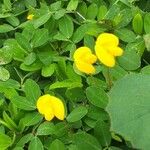
Arachis hypogaea
Peanut · Goober · Groundnut · Amazambane · Monkey nut
Description
Source: leafsnapThe peanut (Arachis hypogaea), also known as the groundnut, goober (US), pindar (US) or monkey nut (UK), is a legume crop grown mainly for its edible seeds. It is widely grown in the tropics and subtropics, being important to both small and large commercial producers. It is classified as both a grain legume and, due to its high oil content, an oil crop. World annual production of shelled peanuts was 44 million tonnes in 2016, led by China with 38% of the world total. Atypically among legume crop plants, peanut pods develop underground (geocarpy) rather than above ground. With this characteristic in mind, the botanist Carl Linnaeus gave peanuts the specific epithet hypogaea, which means "under the earth". The peanut belongs to the botanical family Fabaceae (or Leguminosae), commonly known as the legume, bean, or pea family. Like most other legumes, peanuts harbor symbiotic nitrogen-fixing bacteria in root nodules. The capacity to fix nitrogen means peanuts require less nitrogen-containing fertilizer and improve soil fertility, making them valuable in crop rotations. Peanuts are similar in taste and nutritional profile to tree nuts such as walnuts and almonds, and, as a culinary nut, are often served in similar ways in Western cuisines. The botanical definition of a nut is "a fruit whose ovary wall becomes hard at maturity". Using this criterion, the peanut is not a nut. However, peanuts are usually categorized as nuts for culinary purposes and in common English more generally.
🌳 There's more to the peanut than just a favorite snack. Grown as an oil crop, peanut oil is a healthy cooking fat, rich in unsaturated fats, vitamin E, and phytosterols. The "groundnut," as it's commonly called, also has an unexpected role in cosmetics. Its oil is included in moisturizers and soaps because of its hydrating properties. Beyond that, peanut shells are used as biochar — a soil amendment and a possible component in water purification systems.
🎭 Steadiness, prosperity, riches
Care Guide
💧 Water
Peanuts are well-suited for dry, sandy environments with low humidity, and they have a moderate tolerance for drought. For optimal growth, peanuts need weekly watering and thrive best in warm climates. In such climates, their growth cycle typically aligns with the rainfall patterns, which influences both irrigation needs and pod development.
How should I water my Peanut plant?
The Peanut has specific water preferences and is particular about how it is supplied. Improper watering techniques can harm your tomatoes. To water Peanut effectively, apply water directly to the soil in a slow and gentle manner. Avoid pouring all the water at once or doing overhead watering. It is important to water slowly yet deeply to ensure sufficient moisture throughout the soil where Peanut grows.
What do I need to do if I give my Peanut too much or too little water?
If you realize you've overwatered your Peanut plant and are worried about the risk of disease, it's important to take action right away. The best approach is to carefully remove the plant from its current spot and let the roots dry out a bit before replanting it somewhere with better drainage. If you're growing in pots, you might consider transferring the plant to a pot with more or bigger drainage holes. On the other hand, if you've been underwatering your Peanut plant, simply increase the frequency of watering.
How often do I need to water my Peanut plant?
Peanut plants need a lot of water during their growing season. To meet this need, you should water them regularly from spring to summer. In the early part of the growing season, water them once or twice a week. As the season goes on, increase your watering frequency. In the summer, you may need to water them twice a day or more, depending on the weather. Once the plants have reached their peak growth, you can reduce watering to about once a week until the end of the growing season.
How much water does my pet Peanut need?
Peanuts are highly popular plants, and both professional and amateur gardeners have found success in growing them. Therefore, we have a good understanding of how to care for these plants, including knowing how much water they require. On average, Peanuts need approximately 1 - 1.5 inches of water per week, which should be evenly distributed during your weekly watering. As the temperature rises, you may need to increase the amount of water you provide, but in most cases, a baseline of two inches per week is sufficient.
How can I know if I am giving enough water to my Peanut?
Both underwatering and overwatering can cause problems for your Peanut plant, and these problems can show similar symptoms. For instance, both overwatering and underwatering can result in foliage discoloration and wilting. When your Peanut plant is underwatered, its leaves will initially curl and droop, and you will notice a decrease in leaf vitality. Underwatering can also hinder the plant's growth and overall development, as this plant requires a high amount of water for both its flowers and its overall health. On the other hand, overwatering is more likely to lead to disease and rot, and may cause unpleasant smells from the soil. The symptoms of underwatering tend to appear faster than those of overwatering. Additionally, overwatering can be recognized by saturated and waterlogged soils, while underwatering is associated with dry soil conditions.
☀️ Light Full sun
Peanut needs a steady, plentiful supply of light for healthy growth, especially during flowering and fruiting. Its native habitat is characterized by abundant sunshine. Insufficient exposure can lead to spindly plants and reduced nut production. Conversely, excessive light may cause leaf scorch.
What are the sunlight requirements for peanut plants?
Peanut plants thrive in environments that mimic their native habitat, which is characterized by an abundant presence of sunlight. For healthy growth, especially during their flowering and fruiting stages, peanuts require a continuous and generous amount of light. The plant needs to be placed in areas that receive full sun, defined as above 6 hours of sunlight daily, or partial sun, about 3-6 hours of sunlight daily. It's important to observe the movement of sunlight through your garden carefully, selecting locations that offer the right balance of light and shade to ensure the well-being of your plants.
How does insufficient sunlight affect peanut plants?
Peanuts require full sunlight for optimal growth. When grown indoors or under limited light conditions, they may exhibit symptoms like small leaves, leggy or sparse growth, faster leaf drop, slowed or ceased growth, lighter-colored new leaves, chlorosis, sunscald, leaf curling, wilting, and leaf scorching. Each of these symptoms can indicate that the plant is not receiving the adequate light needed for its development, leading to decreased nut production and overall health. It's crucial to address these signs by adjusting light exposure to prevent such deficiencies.
What are some solutions for managing light conditions for peanut plants?
To manage light conditions effectively for peanut plants, you can implement several strategies based on the plant's location. For indoor plants, gradually move them to a sunnier spot each week until they receive at least 6 hours of direct sunlight daily, utilizing a south-facing window. If the plant is large or not easily movable, consider using artificial light sources like professional plant grow lights or keeping a desk or ceiling lamp on for at least 8 hours daily. For outdoor plants, similarly, move them gradually to sunnier spots to avoid shock and sunburn. If the issue is due to sunlight obstruction, consider pruning trees or transplanting smaller plants to areas with better sunlight and drainage during their dormant period. The goal is to ensure plants get optimal sunlight without sudden changes in exposure.
Can artificial lighting be used for peanut plants and how?
Yes, artificial lighting can be a crucial solution for peanut plants when natural sunlight is insufficient, such as during winter or in less sunny spaces. To use artificial lighting effectively, choose the right type of light like LED lights, which can be customized to provide specific wavelengths of light that plants need. Depending on the plant's sunlight requirements, full sun plants may need 30-50W/sq ft, partial sun plants 20-30W/sq ft, and full shade plants 10-20W/sq ft of artificial light. Position the light source 12-36 inches above the plant to mimic natural sunlight, and determine the duration to match the length of natural daylight hours, typically 8-12 hours per day for most plants. This approach helps in promoting faster, healthier growth.
🌡️ Temperature 15–35°C
Peanut is native to warmer climates and performs best at temperatures from 68 to 95 °F (20 to 35 ℃). In colder conditions, this plant may need extra insulation or a heated environment to ensure successful growth.
What is the best temperature for growing peanuts?
Peanuts, botanically known as Arachis hypogaea, thrive best in warmer climates with temperatures ranging between 68 to 95°F (20 to 35°C). To ensure successful growth, it's beneficial to maintain temperatures above the minimum suitable growth temperature during winter cultivation, while keeping them above freezing point to prevent freezing damage. When outdoor temperatures approach -5°C (25°F) during winter, bringing the Peanut plant indoors or providing protection through a temporary greenhouse or wrapping materials such as plastic film or fabric is advisable.
What are the symptoms of low temperature in peanuts and their solutions?
Peanut plants have moderate tolerance to low temperatures and thrive best when temperatures are maintained between the suitable growth temperature range. During winter, temperatures should be kept above the tolerable growing temperature minimum. Exposure to temperatures below the growth limit can result in leaves darkening in color, and in severe cases, water-soaked necrosis, wilting, drooping, and the gradual browning of leaves may occur. The solution involves trimming away frost-damaged parts, moving the plant to a warm environment indoors, or setting up a makeshift greenhouse for cold protection. It's also beneficial to place the plant near a south-facing window for ample sunlight, or use supplemental lighting if natural light is insufficient.
How to address high temperature issues in peanuts?
During summer, it's crucial to keep Peanut plants below the maximum suitable growth temperature. Exceeding the tolerable growing temperature maximum slows down growth, lightens the color of the leaves, and increases susceptibility to sunburn. To mitigate high temperature issues, trim away the sunburned and dried-up parts. Relocating the plant to a shaded area, especially from the afternoon sun, and watering in the morning and evening to maintain soil moisture, are effective solutions.
💨 Humidity
🪴 Soil 5-7
🌱 Fertilizer
To feed Peanut, apply natural or commercial fertilizer high in nitrogen for leaf growth, phosphorus for roots and flowering, and potassium for photosynthesis and maximum fruit production. Plant in spring, enrich the soil with compost or manure, and fertilize seedlings when they are 2–4 inches (5.1–10.2 cm) tall. A shortage of macronutrients causes slow growth, wilting, and problems with fruit quality.
Why should I put fertilizer on my Peanut plant?
When growing Peanut for its fruit, it is important to supplement the soil with additional nutrients to ensure optimal harvest. Each main macronutrient plays a unique role in supporting plant growth. Phosphorus, in particular, is essential for promoting the formation of flowers and fruit. Additionally, plants require proper root systems and healthy leaves to absorb sunlight in order to produce flowers and fruit. Therefore, the nutrients that support these plant parts are equally important. Insufficient macronutrients can lead to diminished vitality, slower growth, and potential wilting. Since flowering and fruiting processes require considerable energy, a deficiency in these essential components will also manifest in the resulting fruits.
When should I fertilize my Peanut plant?
To successfully grow peanuts, it is important to plant them in the spring so that they can bear fruits during the summer. Each variety may have a specific planting time, so be sure to check that. Additionally, peanuts thrive in rich and fertile soil. Prior to planting, it is recommended to mix a 2-inch layer of compost or well-rotted manure into the soil as these materials provide nutrients that promote peanut growth and improve soil drainage. If you are using transplants, you can fertilize them immediately after planting. However, for seedlings, it is best to wait until they have reached a height of 2 to 4 inches before fertilizing them for the first time. Established plants should be fed every 3 to 4 weeks throughout the growing season, up until the first frost or when the plant stops producing. It is important to consider the specific variety of peanut and fertilizer type when deciding on the fertilization schedule, as customization is key. If uncertain, it is better to apply less fertilizer.
When is the best time to not fertilize my Peanut plant?
When fertilizing Peanut, be careful not to use a fertilizer with excessive nitrogen as it can result in lots of leaves but few flowers or fruits. Instead, choose a fertilizer that has a lower nitrogen level compared to other nutrients. Avoid fertilizing Peanut during hot temperatures or dry conditions as the fertilizer can easily wash away without being absorbed. Additionally, plants have reduced nutrient absorption capabilities during hot weather, leading to the fertilizer remaining in the soil and hindering water uptake. This can be detrimental to plants, especially during a drought or heatwave.
What kind of fertilizer does my Peanut plant need?
To determine the right fertilizer for your Peanut, it's important to understand what nutrients are already present in your soil and what might be lacking. Conducting a soil test can help with this, but many people successfully grow Peanuts without one through trial and error. While there are commercial fertilizers tailored for different Peanut varieties, it's not necessary to buy a separate fertilizer for each vegetable you grow. By identifying the basic needs of your plants and the nutrients already in your soil, you can use the same fertilizer for multiple plants. Many growers prefer high-phosphorus fertilizers that promote flower and fruit growth, with an NPK ratio like 8-32-16 or 10-30-10. However, using a balanced fertilizer like 10-10-10 for all your garden plants is also an option to simplify things.
How do I make my Peanut plant grow better?
When using different types of fertilizer, it's important to carefully follow the provided instructions. Some varieties may need to be diluted or measured out precisely. By doing your research and following instructions, you can avoid over fertilizing your garden. If you have Peanut plants in a row, you can use the side-dressing method to ensure that the fertilizer reaches the roots without touching the plant itself. To do this, mix the fertilizer into the soil along the rows on both sides, about 3 to 4 inches away from the plant base. Water will then carry the nutrients into the soil and down to the roots. If the side-dressing method doesn't work for your garden setup, you can apply the fertilizer to the soil around the plant, again staying about 3 to 4 inches away. For granular fertilizers, scatter them onto the soil and lightly mix them in to ensure they are incorporated properly. After applying dry fertilizers, be sure to water thoroughly. Liquid fertilizers, on the other hand, are mixed into a watering can and used to water and fertilize plants simultaneously. Alternatively, foliar feeding involves spraying the leaves with a specialized fertilizer mix instead of adding nutrients to the soil.
🪴 Pot & Repot
When repotting Peanut, choose a pot that's 1-2 inches (2.5–5.1 cm) larger in diameter and ensure it has good drainage. Use a well-draining potting mix and consider adding perlite for extra drainage. Repot in spring or early summer, water thoroughly afterward, and place it in a shady spot initially.
✂️ Pruning
Peanuts are low-growing leguminous plants known for their yellow flowers and underground pods. To maintain their health and appearance, it's important to prune them from early to late spring. This process helps remove dead leaves, improve air circulation, and prevent disease. Be sure to use clean, sharp tools for pruning, as this promotes effective photosynthesis and nutrient distribution.
🌿 Propagating
🐛 Diseases & pets
☠️ Toxicity
Characteristics
- Plant Type
- Herb
- Life Cycle
- Annual
- Genus
- Arachis
- Family
- Fabaceae
- Hardiness Zone
- 7-10
- Mature Height
- 23 cm to 46 cm
- Mature Spread
- 23 cm to 46 cm
- Leaf Color
- Green
- Leaf Type
- Deciduous
- Flower Color
- Yellow, Orange
- Flower Size
- 2.54 cm to 7.62 cm
- Bloom Time
- Late spring, Early summer, Mid summer
- Planting Time
- Spring, Summer
- Harvest Time
- Mid summer
- Native Area
- Brazil, China