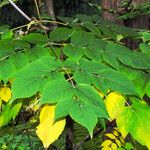
Aralia cordata
Udo · Spikenard · Japanese-asparagus · Japanese-spikenard · Herbal aralia
Description
Source: leafsnapAralia cordata, commonly known as Japanese spikenard or udo, is a perennial herbaceous plant belonging to the Araliaceae family. Native to Japan and Korea, it has been cultivated for centuries for its edible shoots and roots. The plant can grow up to 2 meters tall and features large heart-shaped or triangular leaves. Its small flowers are white or greenish-yellow and are arranged in sizeable umbels that can span up to 50 cm across. The Japanese spikenard thrives in moist soil with partial shade but can also tolerate full sun. It is a hardy plant, capable of withstanding temperatures as low as -20°C, though it does require protection from strong winds. In addition to its culinary uses, Aralia cordata has been traditionally used for medicinal purposes, thanks to its anti-inflammatory properties. The roots have been utilized in traditional Chinese medicine for treating rheumatism and arthritis. Moreover, the Japanese spikenard has ornamental value due to its attractive foliage, making it a popular choice among gardeners worldwide. Overall, Aralia cordata is a versatile plant with diverse uses, from culinary and medicinal applications to ornamental appeal, making it an excellent addition to both indoor and outdoor settings.
Care Guide
💧 Water Every 7 days
Spikenard flourishes in moist environments, thriving best in consistently damp soil similar to that of its natural woodland habitat. To prevent overwatering, it is ideal to water the plant once a week. Being an herbaceous perennial, applying mulch during its growing season helps retain moisture, ensuring the plant remains well-hydrated and healthy.
☀️ Light Partial sun
Spikenard does best with moderate sunlight but can tolerate lower light levels, reflecting its native forest-floor habitat. Sunlight is required for healthy growth, though too much can be harmful. It maintains the same light preference throughout its different growth stages.
What are the sunlight requirements for Spikenard?
Spikenard thrives in moderate sun exposure but can also grow in lower light conditions, similar to its natural habitat on the forest floor. It requires sunlight for healthy growth, but too much direct exposure can be harmful. The plant generally needs about 3-6 hours of sunlight daily, which is considered partial sun. For locations with full shade, it's important to ensure they receive less than 3 hours of sunlight. Observing how sunlight moves through your garden and choosing locations that offer a balance of light and shade is crucial for the plant's well-being.
How can artificial lighting support Spikenard's growth indoors?
Indoor Spikenard plants require adequate lighting to grow optimally, especially when natural sunlight is not sufficient, such as during winter or in less sunny spaces. Artificial lighting, such as LED lights, is a beneficial solution that promotes healthier, faster growth by providing the necessary wavelengths of light. For plants needing full sun, the requirement is 30-50W per square foot, while partial sun plants require 20-30W, and full shade plants need 10-20W. The light source should be placed 12-36 inches above the plant, mimicking natural sunlight, and most plants benefit from 8-12 hours of light per day to thrive indoors.
What symptoms indicate that Spikenard is receiving insufficient light?
When Spikenard receives insufficient light, it may exhibit several symptoms, including the growth of smaller leaves compared to previously matured ones, leggy or sparse growth due to longer spaces between leaves or stems, faster leaf drop as a survival response to conserve resources, slowed or halted leaf production, and the appearance of lighter-colored or irregularly patterned new leaves. Insufficient sunlight can also lead to chlorosis, where leaves lose their green color, as well as other conditions like sunscald, leaf curling due to reduced surface area exposure, wilting from loss of turgor pressure, and leaf scorching from excessive sunlight exposure. These symptoms highlight the plant's struggle to adapt to insufficient light conditions.
What solutions can help Spikenard adapt to changing light conditions?
To help Spikenard adapt to changing light conditions, gradually increase its exposure to sunlight by moving it to sunnier spots each week until it receives 3-6 hours of direct sunlight daily. For indoor plants that are large or not easily movable, consider using artificial light, such as a desk or ceiling lamp for at least 8 hours daily, or invest in professional plant grow lights. Outdoors, it's crucial to avoid sudden changes in light intensity by gradually moving plants to sunnier locations to prevent sunburn. Additionally, minimizing obstructions like pruning trees can help, and for smaller plants, transplanting during the dormant period to a location with ample sunlight and good drainage can be beneficial. Note that parts of the plant affected by prior insufficient sunlight may not recover fully, but new growth will be healthy with improved light exposure.
🌡️ Temperature 5–35°C
Spikenard is native to areas where normal temperatures fall between 41 and 95 °F (5 to 35 ℃). In colder periods it typically prefers warmer indoor surroundings. If conditions become too hot, providing shade and ventilation is necessary to maintain its health.
What is the ideal temperature range for growing Spikenard?
Spikenard flourishes in temperatures ranging from 41 to 95 °F (5 to 35 °C). It is a plant that has strong cold resistance and does not typically need special frost protection measures during winter. However, during the colder months, maintaining a warmer indoor environment is beneficial for its growth. In regions where the temperature may fall below -30°C, it is crucial to offer protection against the cold by covering the plant with insulating materials like soil or straw. Additionally, watering the plant abundantly before the first freeze in autumn is recommended to keep the soil moist, which helps prevent drought and water scarcity throughout the winter and early spring.
How does Spikenard react to low temperatures, and what solutions are there?
Spikenard shows a remarkable tolerance to cold, thriving best when temperatures are maintained above 5°C. However, during winter, it should be kept from falling below -25°C. Exposure to temperatures below -30°C might not visibly affect the plant during the winter, but it can lead to reduced sprouting or lack thereof during the spring. If such a situation occurs, the recommendation is to remove any parts of the plant that have failed to sprout in the spring, as a solution to encourage healthy new growth.
How does Spikenard react to high temperatures, and what are the recommendations?
In the summer, it is crucial to keep Spikenard's surrounding temperature below 35°C to prevent heat stress. Exceeding 38°C may cause the plant's leaves to lighten in color, curl, become prone to sunburn, and in severe cases, the plant can wilt and dry out completely. To mitigate these effects, trim away any sunburned and dried parts of the plant. Moving it to a location that offers shade during the midday and afternoon sun, or utilizing a shade cloth, can protect it. Additionally, watering the plant in the morning and evening helps in keeping the soil moist, further aiding in its recovery and health during hot conditions.
💨 Humidity
🪴 Soil 6-7
🌱 Fertilizer
To maximize Spikenard's yield and flavor, maintain sufficient nitrogen throughout the entire growth period, from pre-planting through harvest. Plants that are well-watered and adequately fertilized produce plentiful, healthy leaves and exhibit less bitterness. Before planting, enrich the soil with organic matter such as compost or manure, ideally 2 to 8 weeks beforehand.
🪴 Pot & Repot
✂️ Pruning
Spikenard has large, heart-shaped leaves and aromatic roots. Prune it from early to late spring to encourage growth, improve air circulation, and reduce the risk of disease. Trim old stems and remove any damaged branches to stimulate new shoots, enhance root development, and maintain the plant's shape and health.
🌿 Propagating
🐛 Diseases & pets
☠️ Toxicity
Characteristics
- Plant Type
- Herb
- Life Cycle
- Perennial
- Genus
- Aralia
- Family
- Araliaceae
- Hardiness Zone
- 4-9
- Mature Height
- 1.22 m
- Mature Spread
- 1.22 m
- Leaf Color
- Green, Yellow, Gold
- Leaf Type
- Deciduous
- Flower Color
- White
- Flower Size
- 0.25 cm to 0.51 cm
- Bloom Time
- Mid summer, Late summer
- Planting Time
- Spring, Summer
- Harvest Time
- Early fall, Mid fall
- Native Area
- Russia, Japan, Koppen, South Korea, China