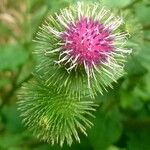
Arctium minus
باباآدم صغیر · Common burdock · Lesser Burdock · Cuckoo-button · Sticky Buttons
Description
Source: leafsnapArctium minus, commonly known as lesser burdock, little burdock, louse-bur, common burdock, button-bur, cuckoo-button, or wild rhubarb, is a biennial plant. This plant is native to Europe, but has become introduced elsewhere such as Australia, North and South America, and other places.Lesser burdock produces purple flowers in its second year of growth, from July to October. Outer bracts end in hooks that are like Velcro. After the flower head dries, the hooked bracts will attach to humans and animals to transport the entire seedhead.
🌳 Common burdock has been identified as a potential bioindicator of soil nitrate levels. Because it prefers high-nitrate soils, the presence of common burdock can signal elevated nitrate concentrations in the environment, alerting farmers and ecologists to soil fertility and potential environmental concerns.
🎭 Plenty, safeguarding
Care Guide
💧 Water
Lesser burdock, which originates from temperate regions, thrives with moderate moisture and consistent weekly watering. Although it can withstand slight variations in its watering schedule, it needs more frequent irrigation during dry spells to simulate the rain patterns of its natural habitat.
When should I water my Lesser Burdock?
Timely hydration is essential for the health and growth of Lesser Burdock. You should water it when the soil surface feels dry to the touch. Key indicators that the plant needs water include wilted or droopy leaves, slow or stunted growth during its active phase, and the browning of leaf edges. Ignoring these signs can lead to issues like yellowing leaves, wilted leaves, stunted growth, or even plant death due to dehydration or overwatering leading to root rot. It's crucial to maintain a balance, not allowing the soil to become either too dry or waterlogged.
How should I water my Lesser Burdock?
Lesser Burdock thrives in moist, well-drained soil and does not fare well with prolonged drought or waterlogged conditions. Watering techniques that benefit the plant include bottom-watering and using a rain or watering can with a coarse spray to moisten the soil without accumulating water on the foliage. Tools like a moisture meter and a watering can with a coarse spray head can help prevent over or under-watering. Focus on watering the base of the plant rather than the foliage to avoid diseases, and ensure not to create soggy soil conditions.
How much water does Lesser Burdock really need?
The watering needs of Lesser Burdock vary based on factors such as pot size and plant size, but a moderate amount of water is generally sufficient to keep the soil consistently moist. For a plant in a 6-inch pot, about 300-400 mL of water per session is recommended. Proper hydration is indicated by vibrant green leaves, upright stems, and an abundance of flowers, while signs of overwatering include yellowing leaves and soggy soil. To prevent overwatering and ensure root access to oxygen, allow the top inch of soil to dry out slightly between watering sessions and provide adequate drainage.
What kind of water is best for Lesser Burdock?
Lesser Burdock benefits from using distilled water or rainwater, as they are free from harmful substances like chlorine or certain minerals found in tap water. If you must use tap water, let it sit out for 24 hours to dechlorinate. Lesser Burdock is sensitive to high mineral content and fluoride, so hard tap water and fluoridated water should be avoided when possible. Room temperature water is advisable to avoid shocking the plant's system.
How do Lesser Burdock's watering needs change with the seasons?
Lesser Burdock's watering needs vary throughout the year. In spring, during its active growth phase, maintain consistent soil moisture with regular watering. Reduce watering frequency in summer, allowing the soil to dry slightly between sessions. As the plant prepares for dormancy in autumn, gradually decrease watering frequency but ensure the soil remains lightly moist. In winter, water sparingly, letting the topsoil dry out between waterings, as the plant requires minimal moisture during this dormant period.
☀️ Light Full sun
Common burdock thrives when exposed to sunlight all day for healthy development. It can tolerate shadier conditions, but its best growth occurs with plenty of sun. Because it originates from habitats that regularly receive full sunlight, both too much and too little light can negatively affect its health.
What are the sunlight requirements for lesser burdock?
Lesser burdock requires full sun exposure, which means it should receive above 6 hours of sunlight for healthy growth, but it can also tolerate partial sun, getting about 3-6 hours of sunlight. Optimal growth occurs with abundant sunlight, and although it can withstand less sunny environments, both excessive and insufficient light can adversely affect its well-being. It's important to watch how sunlight moves through your garden and choose spots that provide the right balance of light and shade for your plants.
How does artificial lighting benefit indoor plants like lesser burdock?
Indoor plants, including lesser burdock, require adequate lighting for optimal growth, especially when natural sunlight is insufficient. Artificial lights offer a vital solution in conditions like winter or less sunny spaces, promoting faster, healthier growth. LED lights are a popular choice as they can be customized to provide specific wavelengths needed by the plants. For full sun plants, 30-50W/sq ft of artificial light is recommended, partial sun plants need 20-30W/sq ft, and full shade plants require 10-20W/sq ft. The light source should be placed 12-36 inches above the plant to mimic natural sunlight and be kept on for 8-12 hours per day.
What are the common symptoms of insufficient light in lesser burdock?
When grown indoors or in inadequate light conditions, lesser burdock may display symptoms such as smaller new leaves, leggy or sparse growth, faster leaf drop, slower or no new growth, and lighter-colored new leaves indicating a lack of chlorophyll and essential nutrients. Chlorosis, sunscald, leaf curling, wilting, and leaf scorching are also symptoms that can emerge from extreme sunlight exposure or deficiency, affecting the plant’s ability to photosynthesize and maintain good health.
How can I improve my lesser burdock's exposure to sunlight?
To ensure optimal growth for your lesser burdock, gradually increase its sun exposure to at least 6 hours of direct sunlight daily. If your plant is indoors and large or not easily movable, consider using artificial light such as desk, ceiling lamps, or professional plant grow lights for at least 8 hours daily. For outdoor plants, move them to sunnier spots gradually each week to prevent sunburn. If trees obstruct sunlight, prune the branches and leaves to allow sunlight through. For smaller plants considering transplanting, do so during their dormant period in late winter or early spring to a location with ample sunlight and good drainage.
🌡️ Temperature 5–35°C
Common burdock originates in temperate regions and shows best growth at temperatures between 68 and 95°F (20 and 35°C). Its native habitats undergo seasonal temperature changes, indicating the plant's adaptability.
What is the native climate for Lesser Burdock?
Lesser Burdock is native to moderate climates, thriving best in temperatures ranging from 68 to 95°F (20 to 35°C). Its natural habitat undergoes shifts in temperature across different seasons, which highlights Lesser Burdock's ability to adapt to varying environmental conditions.
Does Lesser Burdock require special frost protection measures?
Lesser Burdock exhibits strong cold resistance, which generally eliminates the need for special frost protection measures during winter. However, if winter temperatures are predicted to fall below -30°C, it's crucial to provide cold protection. This can be done by covering the plant with soil or straw, and it's recommended to water the plant abundantly before the first freeze in autumn to maintain moist soil that enters a frozen state, aiding in preventing drought and water scarcity during winter and early spring.
How does low temperature affect Lesser Burdock, and what are the solutions?
Lesser Burdock is cold-tolerant and can thrive best when temperatures are above 20°C. While it should be kept above 0°C during winter, temperatures falling below -30°C may not show noticeable changes during the winter season. However, there might be a decrease in sprouting or even no sprouting at all during springtime. To counteract this, it's advisable to remove any parts of the plant that have failed to sprout in the spring.
What should be done if Lesser Burdock is exposed to high temperatures?
During the summer, it is important to ensure that Lesser Burdock is kept below 35°C. Exposure to temperatures exceeding 41°C may cause the leaves to lighten in color, become prone to curling, susceptible to sunburn, and in severe cases, the entire plant may wilt and become dry. To manage this, trim away the sunburned and dried-up parts of the plant. Additionally, moving the plant to a location that provides shade during the midday and afternoon sun or using a shade cloth can help. Watering the plant in the morning and evening is also recommended to keep the soil moist.
💨 Humidity
🪴 Soil 6-7
🌱 Fertilizer
Common burdock is regarded as a heavy feeder in terms of nutrients. It requires frequent, low doses of nitrogen and potassium fertilizers and periodic applications of phosphorus, micronutrients, sulfur, and magnesium to sustain good growth and bright coloration. Continuous fertilization throughout the growing season is needed to prevent deficiency symptoms and maintain optimal growth.
🪴 Pot & Repot Every 12 months
✂️ Pruning
🌿 Propagating
🐛 Diseases & pets
☠️ Toxicity
Burdock is not thought to be toxic.
Characteristics
- Plant Type
- Herb
- Life Cycle
- Biennial
- Genus
- Arctium
- Family
- Asteraceae
- Hardiness Zone
- 4-10
- Mature Height
- 0.49 m to 3.05 m
- Mature Spread
- 91 cm
- Leaf Color
- Green, White
- Leaf Type
- Deciduous
- Flower Color
- Pink, Purple
- Flower Size
- 2.03 cm
- Bloom Time
- Early summer, Mid summer
- Planting Time
- Autumn
- Harvest Time
- Mid summer
- Native Area
- Eurasia