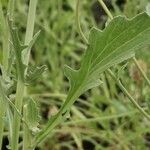
Arctotis venusta
African daisy · Blue-eyed African daisy · Free State daisy · Silver arctotis
Description
Source: leafsnapArctotis venusta is a species of South African plants in the family Asteraceae. Common names include silver arctotis, kusgousblom, and blue-eyed African daisy. It is native to the western coast of South Africa, The species is widely cultivated as an ornamental, and has become naturalized in parts of the United States (California, Arizona, South Carolina), Australia, and Central and South America, where it has escaped from gardens to become a noxious weed.Arctotis venusta is grown as a ground cover because of its silvery foliage and showy flower heads. It is adaptable to many conditions and is sometimes used to control erosion. It is a perennial with stout, woolly stems and aromatic, violin-shaped, heavily lobed leaves. The flower heads have many creamy-white to pink or bronze ray florets with lavender to reddish undersides and centers filled with purple disc florets. The fruit is a hard achene with a tuft of plumelike hairs on one end and an array of pappus scales on the other.The species is sometimes regarded as the same species as the rare A. stoechadifolia, but authors separate the two as distinct species.
Care Guide
💧 Water
The blue-eyed African daisy excels in dry conditions and requires little water, needing only a weekly watering. Its drought tolerance makes it ideal for low-maintenance gardens. It prefers well-draining soil to avoid waterlogging. Typically, this plant is grown outdoors and thrives in direct sunlight.
☀️ Light Full sun
That the blue-eyed African daisy originates from Africa implies it needs plenty of sun to grow optimally. Its capacity to tolerate low-light conditions has not been established. Too little sun can lead to stunted growth, while too much light can cause leaf burn.
What are the sunlight requirements for Blue-eyed african daisy?
The Blue-eyed african daisy requires full sun exposure for optimal growth, meaning it should receive above 6 hours of sunlight daily. Observing the movement of sunlight through your garden helps in choosing spots that provide a perfect balance of light and shade for the plant, ensuring its well-being. Insufficient sunlight can lead to stunted growth, while excessive light might cause leaf burn.
What are crucial facts about lighting for Blue-eyed african daisy?
Originating from Africa, the Blue-eyed african daisy thrives under ample sun exposure. Indoor plants, if not exposed to sufficient natural sunlight, especially in winter or less sunny spaces, can benefit from artificial lighting, promoting healthier growth. LED lights are ideal for indoor plants, providing specific wavelengths needed for growth. Full sun plants require 30-50W/sq ft, partial sun 20-30W/sq ft, and full shade 10-20W/sq ft of artificial light. The light source should be 12-36 inches above the plant, mimicking natural sunlight for 8-12 hours per day.
What are the symptoms of improper lighting for Blue-eyed african daisy?
When the Blue-eyed african daisy is grown indoors with inadequate light, it may show symptoms like smaller new leaves, leggy or sparse growth, faster leaf drop, slower or no new growth, lighter-colored new leaves, chlorosis, sunscald, leaf curling, wilting, and leaf scorching. These symptoms indicate either a deficiency or excess of sunlight exposure, affecting the plant’s health negatively.
How can lighting conditions be improved for indoor Blue-eyed african daisies?
To enhance growth, gradually move plants to sunnier locations until they receive at least 6 hours of direct sunlight daily. Use south-facing windows and keep curtains open during the day. If the plant is large or not easily movable, provide additional light using desk or ceiling lamps for at least 8 hours daily, or consider investing in professional plant grow lights. However, parts affected by insufficient sunlight may not recover, but new growth post exposure to increased light will be healthy.
What solutions are available for outdoor Blue-eyed african daisies concerning sunlight?
For outdoor plants, gradually adapt them to sunlight by moving to sunnier locations each week to prevent sunburn. It's crucial to avoid sudden changes in light intensity. For plants in the ground, identify and reduce obstructions like trees by pruning branches and leaves to let more sunlight through. If dealing with smaller plants, consider transplanting during the plant's dormant period, usually in late winter or early spring, to a location with ample sunlight and good drainage.
🌡️ Temperature 20–37.8°C
Blue-eyed African daisy comes from areas with a mild to warm climate and prefers temperatures between 68 and 100°F (20 and 38°C). It may require seasonal adjustments to keep conditions within that range, particularly in colder regions.
What is the preferred temperature range for Blue-eyed african daisies?
Blue-eyed african daisies thrive in environments with moderate to warm climates, preferring temperatures between 68 to 100°F (20 to 38°C). To promote optimal growth, it is important to maintain this temperature range, especially in colder climates. During the colder months, it's recommended to bring these plants indoors, placing them near a bright window but away from direct heat sources to avoid any damage. Keeping the temperature above 20°C during winter benefits the plant, while temperatures nearing 10°C can be harmful.
How do you care for Blue-eyed african daisies in low temperatures?
Blue-eyed african daisies strive best in warm conditions and do not tolerate low temperatures well. It's crucial to keep them in an environment where the temperature remains above 20°C. If winter temperatures drop below 10°C, the plant should be kept indoors in a warm, sunny spot, preferably near a south-facing window. Avoid placing the plant too close to heaters or air conditioning vents to prevent the air from becoming excessively dry. If the plant is exposed to temperatures below 5°C, its leaves may lighten, indicating frost damage. In such cases, trim off the damaged parts and move the plant to a warmer location immediately.
What should you do if a Blue-eyed african daisy experiences high temperatures?
During the summer, it is essential to ensure that Blue-eyed african daisies are not exposed to temperatures above 38°C. High temperatures, especially those exceeding 43°C, can cause the leaves to lighten and increase susceptibility to sunburn. If this occurs, remove sunburned or dried parts of the plant. To protect the plant, relocate it to an area with shade during the midday and afternoon sun. Additionally, watering the plant in the morning and evening can help maintain soil moisture, mitigating the stress from high temperatures.
💨 Humidity
🪴 Soil 6-7
🌱 Fertilizer
When Blue-eyed african daisy has opened most of its blooms to full size, resume fertilizing. Around the time the blooms reach peak output, fertilize once every three to four weeks, as weather allows. Then, once Blue-eyed african daisy begins producing fewer new blooms, stop fertilizing; there’s no need to feed the plant when it can’t produce more blooms.
🪴 Pot & Repot
✂️ Pruning
The blue-eyed African daisy is known for its striking blue-centered flowers. It benefits greatly from annual pruning, which should be done in early to mid-spring. Trimming the plant back by one-third encourages more compact growth and results in more abundant blooms. Additionally, regular deadheading extends the flowering period. Using clean, sharp tools for pruning helps maintain plant health by minimizing damage and improving air circulation.
🌿 Propagating
🐛 Diseases & pets
☠️ Toxicity
Characteristics
- Plant Type
- Herb
- Life Cycle
- Annual, Biennial
- Genus
- Arctotis
- Family
- Asteraceae
- Hardiness Zone
- 11-12
- Mature Height
- 30 cm to 46 cm
- Mature Spread
- 40 cm
- Leaf Color
- White, Red, Silver
- Leaf Type
- Evergreen
- Flower Color
- Orange, Yellow
- Flower Size
- 7.62 cm to 10.16 cm
- Bloom Time
- All year round
- Planting Time
- Spring, Autumn
- Harvest Time
- Late spring, Summer, Fall, Winter, Early spring, Mid spring
- Native Area
- Lesotho, South Africa, Namibia, Botswana, Zimbabwe