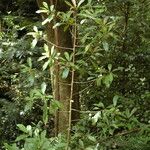
Ardisia elliptica
Shoebutton · Shoe-button ardisia · Shoebutton ardisia · Inkberry · Seashore ardisia
Description
Source: leafsnapArdisia elliptica, commonly known as shoebutton ardisia or scratchthroat, is a tropical evergreen shrub that belongs to the Myrsinaceae family. Native to Southeast Asia, it is found in countries like Malaysia, Indonesia, and Thailand. The plant typically grows up to 2 meters in height and features glossy, elliptical green leaves. Its small flowers are white or pinkish-white with a sweet fragrance. The fruit of Ardisia elliptica is a bright red berry containing several seeds. Although these berries are edible, they have a sour taste, making them less desirable for consumption. For centuries, traditional healers have used Ardisia elliptica for its anti-inflammatory properties. Additionally, the plant is popular as an ornamental species because of its attractive foliage and colorful berries. However, Ardisia elliptica can become invasive when introduced to non-native habitats, such as Florida, where it poses a threat to local flora by outcompeting native species for resources. In summary, Ardisia elliptica is a fascinating plant with medicinal uses and ornamental appeal, but it should be carefully managed when introduced into non-native environments.
Care Guide
💧 Water Every 7 days
Shoebutton is well-adapted to irregular rainfall and demonstrates strong drought tolerance. To maintain optimal health, it should be watered every 2-3 weeks. This evergreen plant is usually grown outdoors and thrives in areas with consistent annual rainfall.
How should I water my Shoebutton plant?
When watering your Shoebutton, you have a lot of flexibility in choosing a watering tool. Watering cans, hoses, or even cups will all work fine. The important thing is to water the plant's soil directly, making sure to moisten all areas evenly to provide water to the entire root system. Using filtered water is best, as tap water may contain harmful particles. It is also recommended to use water that is at or slightly above room temperature to avoid shocking the shoebutton. However, the plant generally responds well to any type of water.
What should I do if I give too much or too little water to my Shoebutton?
For outdoor plants, especially newly planted ones or seedlings, lack of watering can be a common problem. It's important to remember to water them enough for the first few months while they are small or recently planted. Once the roots are established, Shoebutton plants can rely on rain most of the time. When Shoebutton plants are in pots, overwatering is more likely to happen. If you accidentally overwater your Shoebutton, you should take immediate action to fix the situation. Firstly, stop watering your plant right away to minimize the effects of overwatering. Then, remove the Shoebutton from its pot to check its roots. If there is no sign of root rot, you can put the plant back in its pot. However, if you find any roots affected by root rot, trim them away and consider using a fungicide to prevent further damage. Finally, replant your Shoebutton in well-draining soil. On the other hand, if you underwater your Shoebutton, the solution is simple. Just water the plant more frequently. When a Shoebutton is underwatered, its leaves will droop, dry out, and fall off. However, with sufficient watering, the leaves will quickly regain fullness. So, adjust your watering frequency as soon as you notice underwatering.
How frequently should I water my Shoebutton plant?
When it comes to watering plants that grow outdoors, most of them can rely on rainfall. However, if you live in an area with limited rainfall, you should make sure to water your plants every 2 weeks in the spring and fall, and more frequently in the summer. During winter, when plant growth slows down, you can water them less often or not at all. It's important to water young or newly planted Shoebutton plants more frequently to help them establish and become more adaptable to drought conditions. For potted plants, there are two ways to determine how often to water your Shoebutton. The first method is to follow a set watering schedule, such as once every week or every other week. However, this approach may not work well for your specific growing environment. The other option is to assess the soil moisture before watering. It's best to wait until the top two to four inches of soil (about ⅓ to ½ depth of the pots) are completely dry before giving more water. Keep in mind that during summer, when the water needs of the plant are highest, a predetermined watering schedule may not be sufficient.
How much water does my Shoebutton plant require?
When watering your Shoebutton plant, you may be surprised to learn that it doesn't always require a large amount of water. If only a few inches of soil have dried out since the last watering, you can support healthy growth by giving it about five to ten ounces of water each time. You can also determine the amount of water based on the moisture in the soil. Take note of how many inches of soil have dried between waterings. To ensure that your Shoebutton plant receives the necessary moisture, water enough to moisten all the dry layers of soil since the previous watering. If more than half of the soil is dry, it may be necessary to give more water than usual, until you see excess water draining from the pot's holes. If the Shoebutton plant is planted in an area with sufficient rain, additional watering may not be needed. In the early stages of growth, make sure it receives 1-2 inches of rain per week. As it becomes more established, it can survive solely on rainwater, only requiring a full watering if there is no rainfall for 2-3 weeks during hot weather to prevent stress.
How do I know if I am watering my Shoebutton plant enough?
When it comes to the Shoebutton, overwatering is a common problem that you should watch out for. If your Shoebutton is overwatered, you'll notice yellowing leaves and possibly leaf drop. Overwatering can also make the plant's structure shrink and lead to root rot. On the other hand, an underwatered Shoebutton will start to wilt and may have brown or brittle leaves. If you see signs of either overwatering or underwatering, take action to restore your Shoebutton's health.
☀️ Light Partial sun
Shoebutton naturally occurs in habitats like forest understories and rocky areas, where it grows in natural shade. It prefers partial sun but can tolerate full sun or full shade, demonstrating its versatile and hardy nature.
What are the sunlight requirements for Shoebutton (Ardisia elliptica)?
Shoebutton (Ardisia elliptica) thrives in conditions where it can receive ample sunlight throughout the day. It requires 'Full sun' exposure, meaning it needs above 6 hours of sunlight daily, to perform its best. However, it can also tolerate 'Partial sun' conditions, which involves receiving about 3-6 hours of sunlight each day. It's important to observe your garden's sun exposure closely. The goal is to find spots that offer a harmonious balance of light and shade, ensuring your plants grow happily and healthily.
🌡️ Temperature 15–35°C
Shoebutton comes from tropical areas, where the climate is generally warm and humid. Because of this, it is well suited to high temperatures and humidity. It does not tolerate sudden temperature shifts and prefers a constant temperature, so avoid fluctuations indoors. It usually cannot endure cold and needs warmer conditions to grow. If the ambient temperature falls too low, the plant may stop growing or even die.
What is Shoebutton?
Shoebutton, scientifically known as Ardisia elliptica, is a plant species known by its common name but further details about its characteristics, uses, or specific information regarding its care and growth were not provided in the available data.
💨 Humidity
🪴 Soil 5-6
🌱 Fertilizer
The best time to fertilize a Shoebutton is in early spring when it comes out of dormancy. Doing so encourages general growth and the development of flowers. Feeding the plant improves foliage, stems, and branches, and promotes flowers that are larger, more vivid, and longer-lasting. It also helps transport nutrients from the roots to the blooms and enhances the plant’s health and resistance to disease.
🪴 Pot & Repot Every 12 months
✂️ Pruning
Shoebutton is characterized by its glossy leaves and small, dark fruits. To maintain healthy growth and improve airflow, it is best to prune regularly, especially from early to late winter. Be careful not to over-prune, as this can cause stress to the plant. Additionally, make sure all cuts are clean to reduce the risk of disease.
🌿 Propagating
🐛 Diseases & pets
☠️ Toxicity
Many people believe China shrub to be harmful. It was reported to harm livestock in Florida in 2001 and 2007. It has toxic potential for animals, pets, and humans.
Characteristics
- Plant Type
- Tree, Shrub
- Life Cycle
- Perennial
- Genus
- Ardisia
- Family
- Primulaceae
- Hardiness Zone
- 8-10
- Mature Height
- 2.44 m to 4.88 m
- Mature Spread
- 2.44 m to 4.88 m
- Leaf Color
- Green, Red
- Leaf Type
- Evergreen
- Flower Color
- White, Pink
- Flower Size
- 0.51 cm to 1.27 cm
- Bloom Time
- Summer, Early fall, Mid fall
- Planting Time
- Spring, Summer
- Harvest Time
- Fall, Winter
- Native Area
- Nepal, Sri Lanka, India, Malaysia, Philippines, Bangladesh, Laos, Brunei, China, Indonesia, Cambodia, Vietnam, Myanmar, Japan, Papua New Guinea, Bhutan, Singapore, Thailand